

3 weeks ago
Gujarat to add 20,000 household biogas plants under GOBARdhan

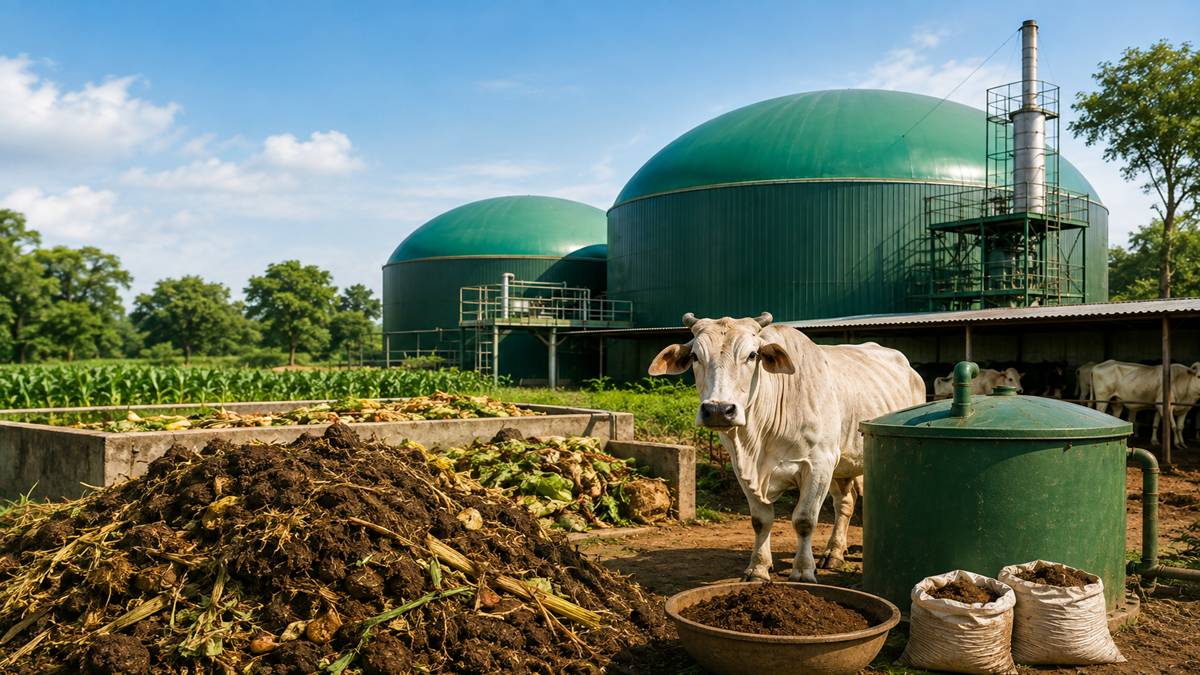
In the Indian state of Gujarat, many families keep cows and buffaloes for milk.
Cow dung can be turned into something very useful: gas for cooking and fertilizer for fields.
The government runs a program called GOBARdhan, where 'gobar' means cow dung.
More than 14,000 families already have a special machine called a biogas plant.
Now the government wants 20,000 more families to get one next year.
The government pays most of the cost, and families pay a small part.
The machine makes clean cooking gas, so families need to buy fewer LPG cylinders.
It also makes fertilizer that helps farmers use less chemical fertilizer and keeps villages cleaner.
And it reduces smoke and pollution, which is better for people's health and the planet.

Gujarat will install 20,000 additional household biogas plants under the GOBARdhan scheme in 2026-27 at an estimated cost of Rs 25 crore.
More than 14,000 plants are already operational across 88 clusters since the scheme's rollout in 2023-24.
Each beneficiary receives Rs 25,000 financial assistance under Swachh Bharat Mission (Gramin) and contributes Rs 5,000 themselves.
The expansion follows Union Cabinet approval of the National Circular Bioenergy Scheme – GOBARdhan with a total outlay of Rs 23,731 crore.
Per a UNICEF survey, a two-cubic-metre biogas plant can save the equivalent of 8-10 LPG cylinders annually and reduce carbon dioxide emissions by about 834 kg.
- Who
- The Gujarat state government, implementing the GOBARdhan scheme under the Swachh Bharat Mission (Gramin) with support from NDDB, GCMMF, Amul, Banas Dairy, Dudhsagar Dairy and Savaj Dairy, led by Chief Minister Bhupendra Patel.
- What
- Installation of 20,000 additional household biogas plants under the GOBARdhan scheme to convert cattle waste into clean energy and organic manure.
- Where
- Gujarat, India, with the announcement made in Gandhinagar.
- When
- Announced August 7, for installation during the 2026-27 financial year.
- Why
- To promote scientific management of livestock waste, improve rural sanitation, generate clean cooking fuel, reduce LPG dependence and carbon emissions, and encourage organic fertiliser use.
Key facts
- Scheme
- GOBARdhan (under Swachh Bharat Mission - Gramin)
- New target
- 20,000 household biogas plants in 2026-27
- Estimated cost
- Rs 25 crore
- Plants operational so far
- More than 14,000 across 88 clusters since 2023-24
- Financial assistance
- Rs 25,000 per beneficiary; beneficiary contributes Rs 5,000
- Technology
- Two-cubic-metre HDPE flexible biogas plants
- Union Cabinet outlay
- Rs 23,731 crore for National Circular Bioenergy Scheme - GOBARdhan
- Example beneficiary
- Manjula Barad, Rangpur village, Gir Somnath district
Quotes
Manjula Barad
Resident of Rangpur village, beneficiary of the biogas scheme
“By using biogas for cooking and slurry in my fields, I have reduced the use of urea fertiliser. This initiative has provided my family with clean energy while encouraging other livestock rearers in the village to make better use of cattle dung and adopt cleaner sanitation practices.”
 freepressjournal.in
Sources
Related news
Cabinet Clears Rs 23,731 Crore GOBARdhan Scheme to Boost Biogas
Cabinet approves Rs 23,731 crore GOBARdhan scheme for biogas fuel
Cabinet approves Rs 23,731-crore GOBARdhan scheme to boost CBG production

Cabinet Approves GOBARdhan Bioenergy Scheme and Guwahati-Tezpur Highway

GOBARdhan Scheme to reduce gas imports by USD 5 billion

One Woman's Idea Gives 368 Gujarat Families Cleaner Cooking, Earnings
Punjab's New Cooperative Housing Notification Criticized

Pune to Host Big Green Fest 2026

Bhuvaneswari Honored with Dairy Award

Telangana Dairy Cooperative Plans Major Expansion
