

2 hrs ago
Festive Demand Hopes Drive Inventories to Record Highs
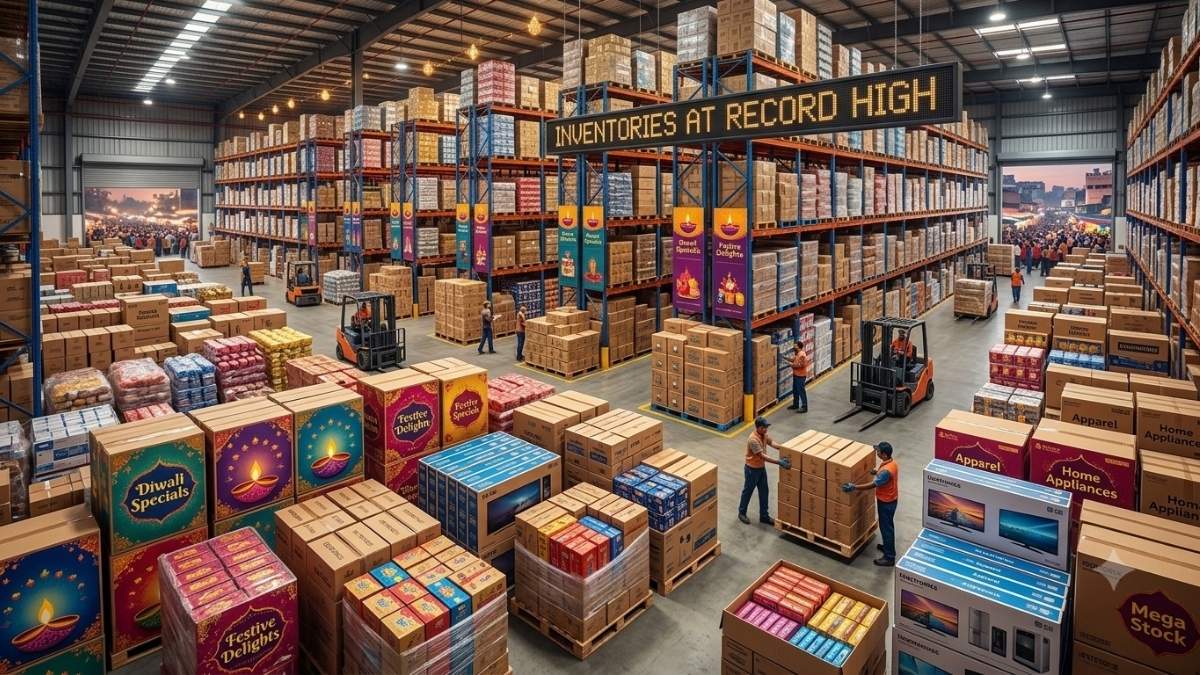
Many companies think people will buy a lot during the upcoming festive season.
So they have stored more finished products and raw materials than usual.
Manufacturing data shows finished-goods stocks reached a very high level in July and stayed high afterward.
Consumer spending has also been growing strongly.
Some businesses say shoppers are choosing more expensive products, but inflation is making things harder for some families.
Car dealers had more vehicles in stock in September than the recommended level.
Automakers are also asking some suppliers to keep extra materials in case supplies are interrupted.
Economists say these stocks could mean companies expect more sales, but in some cases they could be goods that have not sold.
The coming months will show whether festive shopping reduces the extra stocks.

Manufacturing PMI data showed finished-goods inventories reached an 11-and-a-half-year high in July and stayed elevated in the following two months.
Companies are building stocks in anticipation of strong festive-season sales, while private consumption growth has exceeded 7% for three consecutive quarters.
Executives said premium-segment demand is strong, although inflation is creating challenges for mass-market consumers.
Passenger-vehicle dealer inventory reached about 43–45 days in September 2026, above FADA’s recommended 21-day benchmark.
Some automakers have asked component suppliers to hold larger stocks to guard against supply disruptions, while economists said high inventories may also reflect unsold goods.
- Who
- Companies across sectors, including manufacturers, automakers and component suppliers; economists and business executives commented on the trend.
- What
- Businesses have increased inventories amid expectations of strong festive-season demand, while some experts caution that high stocks may include unsold goods.
- Where
- India.
- When
- Inventory readings were high in July and the following two months; passenger-vehicle dealer inventory was reported for September 2026.
- Why
- Companies are preparing for expected festive sales and, in the automobile supply chain, seeking buffers against supply disruptions.
Why inventories are rising
What high inventories may indicate
Expected festive demand
Why inventories are rising
Companies and executives say strong current demand and expectations of festive-season sales are prompting stock-building.
What high inventories may indicate
Economist Madan Sabnavis says elevated inventories may, in some companies or sectors, also represent unsold goods carried forward amid weak demand.
Reading the stock build-up
Why inventories are rising
Rahul Bajoria says the increase is not surprising and should be judged by whether festive sales reduce inventories over the next three months.
What high inventories may indicate
If sales do not absorb the stocks, inventory reduction could imply production is weaker than sales; the article also notes that high stocks can have different causes across companies and sectors.
Consumer demand
Why inventories are rising
Haier’s chief executive said demand remains strong and consumers are seeking upgrades; finance schemes may encourage purchases.
What high inventories may indicate
Godrej Enterprises Group’s appliances business head said inflation is challenging the mass segment, even as the premium segment performs well.
Key facts
- Finished-goods inventories
- Manufacturing PMI inventory readings reached an 11-and-a-half-year high in July and remained elevated in the next two months.
- Private consumption
- Private final consumption expenditure growth was above 7% in each of the last three quarters.
- Future Output Index
- The manufacturing PMI Future Output Index rose to a four-month high in September.
- Passenger-vehicle dealer stocks
- About 43–45 days of inventory in September 2026, compared with FADA’s recommended 21 days.
- Earlier dealer inventory
- Passenger-vehicle dealer inventory was about 38–40 days in August.
- Dealer stock levels
- FADA said 60% of passenger-vehicle dealers were holding more stock ahead of upcoming festivals.
- Supplier inventories
- Some component suppliers were asked to double raw-material stocks; the article says inventory burdens have shifted toward Tier-1, Tier-2 and Tier-3 suppliers.
Quotes
Madan Sabnavis
Chief economist at Bank of Baroda
“The question really is how the festive season goes and whether that results in some inventory reduction over a 3-month period, which would obviously mean that production would be a bit weaker than sales. But if the demand cycle is strong and you see high income growth visibility, then production momentum might also be maintained. So we are not reading too much into the fact that there is some upstocking.”
 financialexpress.com
“Most companies expect a bumper festive period this year given that demand trends remain strong. Second, buying behaviour has also undergone a transformation, people are looking for upgrades as lifestyles improve.”
financialexpress.com
Sources
Related news

India Car Sales Surge 21% as Festive Demand Strengthens

FMCG and Kirana Lead India’s Festive MSME Credit Demand
India Manufacturing Growth Reaches Seven-Month High on Demand

India Private Sector Growth Hits Three-Month High in September

Appliance Makers Forecast Festive Growth Despite Price Hikes

Auto Sales Reach August Records as Base Effect Looms Ahead

Electric Vehicles Reach Record Registrations in India in September

India Auto Retail Hits Records as Festive Demand Builds
India Auto Retail Hits Record September Sales

Festive Two-Wheeler Loan Demand Rose Sharply in 2025
