45 mins ago
Foreign Media Coverage of BRICS Summit Draws India Bias Criticism
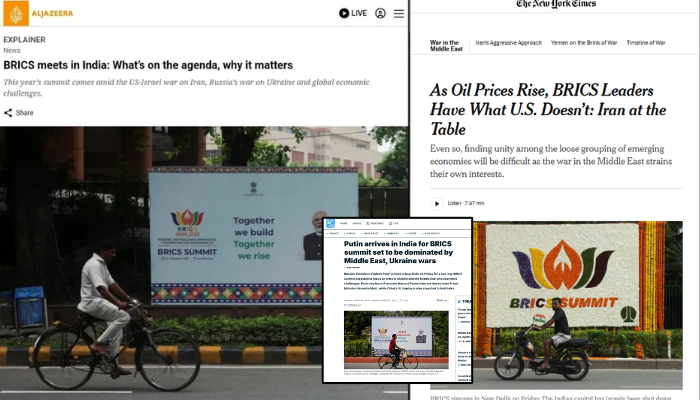
The article says some foreign news organizations showed pictures of ordinary Indian streets while reporting on the BRICS Summit.
These pictures included people riding bicycles, mopeds, or auto-rickshaws near signs about the summit.
The author believes this makes India look poorer than its achievements suggest.
Some Indian people called this “poverty porn.”
Other people argued that the pictures simply showed real life in India.
The article says both modern buildings and bicycles are part of the same country.
It compares today’s images with older Western stereotypes about India.
It also mentions India’s space missions, economic growth, and technology achievements.
The main argument is that news images should show India more fairly and completely.

The article criticizes foreign media for emphasizing poverty-related imagery during the 2026 BRICS Summit in New Delhi.
It highlights images of cyclists, mopeds, auto-rickshaws, and pedestrians appearing near BRICS signs or images of Narendra Modi.
The article argues that these editorial choices create an “ambition versus reality” portrayal of India.
Some Indian critics described the coverage as “poverty porn,” while others defended the images as ordinary scenes from India.
The article says India’s economic and technological progress should not be reduced to poverty, crowded streets, or traditional stereotypes.
- Who
- Foreign media outlets, Indian critics, and the Indian government and institutions featured in summit-related coverage.
- What
- A debate over whether foreign media used prejudicial or stereotypical images while reporting on the BRICS Summit.
- Where
- New Delhi, India, particularly around BRICS Summit signage and venues.
- When
- During coverage of the 2026 BRICS Summit; one cited France24 report was published on September 11.
- Why
- Critics say the selected images frame India through poverty and contrast rather than focusing on the summit’s significance and India’s development.
Critics of the Coverage
Defense of the Imagery
Meaning of the photographs
Critics of the Coverage
The article argues that repeatedly placing cyclists, mopeds, or auto-rickshaws beside summit signs creates a misleading “ambition versus reality” narrative and reinforces stereotypes about India.
Defense of the Imagery
Critics of the backlash argue that bicycles, auto-rickshaws, crowded streets, and poverty are genuine parts of life in India and can legitimately appear in news photographs.
India’s national image
Critics of the Coverage
The article says foreign media should give greater weight to India’s economic growth, digital infrastructure, space missions, and modern facilities rather than using poverty as a visual shorthand.
Defense of the Imagery
The article acknowledges that India contains both modern achievements and people using basic transport, meaning such images may reflect the country’s social and economic diversity.
Key facts
- Event
- 2026 BRICS Summit
- Location
- New Delhi, India
- Images criticized
- Photographs showing cyclists, mopeds, auto-rickshaws, pedestrians, and people resting near summit signs
- Outlets mentioned
- The New York Times, France24, Al Jazeera, Deutsche Welle, The Guardian, and China Global South Project
- Critics’ description
- Some Indian commentators called the imagery “poverty porn” and agenda-driven photojournalism
- Earlier example
- The article cites a 2014 New York Times cartoon about India’s Mars Orbiter Mission
- Additional example
- The article says coverage of Tesla’s first Indian showroom in 2025 also showed an auto-rickshaw near the showroom
Sources
Related news

BRICS Summit Tests India’s Balancing Act and Global Influence
Why India Was Unhappy with Its Image in 1960s Sweden

India Seeks Global South Voice Without Making BRICS Anti-West
US Artist's Viral Praise Reframes India's Colonial and Cultural History
Chinese Media Cast BRICS Summit as Opportunity for India Ties
India’s BRICS Tightrope Tests Its Broader Multi-Alignment Strategy
Book Exploring PM Modi’s Humane Side to Launch on Birthday
Jaishankar Says Modi’s India Forged BRICS Consensus Amid Global Polarisation
Ex-Diplomat Warns Modi-Xi Talks Won’t Yield Major Border Concessions
Fact Check Rejects Modi Photo Gift Claim at BRICS