

1 day ago
Spain’s Snap Election Could Decide Progressive Left’s Future

Spain’s leader, Pedro Sánchez, has called an early election for November 29.
He did this after lawmakers rejected his government’s housing plans.
Many people have been protesting because homes are expensive and some people face eviction.
Sánchez’s party needs help from several smaller parties to pass laws, and those parties do not always agree.
Spain’s economy is growing, but many people still worry about rents, prices and the future.
The far-right Vox party has gained support in polls.
The election will show whether Sánchez can get more support or whether other parties can take power.
It will also test whether a progressive government can keep people’s trust while dealing with these problems.

Prime Minister Pedro Sánchez called a snap election for November 29 after his minority government lost a vote on housing reforms.
The defeat followed widespread protests over housing affordability and the eviction of 87-year-old María del Carmen Abascal.
Sánchez’s PSOE government has struggled to pass legislation because it relies on support from smaller regional and left-wing parties.
Spain’s economy is growing, but rising rents, inflation, concerns about public debt and corruption allegations have contributed to public unease.
Polling cited in the article puts Vox at about 18%, raising the possibility that it and the People’s Party could form a right-wing government.
- Who
- Prime Minister Pedro Sánchez, his PSOE-led minority government, and Spain’s political parties.
- What
- Sánchez called a snap election after Parliament rejected proposed housing reforms.
- Where
- Spain.
- When
- The election is scheduled for November 29; the housing reforms were rejected on October 2.
- Why
- The government’s parliamentary difficulties and public concern over housing affordability contributed to the decision to call an early election.
Sánchez and progressive allies
Conservative and far-right parties
Immigration policy
Sánchez and progressive allies
Sánchez has defended pro-immigration policies, citing labour shortages and negative population growth.
Conservative and far-right parties
The article describes Vox as a rising far-right party and immigration as a cultural battleground used to polarise opinion against it; it does not give a detailed Vox policy statement.
Election outcome and governing prospects
Sánchez and progressive allies
Sánchez hopes to win enough seats to regain some room to legislate, even if PSOE does not become the largest party.
Conservative and far-right parties
The article says the People’s Party and Vox could join to form a right-wing government, with Vox gaining support amid dissatisfaction with the established right and fragmented left.
Key facts
- Election date
- November 29
- Trigger for election call
- The Lower House rejected proposed housing reforms on October 2.
- Government party
- The Spanish Socialist Workers’ Party (PSOE) leads the minority government and is formally allied with Sumar.
- Housing protest context
- Protests followed the eviction of 87-year-old María del Carmen Abascal from her Madrid home.
- Vox polling
- The article says current polling puts Vox support at around 18%, compared with 12.4% in the 2023 general election.
- Economic indicators cited
- Spain’s unemployment rate was reported at 9.87% in the second quarter of FY26; 2026 growth was forecast at 2.1%.
Quotes
Jose Ismael Crespo Martinez
Director of the Department of Political Science at Spain’s Universidad de Murcia
“Much of this growth also came from the EU NextGeneration funds [a post-pandemic programme for EU nations], loose control over the deficit and Spain’s rising public debt.”
 indianexpress.com
Sources
Related news

Sánchez Calls Snap Election After Housing Measures Defeated

Spain's Sánchez Calls Snap Election After Housing Measures Defeated
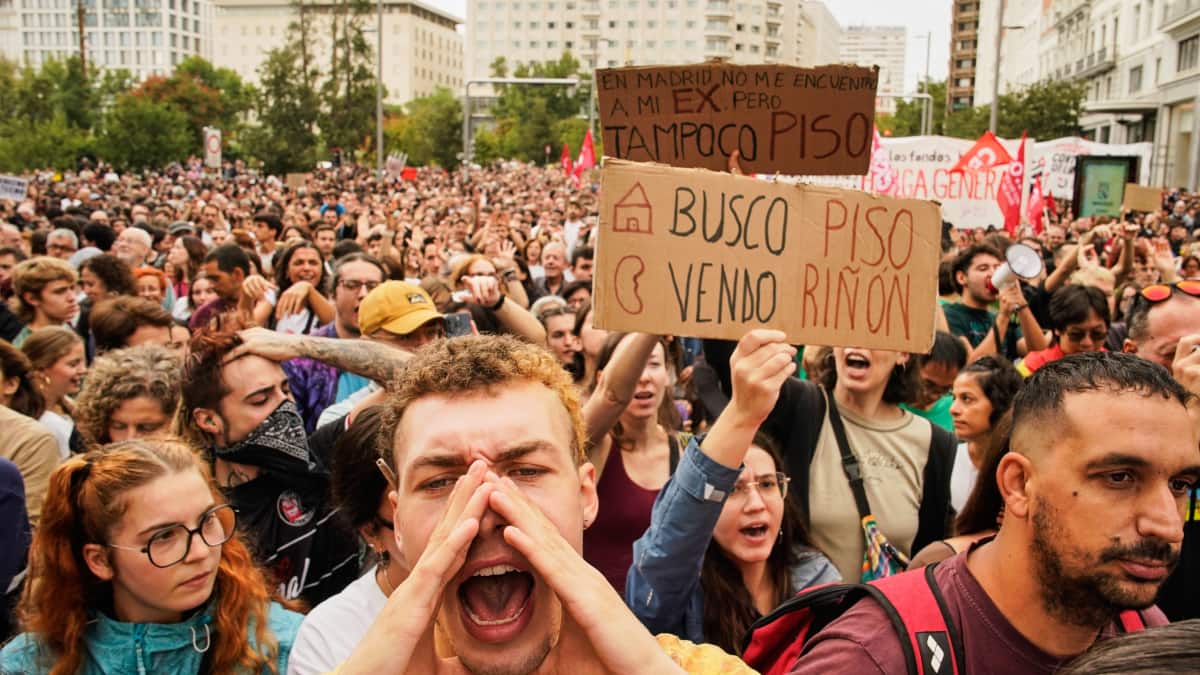
Eviction Protests Intensify Spain’s Housing Crisis and Election Stakes

Tens of Thousands Protest Across Spain for Affordable Housing
Spain’s Unions Call Housing Strike Weeks Before Snap Election

Maricarmen Abascal’s Death Intensifies Spain’s Housing Crisis Debate
Spain Lifts Puigdemont Arrest Warrant After Court Amnesty Ruling

Spain's Socialists face backlash over harassment claims handling