

1 month ago
India's EV Charging Infrastructure Grows Amid Rising Demand
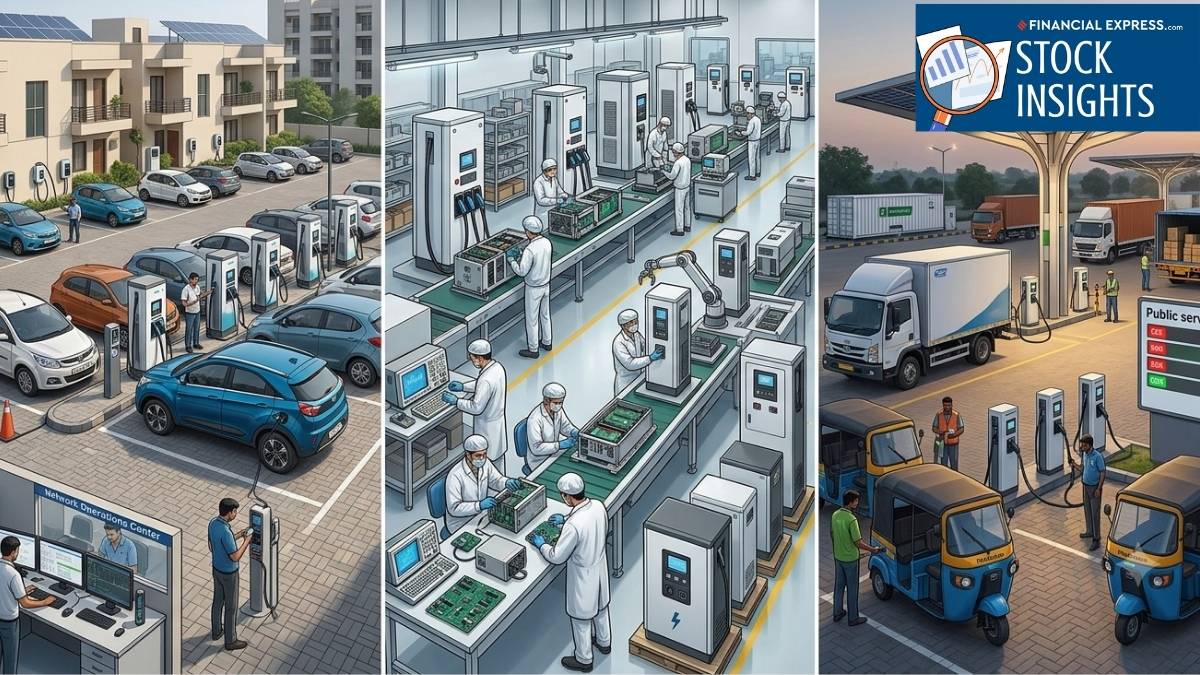
India is seeing a rapid increase in electric vehicle (EV) sales, with 24.5 lakh EVs sold in FY26.
However, the country's charging infrastructure is struggling to keep up, with only one public charger for every 135 EVs.
The Indian government aims to have 8 crore EVs on the road by 2030, which will require around 39 lakh charging stations.
Three companies, Tata Power, Exicom Tele-Systems, and Servotech Renewable Power System, are leading the way in building India's EV charging backbone.
Tata Power has the largest network, with over 2,00,000 home chargers and 5,800 public and fleet charging points.
Exicom is focusing on manufacturing and global expansion, while Servotech is targeting commercial fleets and international markets.
Despite the challenges, these companies are poised to capture the growing EV charging opportunity in India.

India recorded 24.5 lakh EV sales in FY26, up 24.6%, with electric passenger vehicles crossing the 4.6% adoption threshold.
India currently has just one public charger for every 135 EVs, compared with the global benchmark of one charger for every 6 to 20 EVs.
Tata Power operates India’s premier electric vehicle (EV) charging network with over 2,00,000 home chargers and 5,800 public and fleet charging points.
Exicom Tele-Systems is India’s #1 EV charger company, with a comprehensive product range and a focus on manufacturing and global expansion.
Servotech Renewable Power System is targeting commercial fleets and international markets, with a focus on end-to-end clean energy solutions.
- Who
- Tata Power, Exicom Tele-Systems, Servotech Renewable Power System
- What
- Expansion of EV charging infrastructure in India
- Where
- Across India, with a focus on metro and Tier-2 cities
- When
- FY26 and Q1FY27
- Why
- To support the growing number of EVs and meet government targets
Pro-Infrastructure Expansion
Cautious Growth
Infrastructure Development
Pro-Infrastructure Expansion
Rapid expansion of charging infrastructure is essential to support the growing number of EVs and meet government targets.
Cautious Growth
Focus should be on sustainable and strategic growth to avoid over-investment and ensure long-term viability.
Policy Support
Pro-Infrastructure Expansion
Government initiatives like PM E-Drive and state policies such as Delhi EV Policy 2026 are crucial for accelerating EV adoption and infrastructure development.
Cautious Growth
Policy support should be balanced with market-driven solutions to ensure efficient and cost-effective infrastructure development.
Key facts
- EV Sales in FY26
- 24.5 lakh
- EV Charging Station Market Projection by 2030
- US$2.5 billion (₹24,000 crore)
- Current Charger-to-EV Ratio in India
- 1:135
- Projected Charging Stations Needed by 2030
- 39 lakh
- Tata Power's EV Charging Footprint
- 700+ cities and towns
- Exicom's EVSE Revenue in FY26
- ₹509.9 crore
- Servotech's Revenue Growth in Q1FY27
- 57.9%
- Servotech's Operating Profit Growth in Q1FY27
- Almost doubled to ₹20.4 crore
Sources
Related news
IIT Bombay Launches E-PG Diploma In Computer Science And AI
Bengaluru Engineers Develop Affordable AI PC KEO

Seven AI Courses Offer Paths From Free Lessons to Credentials

Kotak Favors HAL as Defence Indigenization Benefits Electronics
IIT Bombay Launches E-Postgraduate Diploma in Computer Science and AI

PM Modi to Attend IIT Delhi Convocation, Inaugurate AI Supercomputer

Alva's Pragati 2026 job fair places over 2,300 candidates
Exicom Reports Strong Q2 Performance Driven by India Growth, Eyes Scaled-Up Operations
