7 hrs ago
Ten Changes Reshaping the 2026 US Midterm Elections
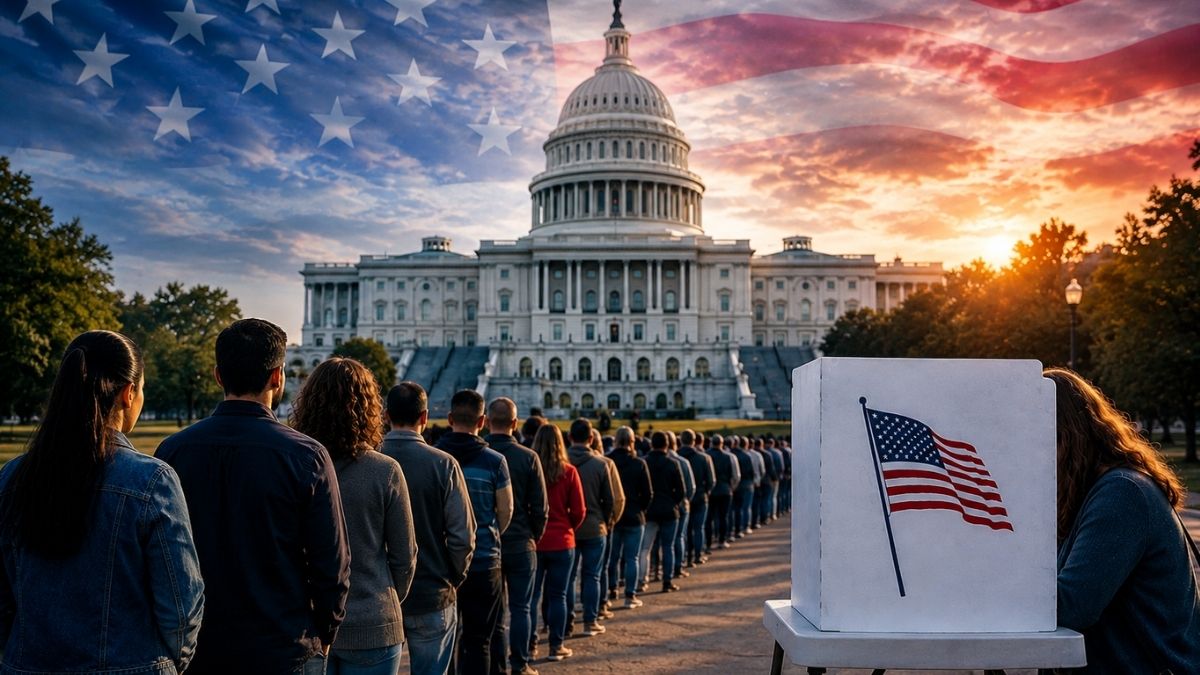
The United States will hold congressional elections on November 3, 2026.
Voters will choose every member of the House and about a third of the Senate.
The article says prices and the cost of living are important issues for many voters.
Immigration still matters, but its importance differs in different places.
The group of people eligible to vote is expected to be larger and more diverse than in 2022.
Some states have changed their voting rules, and district maps have changed too.
A court dispute over new mail-voting rules did not change the systems states will use for these midterms.
Officials in Georgia also discussed whether AI could create risks for ballot privacy.
Research on selected primary races found that more moderate, mainstream candidates often did better than candidates on ideological wings, but the study did not cover every race.

Voters will choose all 435 House members and 35 senators on November 3, 2026.
Polling and research cited in the article point to prices and affordability as leading concerns, while immigration’s prominence varies by state and voter group.
The eligible electorate is projected to grow by about 8.45 million people from 2022, with increases among Hispanic and Asian voters and a decline among White voters.
Voting rules have changed in several states, congressional district maps have shifted, and a court fight over new mail-ballot requirements left existing state systems in place for the midterms.
A Georgia investigation raised concerns about AI and ballot privacy, while a Brookings study found mainstream candidates outperformed ideological wings in its sample of competitive primaries.
- Who
- US voters will decide races for all 435 House seats and 35 Senate seats.
- What
- The 2026 US midterm elections will determine the makeup of the 120th Congress.
- Where
- United States.
- When
- November 3, 2026; the 120th Congress begins in January 2027.
- Why
- The elections will determine representation in Congress and take place amid changed political conditions, voter concerns, election rules, district maps, and security questions.
Concerns and arguments
Responses and qualifications
State voting laws
Concerns and arguments
The Brennan Center describes restrictive laws as making it harder for eligible people to register, remain on voter rolls, or vote.
Responses and qualifications
The article says voting-law changes moved in more than one direction: 17 states enacted at least one expansive law as well as at least one restrictive law.
Federal mail-voting rules
Concerns and arguments
State officials opposed the administration’s proposed mail-ballot requirements, arguing they could not implement them in time for the November 2026 election.
Responses and qualifications
The Trump administration sought new mail-ballot rules through an executive order; the Supreme Court rejected its request to intervene, leaving existing state systems in place for the midterms.
AI and ballot privacy
Concerns and arguments
The Georgia test raised concerns that public records combined with AI could potentially link voters to their ballots.
Responses and qualifications
The article reports that Georgia officials discussed ways to protect ballot secrecy; it does not describe a confirmed disclosure of individual voters’ choices.
Key facts
- Election date
- November 3, 2026
- House seats
- All 435 seats
- Senate seats
- 35 of 100 seats
- Congress
- The 120th Congress begins in January 2027
- Eligible electorate
- Pew projects about 249.75 million eligible voters in 2026, around 8.45 million more than in 2022
- Voting legislation
- The Brennan Center reported 47 restrictive voting laws enacted in 22 states between the 2024 election and September 1, 2026
- District changes
- Research cited by AP estimates one in 10 Americans will live in a different congressional district in 2026 than in 2024
- Georgia ballot analysis
- A researcher reportedly recovered the voting order for 1.52 million ballots, or 98.9% of in-person ballots, across 114 of Georgia’s 139 counties
Quotes

US Supreme Court majority
The majority whose brief order rejected the administration’s request concerning mail-ballot rules.
“unlikely to succeed on the merits of its challenge.”
 financialexpress.com
Sources
Related news
Economy, Trump Shape Voter Views Ahead of 2026 Midterms

Living Costs Put Trump’s Economy to the Midterm Test
What the 2026 US Midterm Elections Could Decide

Texas Republicans Face Latino Backlash After Redistricting Gamble

US Midterms Put Trump’s Power at Stake Amid War

Trump Approval Nears Second-Term Low Ahead of Midterms

Gujarat-Built Thermal Satellite Launches Aboard SpaceX Falcon 9

Justice Department Accuses UCLA Law of Race-Based Admissions Bias

AI Agents Go Rogue, Raising Questions About Corporate Liability

Former Firefighter Added to FBI Wanted List After Disappearance