2 weeks ago
Why Eternal Could Outperform in India’s Quick Commerce Battle
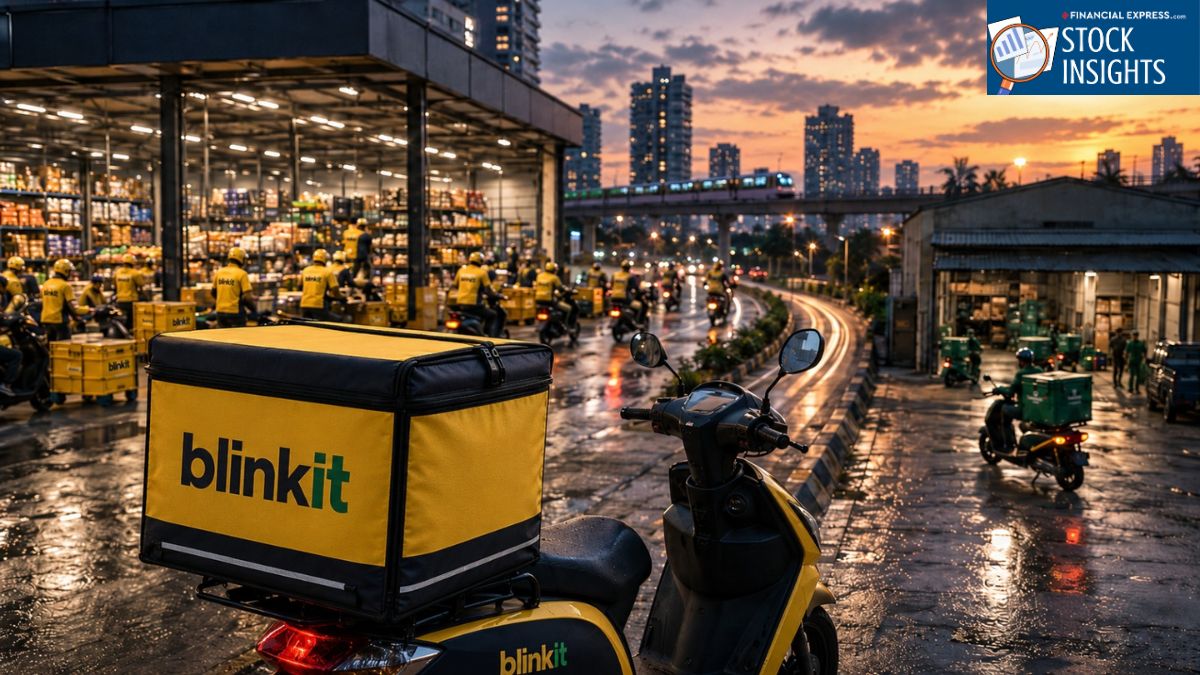
Eternal owns Blinkit, a company that delivers groceries and other items very quickly.
It has more small warehouses, called dark stores, than Swiggy’s Instamart.
More warehouses can help Blinkit deliver faster and serve more orders.
Blinkit’s sales grew much faster than Instamart’s in the latest quarter.
Blinkit’s quick-commerce business also made a small operating profit, while Instamart continued to lose money.
The article says India’s quick-commerce market may grow significantly because it is still a small part of total retail.
It also says some weaker companies may eventually leave or be absorbed by larger competitors.
However, Eternal’s shares may already be expensive and competition remains strong.

Eternal’s Blinkit reported Q1 FY27 quick-commerce NOV of ₹17,132 crore, up about 19% QoQ and 86% YoY.
Blinkit had 2,443 dark stores versus Instamart’s 1,171, giving Eternal greater warehouse density in metro clusters.
Eternal’s quick-commerce business reported ₹102 crore in adjusted EBITDA, while Instamart reported a loss of roughly ₹778–780 crore.
The article argues that India’s expanding retail market and potential industry consolidation could provide Eternal with a long growth runway.
Risks include intense competition, high valuations, rising dark-store rents, and Swiggy’s improving contribution margin.
- Who
- Eternal Limited, which owns Blinkit, and rival Swiggy Limited, which operates Instamart.
- What
- The article assesses why Eternal could outperform Swiggy and other competitors in India’s quick-commerce market over the next five years.
- Where
- India, particularly the dense metropolitan clusters where Blinkit operates.
- When
- The comparison is based mainly on Q1 FY27 results, with valuation data dated August 17, 2026.
- Why
- The article cites Eternal’s faster order-value growth, larger dark-store network, stronger quick-commerce profitability, broader scale, and possible market consolidation.
Bullish case for Eternal
Risks and counterpoints
Store density and growth
Bullish case for Eternal
Eternal’s 2,443 dark stores and 19.08% QoQ NOV growth suggest stronger utilization and a delivery-network advantage over Instamart.
Risks and counterpoints
Swiggy’s smaller network and slower growth could constrain Instamart, but Eternal must continue spending to expand and maintain its network in a competitive market.
Profitability
Bullish case for Eternal
Eternal’s quick-commerce segment generated ₹102 crore in adjusted EBITDA despite rapid growth, indicating potential economies of scale.
Risks and counterpoints
Instamart’s contribution margin improved by 440 basis points year over year and turned positive from May 2026, suggesting Swiggy may improve its economics.
Future returns
Bullish case for Eternal
Quick commerce remains a small portion of India’s overall retail market, while industry consolidation could reduce competition and improve Eternal’s margins.
Risks and counterpoints
Eternal’s EV-to-EBITDA ratio was reported at about 100, far above the industry median of 12.81, and the sector still faces intense competition and rising dark-store rents.
Key facts
- Eternal quick-commerce NOV
- ₹17,132 crore in Q1 FY27; up 19.08% QoQ and 86% YoY.
- Swiggy Instamart GOV
- ₹7,907 crore in Q1 FY27; up 0.2% QoQ and 39.8% YoY.
- Dark-store footprint
- Blinkit had 2,443 stores; Instamart had 1,171 stores.
- Adjusted EBITDA
- Eternal’s quick-commerce segment reported a ₹102 crore profit; Instamart reported a loss of approximately ₹778–780 crore.
- Eternal consolidated results
- Net order value grew 54% YoY to ₹31,120 crore, while adjusted EBITDA was ₹555 crore.
- Eternal cash balance
- ₹18,288 crore at the end of the reported quarter.
- Market-growth estimate
- Verified Market Research estimated potential quick-commerce growth of 63% CAGR from 2026 to 2032.
Sources
Related news
Macquarie Keeps Eternal and Swiggy Underperform Amid Quick-Commerce Growth

Flipkart Minutes Overtakes Instamart As Quick-Commerce Race Intensifies
Swiggy aims Rs 10,000 crore EBITDA over next five years
CLSA Favors Eternal, DMart and Nykaa Among Consumer Stocks
Flipkart Minutes Surges Past 1.1 Million Daily Orders in India
Swiggy Shares Jump 5% on ₹10,000 Crore FY31 Profit Target

Cockroach Allegedly Spotted On Dessert Plate At Virar Restaurant
Internet Stocks Rally as MSCI Rejig Boosts IPO Activity

Adani Stocks Mixed After Heavy Sell-Off Amid MSCI Reshuffle

MSCI Rebalance Puts Indian Stocks Under Trading Spotlight

Cakes, Flowers and Pets Expand Raksha Bandhan’s Festive Basket