Science & Tech · Space · 13 hrs ago
Black hole jets may switch on at the same feeding threshold
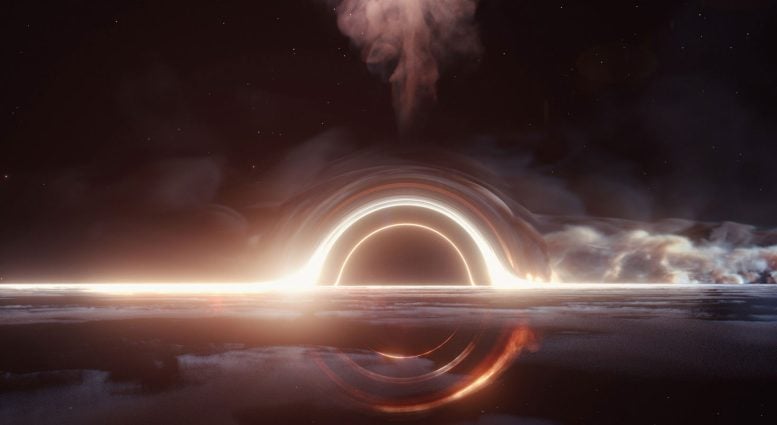
Astronomers studied rare events in which a supermassive black hole tears apart a nearby star.
They tracked how the black hole’s feeding rate changed and when radio signals from jets appeared.
The team analyzed 20 events, then focused on 10 with enough data to model feeding and outflow timing.
They found that supermassive black holes can launch jets when their feeding rate falls to about 2% of the Eddington limit.
A similar threshold is associated with jet formation in much smaller black holes in the Milky Way.
The finding suggests that some rules for how black holes produce jets may hold across a wide range of masses.

Researchers report that supermassive black holes can switch on jets when their feeding rate falls to about 2 percent of the Eddington limit.
That threshold is also associated with jet formation in much smaller black holes in the Milky Way.
The study compared black holes about 10 times the Sun’s mass with supermassive black holes weighing millions of solar masses.
The researchers analyzed tidal disruption events, in which a black hole tears apart a passing star.
The findings were led by Dr. Adelle Goodwin and published in Nature Astronomy.
- Who
- Researchers led by Dr. Adelle Goodwin of Curtin University’s ICRAR and the Forrest Research Foundation.
- What
- The study found that supermassive black holes can launch jets when their feeding rate falls to about 2 percent of the Eddington limit.
- When
- Published on October 11, 2026.
- Where
- The research was published in Nature Astronomy; observations came from telescopes in Australia, the United States, India, South Africa and space.
- Why
- The researchers examined why radio emission after some stellar disruption events appears soon, while in others it takes months or years.
This story does not have two clearly opposing sides.
These black holes are separated by enormous differences in mass, but they appear to switch on their jets at the same point in the feeding process
That tells us something fundamental about black holes: the physics does not seem to care how big they are
When a black hole tears apart a star, it does not swallow everything neatly
You can think of it as a black hole burp, except these burps can blast material across enormous distances and influence the galaxies around them
The black hole’s gravity pulls the star apart in a tidal disruption event.
The black hole’s feeding rate changes, and some material can be expelled in outflows and jets.
The black hole can switch on jets, according to the study.
- Jet threshold
- About 2 percent of the Eddington limit
- Events analyzed
- 20 tidal disruption events
- Events modeled
- 10 events with reliable estimates of feeding rate and radio-outflow timing
- Black hole mass comparison
- Roughly 10 solar masses and millions of solar masses
- Publication
- Nature Astronomy
Sources
Related news
Anduril unveils Steelfin interceptor missile family

EU awards Belgian startup €2.4 billion contract for 264 satellites

French astronaut Sophie Adenot says space brought a full range of emotions

Margaret Hamilton, whose software helped Apollo astronauts reach the Moon, dies at 90
SpaceX plans to expand Starlink into a major US mobile carrier

NASA releases nearly 800 GB of Artemis II lunar data

China’s FAST telescope has discovered more than 1,300 pulsars

Astronomers trace record-distant radio burst to a young galaxy
Simulations Suggest an Earth-Mass Planet Could Orbit One Star in 70 Ophiuchi
Camera captures aurora over parts of the Netherlands

New Images Reveal Gas Knots and a Possible Survivor in Supernova Remnant