Science & Tech · Space · 1 day ago
SpaceX launches 21 military satellites after five-day delay
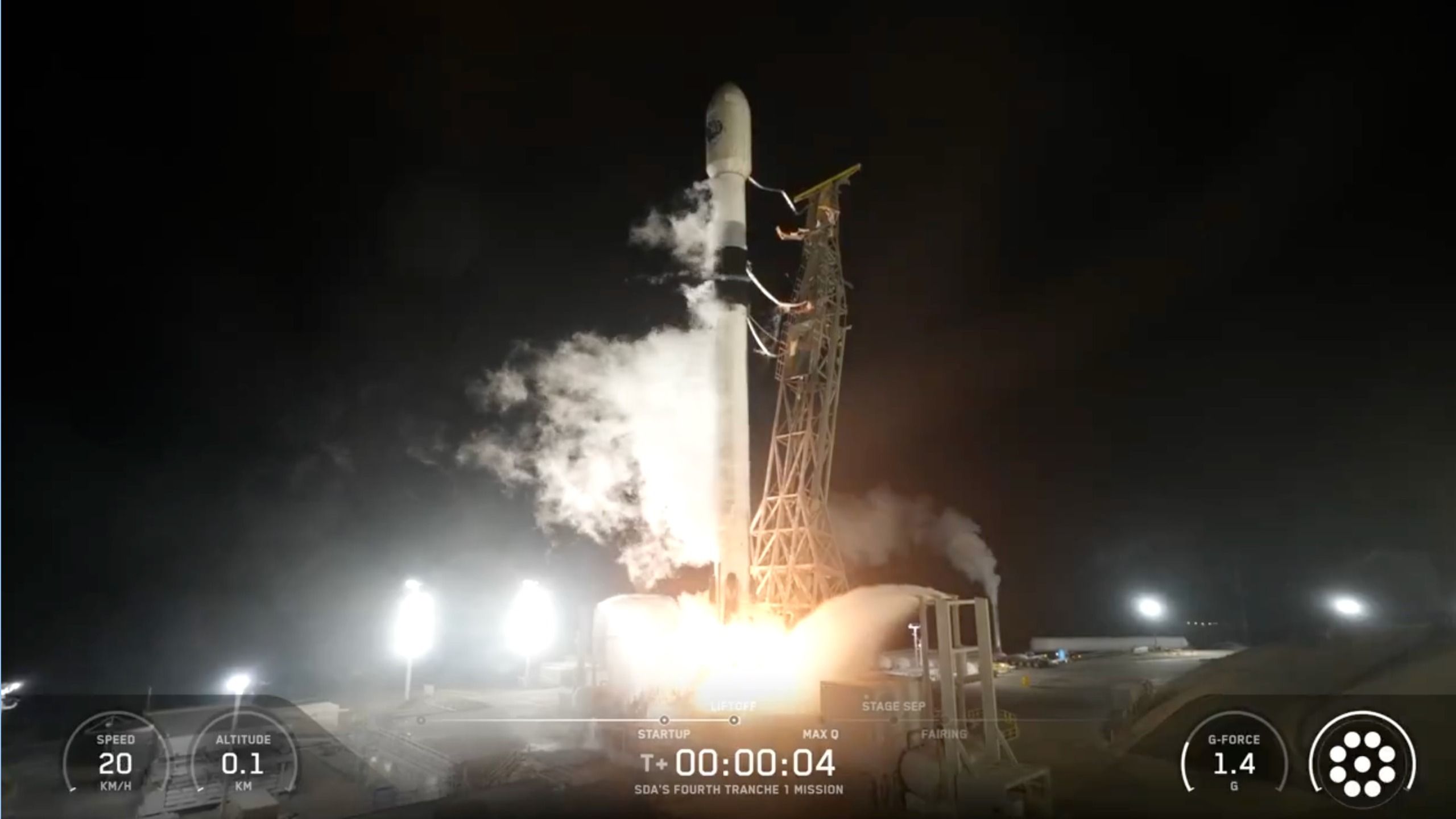
SpaceX launched 21 data-transport satellites for the U.S. Space Force on a Falcon 9 rocket from Vandenberg Space Force Base in California.
The launch took place on Oct.
10, five days later than planned, after an earlier countdown was aborted in its final minute.
The satellites are part of a U.S. military network designed to support communications and missile warning and tracking.
The network is being built in stages, called tranches, with new capabilities planned every two years.
The first stage is planned to include 154 operational satellites, including 126 for data transport and 28 for missile tracking.
This launch was the fourth of nine SpaceX flights planned to help complete that first stage; 84 of the 126 data-transport satellites had launched by then.
The rocket's booster landed back at Vandenberg, but satellite deployment had not yet been confirmed.

A SpaceX Falcon 9 launched 21 data-transport satellites for the U.S. Space Force's Space Development Agency from Vandenberg Space Force Base in California on Oct. 10, 2026.
The launch took place five days later than planned after an Oct. 5 attempt was aborted during the countdown's final minute; SpaceX did not disclose the reason.
The satellites are intended to help build the Proliferated Warfighter Space Architecture, a low-Earth-orbit network for military communications and missile-warning and tracking capabilities.
The launch was the fourth of nine planned SpaceX missions to assemble Tranche 1 of the architecture.
The Falcon 9's first stage landed back at Vandenberg a little over seven minutes after liftoff, but the article said confirmation of satellite deployment was still pending.
- Who
- SpaceX and the U.S. Space Force's Space Development Agency
- What
- Launch of 21 data-transport satellites aboard a Falcon 9
- When
- Oct. 10, 2026, at 3:39 a.m. EDT
- Where
- Vandenberg Space Force Base, California
- Why
- To help build the Proliferated Warfighter Space Architecture for military communications and missile-warning and tracking capabilities
This story does not have two clearly opposing sides.
a mesh network of optically connected satellites in low Earth orbit [LEO] that enable global military tactical communications and missile warning, indication and tracking capabilities.
initial warfighting capability tranche
SDA leverages spiral development to deploy and proliferate new capability into a new generation of the PWSA every two years, called a 'tranche,' to continually increase capability used by the warfighter,
SpaceX attempted the launch, but the Falcon 9 aborted during the countdown's final minute for a reason the company did not disclose.
A Falcon 9 lifted off from Vandenberg Space Force Base at 3:39 a.m. EDT carrying 21 satellites.
The rocket's first stage landed back at Vandenberg.
SpaceX ended its webcast at the SDA's request, and the article said an update on satellite deployment was still awaited.
- Satellites launched
- 21 data-transport satellites
- Launch date and time
- Oct. 10, 2026, at 3:39 a.m. EDT (0739 GMT)
- Delay
- Five days after the originally planned Oct. 5 launch
- Tranche 1 planned operational satellites
- 154: 126 data-transport satellites and 28 missile-tracking vehicles
- Data-transport satellites launched to date
- 84 of 126
- Falcon 9 first-stage booster
- Booster 1103 completed its sixth mission
Sources
Related news

Anduril unveils Steelfin interceptor missile family

EU awards Belgian startup €2.4 billion contract for 264 satellites

French astronaut Sophie Adenot says space brought a full range of emotions

Margaret Hamilton, whose software helped Apollo astronauts reach the Moon, dies at 90
SpaceX plans to expand Starlink into a major US mobile carrier

NASA releases nearly 800 GB of Artemis II lunar data

Astronomers trace record-distant radio burst to a young galaxy

China’s FAST telescope has discovered more than 1,300 pulsars
Simulations Suggest an Earth-Mass Planet Could Orbit One Star in 70 Ophiuchi

Camera captures aurora over parts of the Netherlands

New Images Reveal Gas Knots and a Possible Survivor in Supernova Remnant