

Business · Economy · 1 hr ago
Robert Hall and Michael Woodford win 2026 Nobel economics prize

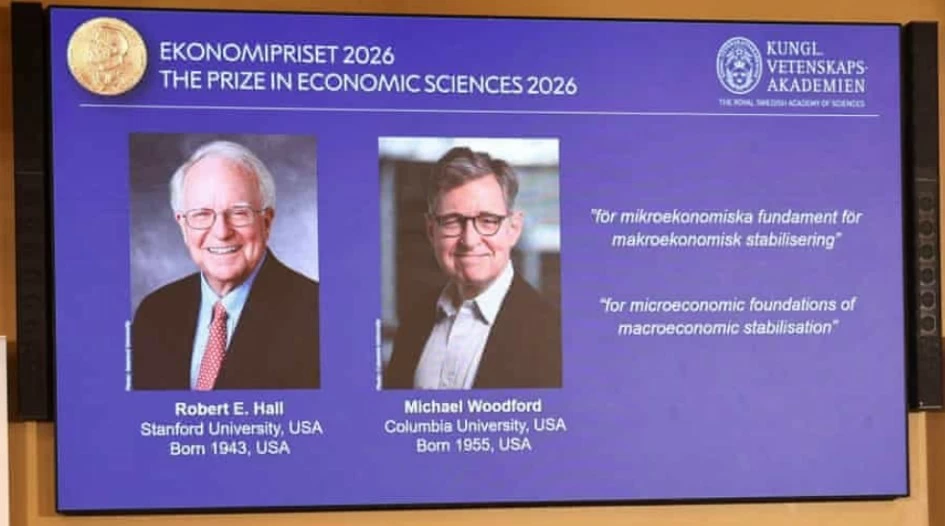
Robert Hall, a Stanford professor emeritus, and Michael Woodford, a Columbia University professor, won the 2026 Nobel economics prize.
Their research explains how decisions by households and businesses affect the economy as a whole.
It also shows why people’s expectations about future government and central bank policies can influence the impact of those policies.
Their work helped build a framework for responding to economic booms and downturns after the limits of older Keynesian approaches became clear during the 1970s oil crisis.
One practical example is forward guidance, when a central bank signals its likely future interest-rate path to shape borrowing and investment decisions.
The approach has been used widely since the global financial crisis, though supply shocks in the 2020s have raised questions about how effective it is.
Woodford said the Middle East war poses a major threat to global economic stability because it can disrupt energy markets and affect many parts of the economy.

Robert Hall and Michael Woodford jointly won the 2026 Nobel Prize in economics.
The Royal Swedish Academy of Sciences said their work established foundations for macroeconomic stabilisation policies.
Their models explain how household and business decisions affect the wider economy.
The research highlights how expectations about future policy can shape the effects of government and central bank actions.
Woodford said the Middle East war was a major threat to global economic stability.
- Who
- Robert Hall, professor emeritus at Stanford University, and Michael Woodford, a professor at Columbia University.
- What
- They jointly won the 2026 Nobel Prize in economics for work on macroeconomic stabilisation policy.
- When
- The award was announced on October 12, 2026, local time.
- Where
- The announcement was made at the Royal Swedish Academy of Sciences in Stockholm, Sweden.
- Why
- Their work developed models of how household and business decisions affect the economy and how policy can respond to economic fluctuations.
This story does not have two clearly opposing sides.
The oil crisis exposed limits in traditional Keynesian stabilisation policies as inflation and unemployment rose together.
Robert Hall became the first chair of the US National Bureau of Economic Research business-cycle dating committee.
Major central banks widely used forward guidance after cutting interest rates to near zero.
The Royal Swedish Academy of Sciences announced Hall and Woodford as joint Nobel economics laureates.
- Award
- 2026 Nobel Prize in economics
- Laureates
- Robert Hall and Michael Woodford
- Announcement venue
- Royal Swedish Academy of Sciences, Stockholm
- Hall's institution
- Stanford University
- Woodford's institution
- Columbia University
What people are saying
How those making consumption and investment decisions anticipate the way policy will develop is decisive for the effect of policy.
In monetary policy, the expectations of market participants and their understanding of the future policy path are very important in determining policy effectiveness.
The Middle East war is a representative example.
War brings great disruption to global energy markets and affects many sectors of the economy.
Sources
Related news

Robert Hall and Michael Woodford win 2026 economics prize

IMF and World Bank leaders urge support for young workers facing AI disruption

IMF Set to Release Global Economic Outlook as Nations and Central Bankers Meet
Robert Hall and Michael Woodford win 2026 economics Nobel
Oil futures rise in Japan as Middle East tensions deepen
Asian shares fall as chip stocks slide ahead of US earnings and inflation data

Oil edges lower as Russian diesel prospects offset Gulf supply risks

Oil prices rise about 2%, with Brent settling at $106.65 a barrel
Paris Motor Show opens with more than 20 Chinese automakers
Gold Holds Its Decline as Middle East Conflict Fuels Inflation Fears

SWI Group raises €800 million to expand AI infrastructure
