1 year ago
India's Only Ape Faces Extinction Due to Shrinking Population
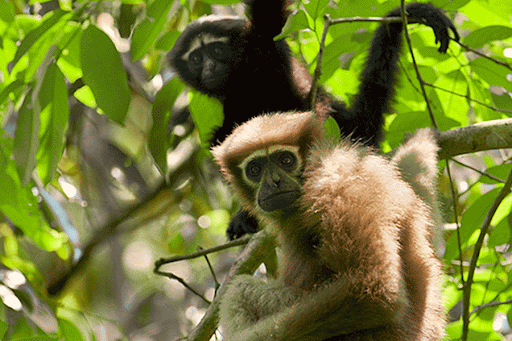
India's only ape, the Western Hoolock Gibbon, is in danger.
These tree-dwelling primates are losing their homes because of forests being cut down and people getting in their way.
There used to be many more of them, but now there are very few.
Scientists and the government are trying to help by replanting forests, involving local communities, and studying the gibbons.
The apes have babies slowly, so it's hard for their numbers to grow back quickly.
Without help, India could lose its only ape forever.

The Western Hoolock Gibbon, India's only ape species, is facing extinction.
The gibbon population in Tripura has decreased to 79 individuals in 2024.
Habitat loss, fragmentation, and human interaction are contributing factors.
Conservation efforts involve forest restoration, community engagement, and ecological studies.
Slow reproduction rates make population recovery challenging.
- Who
- Western Hoolock Gibbons, conservationists, Tripura forest department, Tripura University, local communities.
- What
- The declining population of Western Hoolock Gibbons.
- Where
- India, particularly Tripura and neighboring Meghalaya.
- When
- The gibbons' decline is ongoing, with surveys in 2005 and 2024 showing population decreases.
- Why
- Due to habitat loss, fragmentation, hunting, and conflict with humans.
Conservationists' Concerns
Local Community Perspectives
Balancing Cultural Practices and Conservation
Conservationists' Concerns
Emphasize the need to maintain cultural integrity while protecting the gibbons by integrating traditional methods with conservation strategies
Local Community Perspectives
Focus on reducing ecological harm and respecting cultural traditions while implementing strategies that reduce ecological harm
Key facts
- Species
- Western Hoolock Gibbon
- IUCN Status
- Endangered
- Location
- Tripura, India
- Population in Tripura (2005)
- 97
- Population in Tripura (2024)
- 79
- Habitat Dependence
- Highly canopy-dependent