20 hrs ago
Why the Marathi Chandrakor Bindi Represents Spiritual Strength

The Chandrakor bindi is a crescent-shaped mark associated with Marathi culture.
It is more than decoration according to the article.
In the past, people made it with kumkum or sandalwood paste.
They placed it between their eyebrows.
This spot is connected to the ajna chakra in Vedic traditions.
The ajna chakra is believed to be linked with intuition and spiritual understanding.
Wearing a bindi can therefore be seen as a sacred practice.
The word bindi comes from bindu, which means a dot or special point.
The article discusses its meaning in connection with Ganesh Chaturthi 2026.

The Chandrakor bindi is described as a Marathi cultural expression with spiritual meaning.
Historically, it was painted between the eyebrows using homemade kumkum or sandalwood paste.
Wearing a bindi is presented as a sacred act connected to purity and inner strength.
The mark is associated with the ajna chakra, believed to represent intuition and spiritual insight.
The word “bindi” comes from “bindu,” meaning a dot or sacred point where creation begins.
- Who
- People who wear bindis, particularly those observing Marathi cultural traditions.
- What
- An explanation of the spiritual and cultural significance of the Marathi Chandrakor bindi.
- Where
- Between the eyebrows; a broader geographic setting is not specified.
- When
- The article is framed around Ganesh Chaturthi 2026 and also discusses historical practice.
- Why
- It is associated with purity, inner strength, intuition, spiritual insight, and the ajna chakra.
Key facts
- Cultural expression
- Marathi Chandrakor bindi
- Traditional materials
- Homemade kumkum or sandalwood paste
- Placement
- The space between the eyebrows
- Spiritual association
- The ajna chakra
- Ajna chakra meaning
- Believed to be the seat of intuition and spiritual insight
- Word origin
- “Bindi” derives from “bindu,” meaning a dot or sacred point
- Article context
- Ganesh Chaturthi 2026
Sources
Related news
Ganesh Chaturthi 2026 Prompts Create Personalised Festive AI Images

Ganesh Chaturthi 2026: Tithi, Sthapana Muhurat and Significance
Sri Chakra Depicts the Mother Goddess’s Journey Toward Moksha

Janmashtami: Meaning of Lord Krishna's Peacock Feather
Samantha Ruth Prabhu Shares Traditional Baby Shower Ceremony Photos
How Bharat’s Ancient Practices Shaped Today’s Manifestation Conversation

Political Leaders Join Nationwide Ganesh Chaturthi Celebrations and Prayers
Maharashtra CM Fadnavis Visits Mayor’s Home For Ganesh Blessings
Radhika Ambani Marks Ganesh Chaturthi in Pink Kanjeevaram
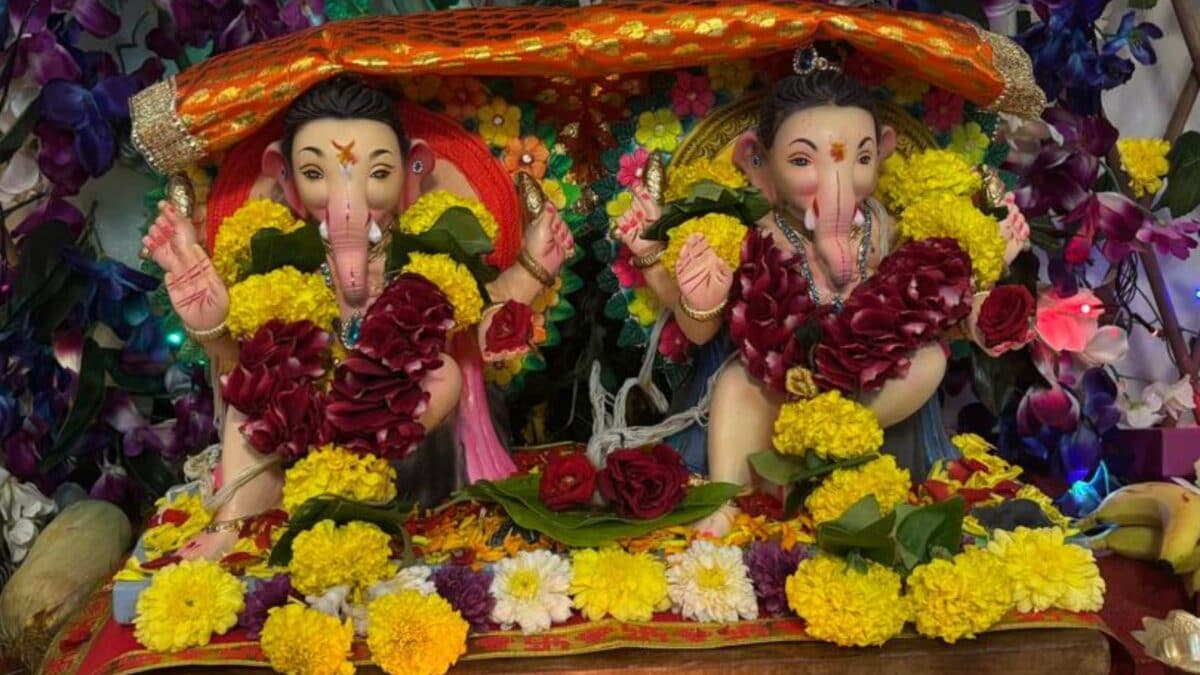
Jodi Ganpati: Why Maharashtra Families Worship Two Ganesh Idols

Govinda Joins Family for Ganesh Chaturthi Celebrations in Mumbai