4 days ago
East of Eden Reconsiders Cathy Ames as Monster or Misunderstood
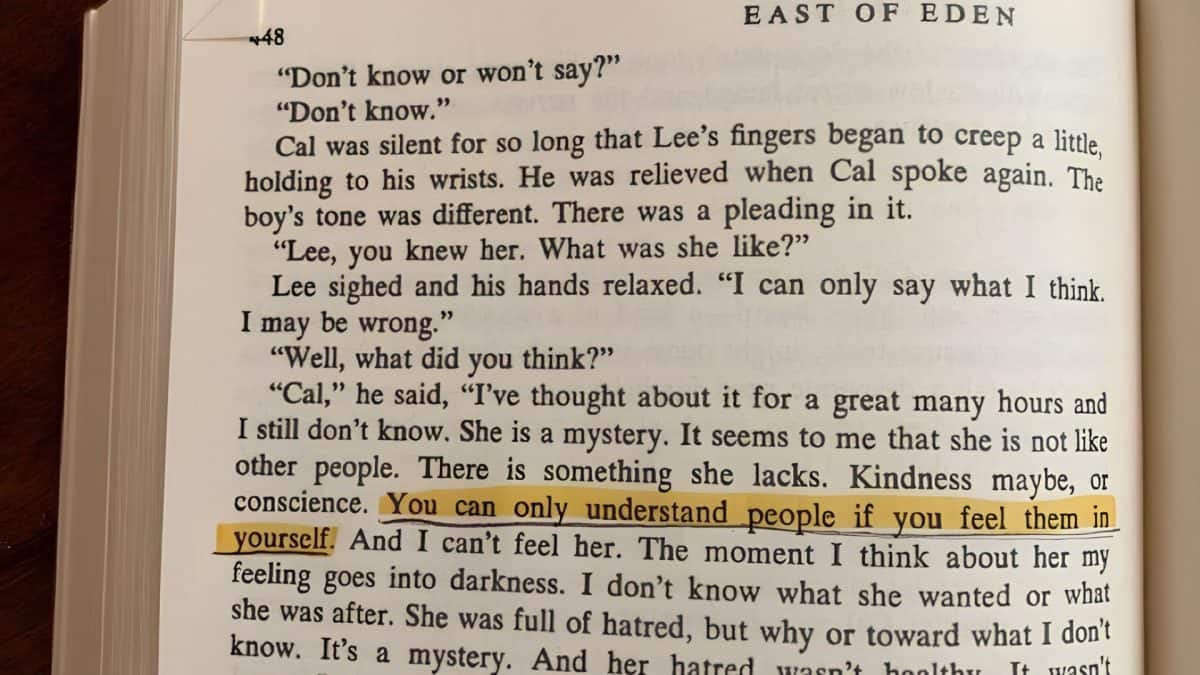
East of Eden is a book about families, choices and rejection.
Cathy Ames is shown as a very cruel person.
But the article points out that readers do not get to hear much about what Cathy thinks or feels.
That makes some people wonder whether the book judges her too quickly.
The story also shows children feeling hurt when they do not feel loved.
A character named Lee explains a word, “timshel,” as meaning “thou mayest.”
In the article’s reading, this means people can choose what they do.
Their family past does not decide everything for them.

The article examines Cathy Ames, a character in John Steinbeck’s 1952 novel East of Eden, through competing interpretations.
The narrator depicts Cathy as cruel and deceptive, while the article argues that readers hear little of her inner life.
Steinbeck briefly questions whether Cathy is truly a monster, noting that her motives may be impossible to understand.
The novel links rejection with anger, wrongdoing and guilt through the experiences of Cain, Cal and other characters.
The Hebrew word “timshel,” interpreted as “thou mayest,” supports the idea that family history does not determine a person’s choices.
- Who
- The article’s writer discusses Cathy Ames and other characters in John Steinbeck’s East of Eden.
- What
- A reflection on whether Cathy is simply evil or whether the novel’s portrayal leaves her motives unexplored.
- Where
- The novel is set in California’s Salinas Valley.
- When
- East of Eden was published in 1952; the article also mentions a Netflix adaptation released at the beginning of the month, without specifying a date.
- Why
- The article explores how rejection, family history and personal choice shape the characters, and questions the narrator’s judgment of Cathy.
Cathy as a monster
Cathy as a poorly understood character
How the novel presents Cathy
Cathy as a monster
The narrator portrays Cathy as deceptive and cruel, likening her to the serpent and describing her as a monster.
Cathy as a poorly understood character
The article notes that Cathy gets little interior perspective compared with other major characters, making the narrator’s account a partial one.
Whether Cathy can be understood
Cathy as a monster
Her actions and lies support the reading that she is fundamentally evil.
Cathy as a poorly understood character
Steinbeck later questions whether “monster” is the right label and suggests her motives may be unknowable.
The role of inherited history
Cathy as a monster
Cathy’s mark and her resemblance to biblical figures connect her to a story of inherited evil.
Cathy as a poorly understood character
The article’s reading of “timshel” emphasizes that people may choose their actions rather than being determined by family history.
Key facts
- Novel
- East of Eden
- Author
- John Steinbeck
- Publication year
- 1952
- Setting
- Salinas Valley
- Key term
- “Timshel,” interpreted in the article as “thou mayest”
- Adaptation mentioned
- A Netflix adaptation, with Florence Pugh playing Cathy and Zoe Kazan associated with the adaptation
Sources
Related news

Netflix’s East of Eden Recasts Steinbeck’s Notorious Villain

Florence Pugh Leads Ambitious Netflix East Of Eden Adaptation

Jeffrey Archer Dies One Day Before Final Novel's Release

New Films and Web Series Arrive Across Streaming Platforms

Mike Flanagan Gives Stephen King's Carrie a Modern Sci-Fi Twist
How Christian Thinkers Debated Gender Beyond the Binary

This Week’s OTT Releases Span Romance, Spies and Fantasy