

1 hr ago
India's Shipbuilding Push Faces Global Competition and Capacity Challenges
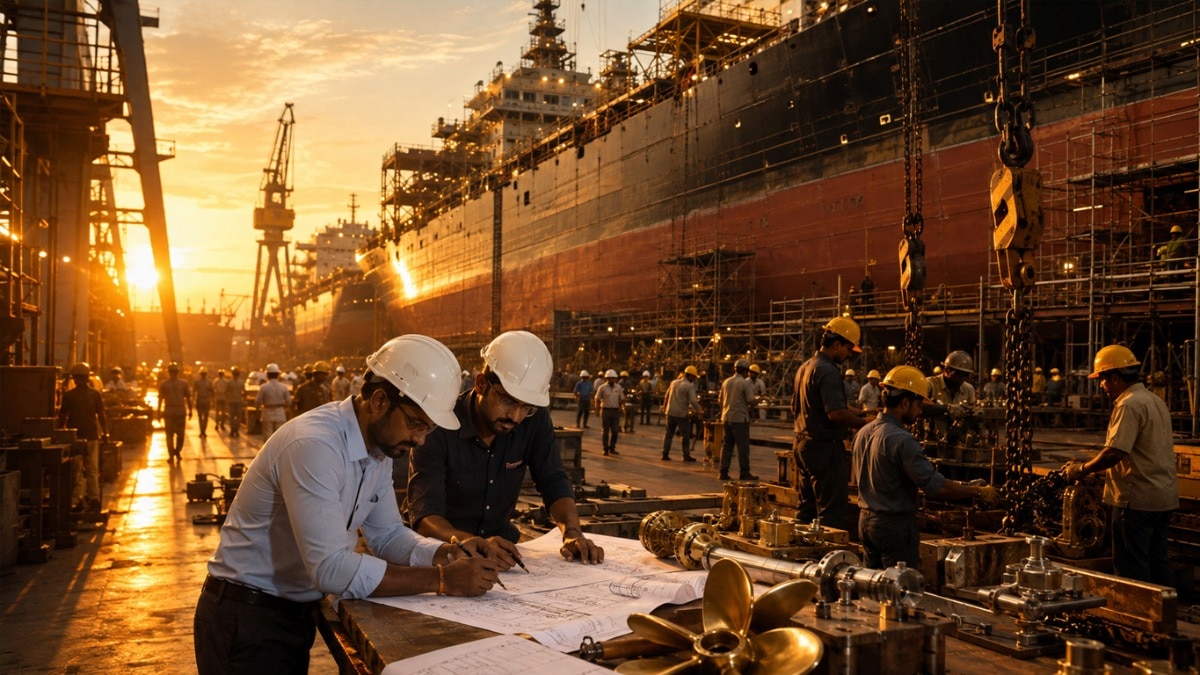
India wants to become one of the world's major shipbuilding countries.
Right now, it builds less than 1% of the world's ships.
China, South Korea and Japan build almost all the rest.
The Indian government has approved a large package to help local shipyards grow.
Indian shipyards are experienced at building warships for the Indian Navy.
They now need to build more commercial ships and sell vessels to other countries.
India is cheaper than some European builders, but Asian competitors are faster or more advanced in some areas.
The country is also considering large shipbuilding clusters and more ship-repair facilities.
Supporters see this as a way to create jobs and improve maritime security, while critics warn that India must solve capacity and funding problems first.

India currently accounts for less than 1% of global shipbuilding capacity, while China, South Korea and Japan together account for 98.5%.
The government approved a Rs 69,725-crore package to make India a top-10 shipbuilding nation by 2030 and top-five nation by 2047.
Indian shipyards are being urged to expand beyond naval vessels and export frigates, training ships and modular warships.
India has cost, naval experience and diplomatic advantages, but trails competitors in tonnage, manufacturing speed, technology integration and maritime scale.
Ship repair, modular construction and proposed mega shipbuilding clusters are being promoted alongside conventional shipbuilding growth.
- Who
- The Indian government, Indian shipyards, the Indian Navy and competing shipbuilding nations including China, South Korea and Japan.
- What
- India is pursuing a major expansion of shipbuilding, ship repair and exports to enter the global shipbuilding elite.
- Where
- The effort involves Indian shipyards and proposed clusters in Tamil Nadu, with other locations under consideration in Andhra Pradesh, Odisha, Gujarat and Maharashtra.
- When
- The government targets a top-10 position by 2030 and a top-five position by 2047; the Navy plans to commission 19 domestically built warships in 2026.
- Why
- To build strategic industrial capacity, support jobs and related industries, reduce dependence on foreign-built vessels, expand exports and strengthen maritime security.
Expansion Opportunity
Scaling Risks
India's competitive advantages
Expansion Opportunity
Supporters point to Indian Navy experience, lower labour costs than China, South Korea and Japan, around 90% indigenous content in Indian warships, competitive pricing and India's location on Indo-Pacific shipping routes.
Scaling Risks
The article notes that India lacks a clear cost advantage over East Asian competitors and faces higher material and financing expenses.
Government support
Expansion Opportunity
The Rs 69,725-crore package, planned purchases of more than 400 vessels, infrastructure-status benefits and proposed mega shipbuilding clusters could give yards stable demand and lower costs.
Scaling Risks
Indian shipyards still need faster policy decisions, adequate funding and continuous orders to prevent assembly lines and skilled workforces from becoming idle.
Global expansion
Expansion Opportunity
Modular construction, diplomatic cooperation and ship repair could help India enter export and maintenance markets without immediately matching the largest Asian yards.
Scaling Risks
India's low tonnage capacity remains a major obstacle: its 0.072 million GT is far below South Korea's 20 million and Japan's nine million, while China also builds ships much faster.
Key facts
- Current global share
- India accounts for less than 1% of global shipbuilding capacity.
- Leading countries
- China, South Korea and Japan together account for 98.5% of global shipbuilding; China alone accounts for 60%.
- Government package
- Rs 69,725 crore approved for shipbuilding development.
- National targets
- Top 10 shipbuilding nation by 2030 and top five by 2047.
- Indian capacity
- India has 0.072 million GT of capacity, compared with 20 million GT for South Korea and nine million GT for Japan.
- Planned vessel orders
- The government plans to buy more than 400 vessels to provide order continuity.
- Commercial shipbuilding
- Only 7% of India-owned commercial ships are built domestically.
- Repair opportunity
- India has less than 2% of the global ship repair and maintenance market, according to the cited report.
Quotes
Rear Admiral Shekhar Mittal
Former CMD of Goa Shipyard Ltd and retired rear admiral
“MRO cash flow cycles are fast, unlike shipbuilding, where it takes three-five years depending on the size of the ship. Refits have a much shorter duration. The money is not blocked.”
 businesstoday.in
“Naval shipbuilding is our strong suit. The commercial ship building has not kept pace. That is where the potential resides.”
businesstoday.in
Sources
Related news
GRSE Plans Rs 2,500 Crore Expansion for Global Growth
Rajnath Singh Backs India as Global Shipbuilding Hub
Rajnath Singh Launches ₹3,500 Crore Bengal Defence Expansion
India Plans 100 Ships to Reduce Foreign Freight Dependence
Danish Firms Seek Bigger Role in India’s Naval Shipbuilding

India and Denmark Expand Maritime Shipbuilding and Technology Cooperation

Srihari Nataraj Reaches Asian Games 50m Backstroke Final

Australia Warns Ageing Population Will Slow Growth as Births Fall

Fresh Transport Chaos Hits Indian Shooters in Japan
Sensex, Nifty Eye Cautious Start Amid High US Yields
