

1 hr ago
NASA Seed Experiment Found No Lasting Effects From Space
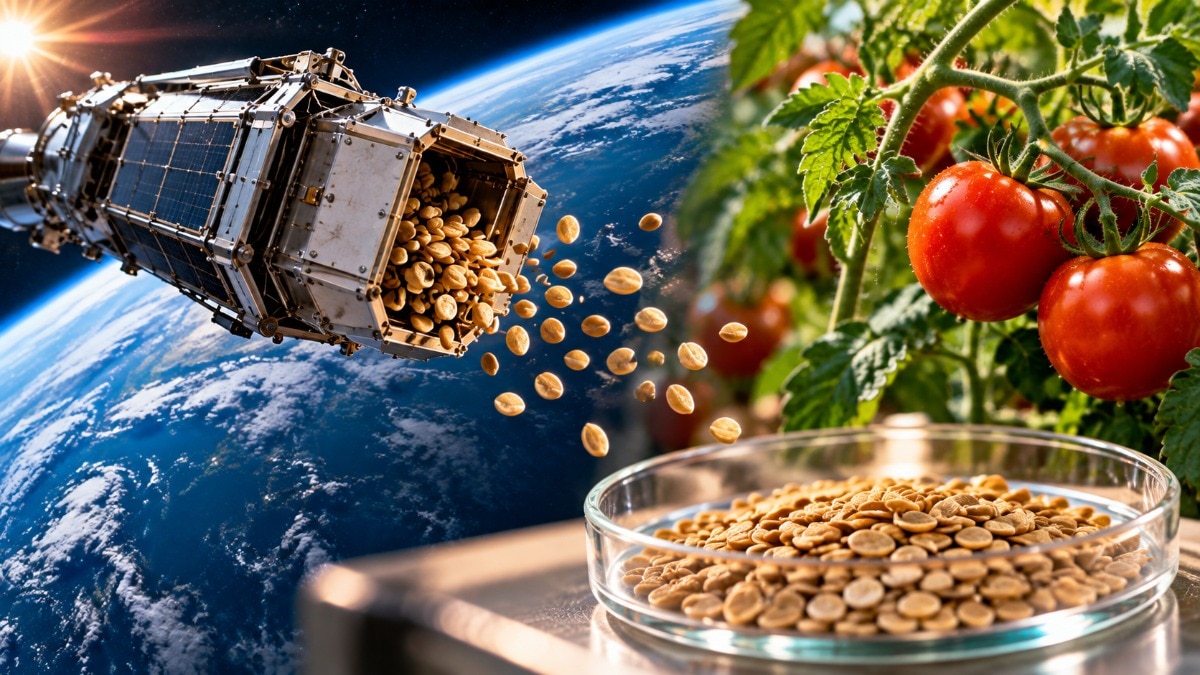
NASA sent millions of tomato seeds into space to see whether space changed them.
The seeds stayed in orbit for almost six years.
They were exposed to radiation, cosmic rays, microgravity and the vacuum of space.
After returning to Earth, the seeds were given to schools for classroom experiments.
Students planted space seeds and regular Earth seeds side by side.
The space seeds sprouted a little more often and slightly faster.
However, the plants and tomatoes later became essentially the same.
The project showed that students could help conduct a very large space science experiment.

NASA’s SEEDS project sent 12.5 million Rutgers California Supreme tomato seeds into orbit.
The seeds spent 69 months aboard the Long Duration Exposure Facility, completing more than 32,000 Earth orbits.
The Space Shuttle Challenger launched the facility in 1984, and the Space Shuttle Columbia retrieved it in 1990.
About 132,000 classroom planting kits were distributed to schools in all 50 states, Washington, D.C., and 30 other countries.
Space seeds germinated slightly more often and faster, but showed no lasting differences in plants or fruit compared with Earth seeds.
- Who
- NASA, its Langley Research Centre, George W. Park Seed, teachers and students participated in the SEEDS project.
- What
- A large experiment compared tomato seeds exposed to space with seeds kept on Earth.
- Where
- The seeds traveled aboard the Long Duration Exposure Facility in orbit around Earth; classroom testing occurred in the United States and 30 other countries.
- When
- The seeds were launched on April 7, 1984, and retrieved on January 12, 1990, after 69 months in orbit.
- Why
- The project aimed to determine whether long-term exposure to the space environment changed tomato germination, growth, reproduction or fruit.
Key facts
- Project
- SEEDS, or Space Exposed Experiment Developed for Students
- Seed quantity
- 12.5 million tomato seeds
- Seed variety
- Rutgers California Supreme
- Time in orbit
- 69 months
- Launch and recovery
- Launched by the Space Shuttle Challenger in 1984; recovered by the Space Shuttle Columbia in 1990
- Classroom participation
- About 132,000 kits were distributed to approximately 40,000 schools
- Germination results
- 73.8% for space seeds versus 70.3% for Earth seeds
- Final finding
- No overall lasting differences were found between the plants or their fruits
Sources
Related news

Google's Project Suncatcher Tests AI Chips in Space
Students Imagine Mars Settlements and Explore Space Science
Google’s Project Suncatcher Tests AI Data Centers in Space

108-Country Girl-Powered ShaktiSat Sets Sights on Moon
Astronaut Shares Ancient Manicouagan Crater View From Space
AstroForge Plans Fully Autonomous AI-Controlled Spacecraft Mission For 2027
Jellyfish heals wounds in minutes
Kalpana Chawla's Maiden Space Mission & Lincoln's Gettysburg Address
