1 hr ago
Split AC Vs Window AC: Cost-Effective Choice for Small Rooms
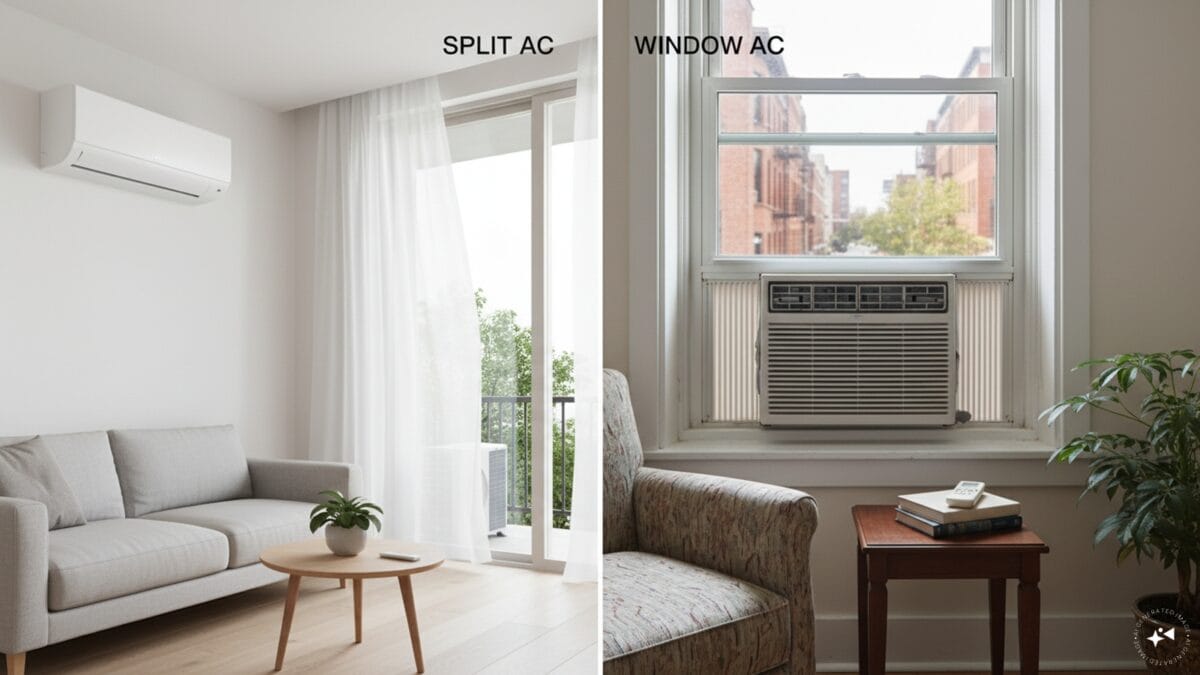
A window AC is usually cheaper to buy and easier to install when a suitable opening is available.
A split AC usually costs more at first.
However, split ACs are quieter because their compressor is outside the room.
Window ACs can be noisy because all their parts are in one cabinet.
Neither type always uses less electricity.
Energy use depends on the model’s rating, size and how long it runs.
A very small room may need less than a 1.5-ton AC.
Choose a window AC to save money upfront, or a split AC for quieter and longer daily use.

Window ACs generally cost less to buy and install, especially when a suitable opening already exists.
Split ACs are typically quieter, offer more installation flexibility and provide a wider choice of inverter models.
Electricity costs depend on capacity, energy rating, inverter technology, room conditions and usage hours—not AC type alone.
A correctly sized window AC may be more economical for occasional use in a small room.
For bedrooms or rooms used for long hours, an efficient split AC may offer better overall value.
- Who
- People choosing an air conditioner for a small bedroom, study, home office or other small room.
- What
- A comparison of the cost, installation, energy use, noise and suitability of split and window ACs.
- Where
- The comparison concerns air conditioners and product prices in the Indian market.
- When
- The article was last updated and first published on October 1, 2026, at 17:00 IST.
- Why
- Buyers need to balance upfront price, installation expense, electricity consumption, room capacity, noise and usage hours.
Split AC
Window AC
Upfront cost
Split AC
Usually costs more to purchase and install, though comparable inverter models can have similar prices.
Window AC
Usually costs less upfront, particularly when a suitable window or wall opening already exists.
Long-term value
Split AC
May provide better overall value for long daily use because efficient inverter models and quieter operation can matter more over time.
Window AC
Can be more economical for occasional use in a small room, especially when the unit is correctly sized.
Room suitability
Split AC
Better suited to bedrooms, rooms without suitable openings and spaces where low noise or appearance matters.
Window AC
Better suited to small rooms with an existing opening, budget-conscious buyers and situations where noise is less important.
Energy consumption
Split AC
Does not automatically use less electricity; actual consumption depends on the model’s capacity, rating, technology and use.
Window AC
Can be highly efficient, as shown by the listed 5-star inverter window models; buyers should compare individual energy labels.
Key facts
- Lowest listed price
- Oakter 0.5-ton inverter window AC: Rs 16,999
- Listed split AC prices
- LG, Daikin and Hitachi 1.5-ton split models range from Rs 36,500 to Rs 37,400.
- Listed window AC prices
- Carrier and Voltas 1.5-ton inverter window ACs are listed at Rs 35,490 and Rs 35,999, respectively.
- Capacity guidance
- The Oakter 0.5-ton model is marketed for rooms of around 75 square feet; several other listed models are 1.5-ton units.
- Noise
- Split ACs generally operate more quietly indoors because the compressor is outside.
- Energy comparison
- The listed Voltas and Carrier window ACs are 5-star inverter models, while the featured LG, Daikin and Hitachi split ACs are 3-star inverter models.
- Installation
- Window AC installation is generally simpler with an existing opening, while split ACs require indoor-outdoor connections and may need extra materials or electrical work.
Sources
Related news
India 2026 Guide to Choosing a 5 Star Refrigerator
Ceiling Fans Cover Rooms, Pedestal Fans Deliver Targeted Summer Airflow

Seven Monitors Compared for Home Office Size, Clarity and Budget

Air Conditioner and Appliance Prices May Rise Before Diwali

Simple Wave Versus Ather Konarc: Which Family Scooter Wins?

Why Indian Refrigerators Feel Full Despite Unused Capacity

Monthlong AC Test Reveals Delhi-NCR Cooling Costs
India's E-Waste Recycling Rules Spark Legal Battle with Tech Giants

Top Air Conditioners: Modern Features and Energy Efficiency