

9 months ago
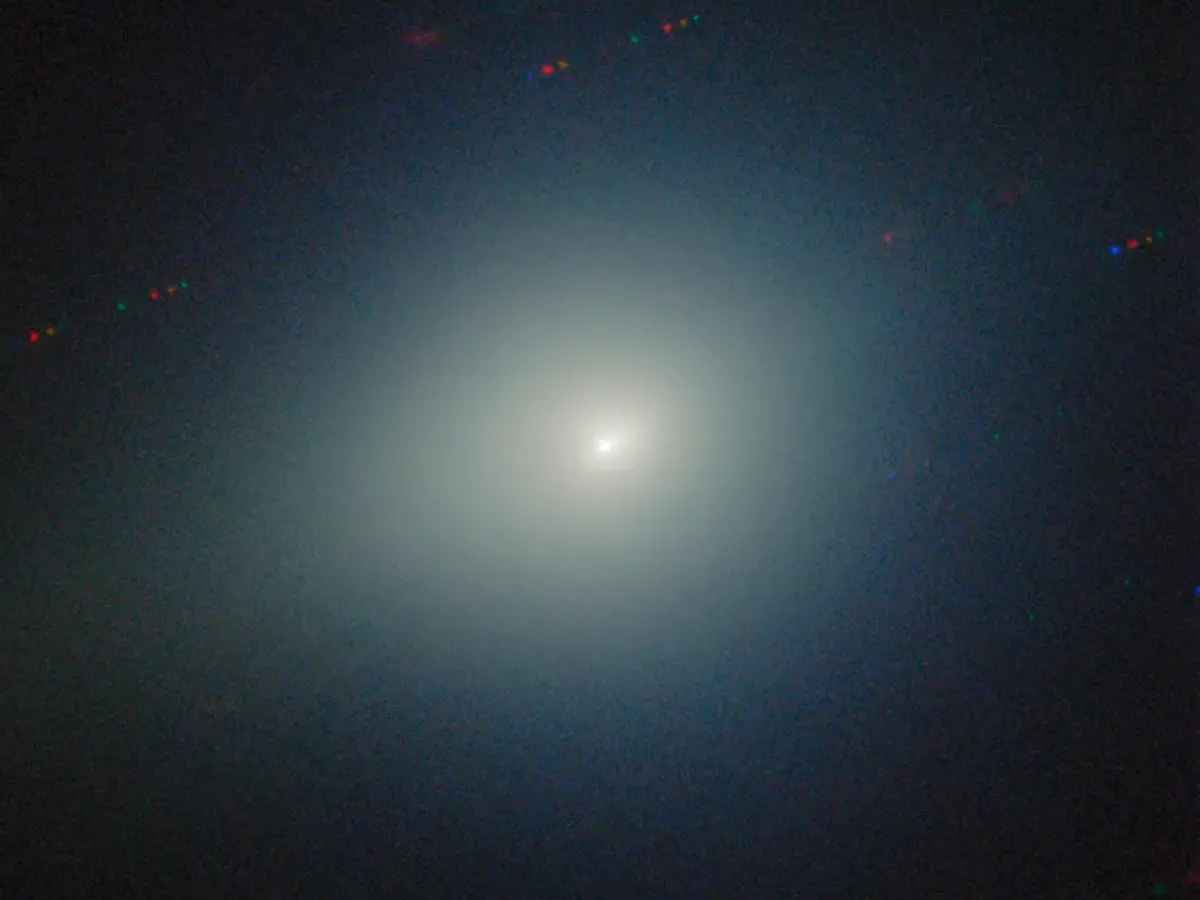
Interstellar Comet 3I/ATLAS Turns Green

A comet named 3I/ATLAS, which comes from outside our solar system, is getting closer to Earth.
Scientists took pictures of it and saw that it has turned green.
This happens because of special molecules in the comet that glow green when they get sunlight.
The comet was discovered in July 2025 and will be closest to Earth on December 19, 2025.
It's the biggest and oldest interstellar object we've ever seen, and scientists are excited to study it.
The green color is not unusual for comets, but it's interesting to see how this one changes as it gets closer to the Sun and then moves away.
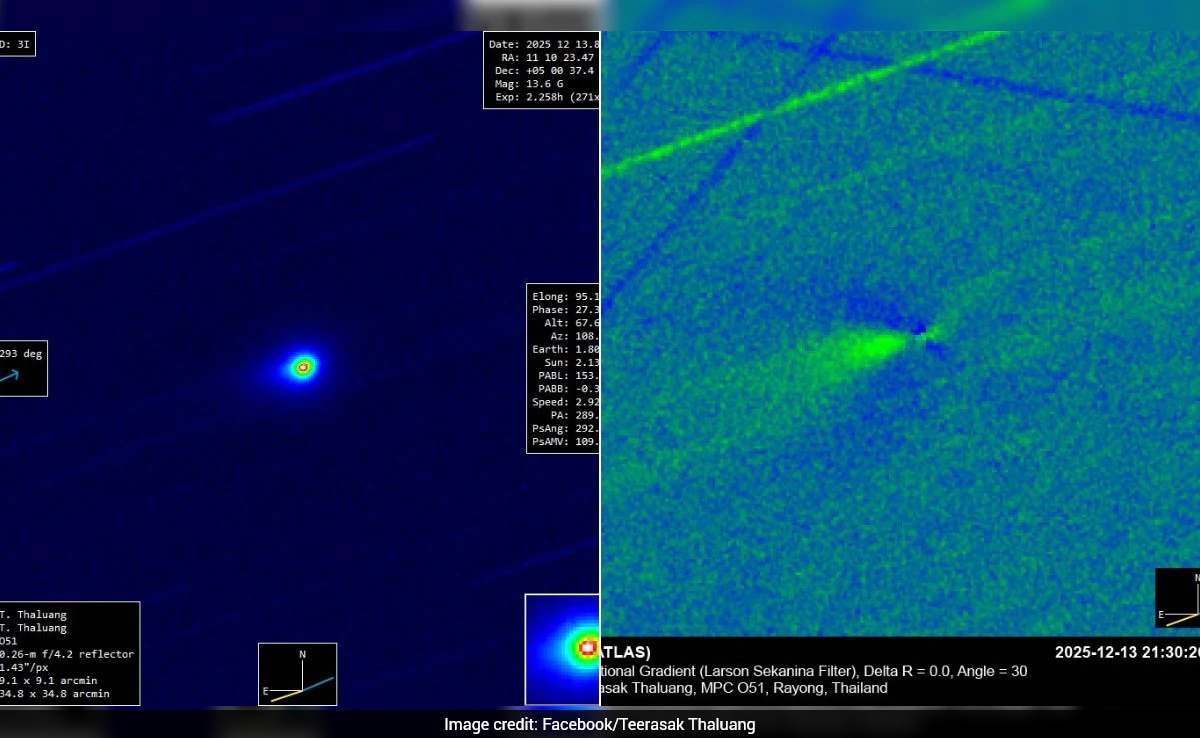
Some scientists think it might not be a natural comet, and they are studying a special feature called an anti-tail, which is a rare phenomenon where the comet's tail points towards the Sun.

Interstellar comet 3I/ATLAS has turned green and is brightening as it approaches Earth.
The comet will be at its closest point to Earth on December 19, 2025, at a distance of 170 million miles (270 million kilometers).
Discovered on July 1, 2025, by the ATLAS telescope in Chile, it is the third interstellar object detected and the largest and oldest observed so far.
The green hue is caused by diatomic carbon (C2) molecules in the coma emitting light at green wavelengths when exposed to solar radiation.
Scientists observed the comet using the Gemini North telescope on November 26, 2025, and noted an anti-tail phenomenon, which is a rare physical feature where the comet's tail points towards the Sun.
- Who
- Scientists using the Gemini North telescope and Avi Loeb
- What
- Interstellar comet 3I/ATLAS turning green and exhibiting an anti-tail
- Where
- Approaching Earth, observed from Mauna Kea, Hawaii, and Thailand
- When
- November 26, 2025 (observation), December 19, 2025 (closest approach)
- Why
- Diatomic carbon (C2) molecules in the coma emit green light when exposed to solar radiation, and the anti-tail is a physical feature caused by the way dust and gas are ejected from the comet.
Natural Comet
Artificial Object
Nature of 3I/ATLAS
Natural Comet
NASA and many scientists believe 3I/ATLAS is a naturally occurring comet.
Artificial Object
Some experts, including Avi Loeb, suggest 3I/ATLAS might not be a naturally occurring object.
Key facts
- Discovery Date
- July 1, 2025
- Discovery Location
- Chile
- Closest Approach to Earth
- December 19, 2025
- Distance from Earth
- 170 million miles (270 million kilometers)
- Observation Date
- November 26, 2025
- Observation Tool
- Gemini North telescope
- Cause of Green Hue
- Diatomic carbon (C2) molecules
- Anti-Tail Observation Dates
- July 21, 2025, November 30, 2025, December 13, 2025
- Anti-Tail Observer
- Teerasak Thaluang
Quotes

Avi Loeb
Harvard scientist and researcher on interstellar objects
“The rotational-gradient brightness map shows a prominent anti-tail, uncommon for comets, pointing in the direction of the Sun.”
 NDTV
NDTV
“Whereas an anti-tail had been seen for solar system comets as a temporary perspective effect when the Earth crossed the comets' orbital plane, this is clearly not the case with 3I/ATLAS.”
NDTV
Sources
Related news

Hawaii’s Famous Hōlei Sea Arch Collapses Into Pacific Ocean

Hawaii’s Holei Sea Arch Collapses After Centuries of Erosion

Kendall Jenner and Jacob Elordi’s Fashion Week Romance Goes Public

SpaceX Starship Reaches Orbit, Ends Historic Flight Early

Laptop Prices Rise as RAMageddon Disrupts Budget Computing
