4 days ago
Japanese Washi Could Help Revive Bengal’s Lost Papermaking Tradition
Japanese washi is paper made slowly by hand from plant fibres.
Bengal also once had its own handmade papermaking traditions.
At a talk in Kolkata, Japanese paper master Asao Shimura and professor Midori Yamamoto discussed whether washi methods could help bring those traditions back.
Their project in Santiniketan combines Japanese and Indian ideas about making paper.
They showed how fibres are prepared and shaped into thin sheets with bamboo screens.
The sheets are then pressed and dried.
Santiniketan’s red soil can also be used to colour and texture paper.
The event included a talk, an exhibition and a display of materials and books about papermaking.

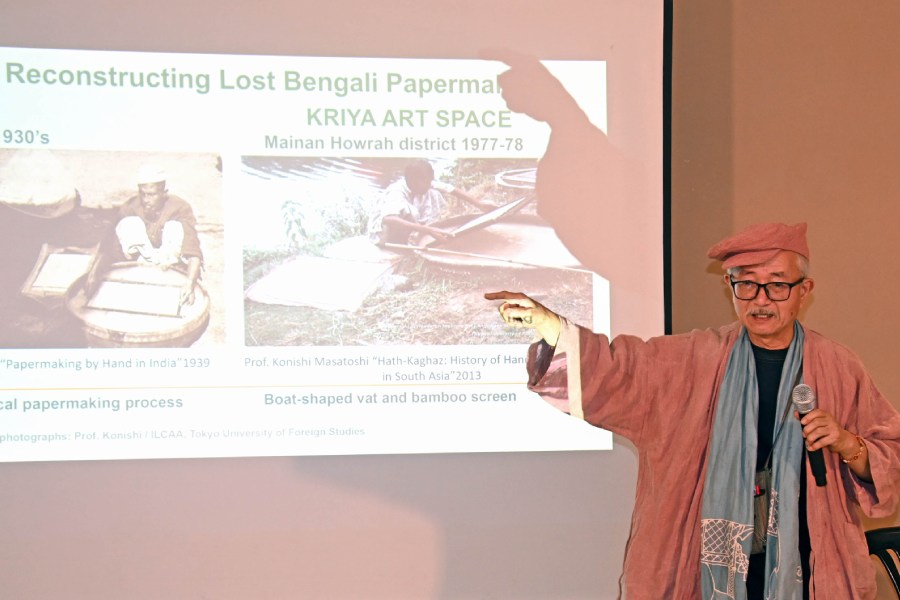
Japanese paper master Asao Shimura and professor Midori Yamamoto discussed reviving Bengal’s lost papermaking tradition at CIMA gallery.
Their Terakoya Kami Santiniketan project researches, shares and blends Japanese and Indian handmade papermaking traditions.
The presenters described turning plant fibres into paper sheets using bamboo screens, pressing and drying them.
The event compared Japanese washi techniques with papermaking traditions once practiced in Dhaka and Mainan, Howrah.
Visitors viewed handmade papers, raw materials, printing blocks and books documenting papermaking traditions across several countries.
- Who
- Japanese paper master Asao Shimura, professor Midori Yamamoto, and artists from Santiniketan, including Kingshuk Sarkar, Reshmi Bagchi Sarkar and Riti Sarkar.
- What
- A talk, exchange and exhibition examined whether Japanese washi-making techniques could help revive Bengal’s lost handmade papermaking tradition.
- Where
- CIMA gallery; the related Terakoya Kami project holds workshops in Santiniketan.
- When
- Friday evening; the article does not specify the date.
- Why
- To research, share and blend Japanese and Indian handmade papermaking traditions and explore their historical connections.
Key facts
- Project
- Terakoya Kami Santiniketan is an ongoing Japanese-Indian cultural and artistic research project.
- Japanese presenter
- Asao Shimura is a paper master, traveller and researcher.
- Papermaking process
- Plant fibres are prepared, formed into sheets with traditional bamboo screens, pressed and dried.
- Bengal tradition
- The presentation referred to a lost papermaking tradition practiced in Dhaka in the 1930s and Mainan in Amta, Howrah district, around 1977.
- Local material
- Santiniketan’s red laterite soil is used as a natural pigment for handmade paper and craftworks.
- Research support
- The Japan Society for the Promotion of Science supports scientific research and international academic collaboration with Visva-Bharati University.
- Exhibition materials
- The walkthrough included handmade papers, raw materials, wooden printing blocks and books on papermaking traditions.
Quotes
Midori Yamamoto
Professor and researcher who presented the papermaking workshop and comparative research
“Santiniketan’s famous laal maati (red laterite soil) is traditionally used by local artists and craftspeople as a natural pigment to smear, tint, and texture handmade paper and craftworks, mirroring the iconic mud-plastered architecture of the Rarh region in Bengal.”
 telegraphindia.com
“The workshop demonstrated the painstaking process of transforming plant fibres into handmade paper, from preparing and processing the fibres to forming thin sheets using traditional bamboo screens before they are pressed and dried.”
telegraphindia.com
Sources
Related news

Handmade Souvenirs, Lac Bangles and Indulgent Matcha Finds
Assam’s Sanchipat Puthi Chitra Gains National Recognition At Exhibition
Where to Learn Origami in Kolkata: Classes, Communities and Institutes

Ruma Choudhury’s Paper Works Explore Nature at Emami Art

Artists from Naxal-Affected Bastar Create I-Day At Home Invitation Kit

Shami Shines as East Zone Reaches Duleep Trophy Final

Bengal Reports Over 4,000 Dengue Cases, Down 50% This Year

Bengal Rolls Out QR System To Monitor Waste Segregation
LPG e-KYC Deadline Ends as 12 Lakh Users Remain Pending
Five Taal Recipes Bring Bengal’s Monsoon Fruit to Janmashtami