3 weeks ago
Defence exports jump 63%, yet India's FY29 target remains conservative
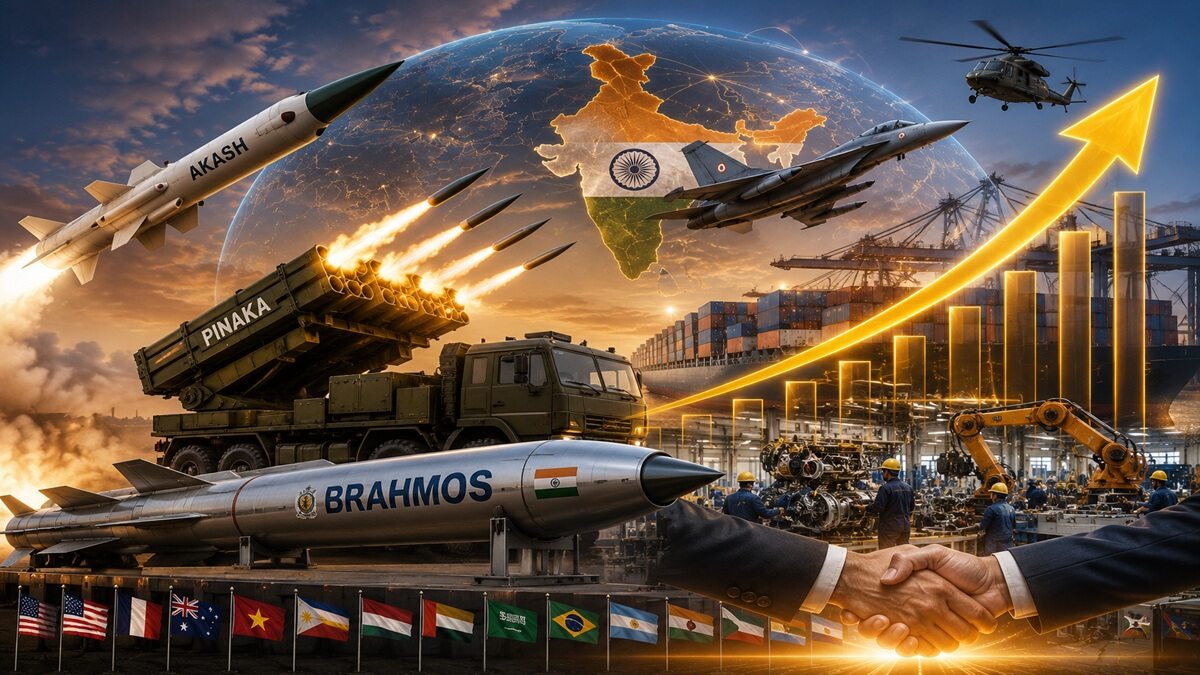
India makes things like fighter planes and other military equipment, and it also sells them to other countries.
The money India earned from selling defence equipment last year was the highest ever at Rs 38,424 crore.
That was a giant jump, more than 60% higher than the year before.
The government hopes to sell Rs 50,000 crore worth by 2029.
Because sales have grown so quickly, many people think that plan is too careful and might be beaten.
Government-owned companies still make most of the equipment, but private companies are growing their share fast.
India now sells defence equipment to more than 80 countries.
India used to buy most of its weapons from Russia, but it now buys more from France and Israel instead.
The government is also giving defence companies a lot of money to make weapons in India.
Whether India can sell even more than planned is still an open question.

India's defence exports hit a record Rs 38,424 crore in FY26, up 62.66% from the previous year, per CareEdge Ratings.
The government's FY29 export target of Rs 50,000 crore implies a roughly 9% CAGR, far below the near-20% annual growth pace since FY19.
DPSUs accounted for 54.84% of exports and private firms 45.16% in FY26, with the number of exporters rising to 145 from 128.
India exports defence equipment to more than 80 countries; Myanmar, the Philippines and Armenia were the top destinations during 2021-25.
The FY27 defence budget rose about 15% to Rs 7.85 lakh crore, while Russia's share of India's arms imports fell to around 40%.
- Who
- Indian defence manufacturers — DPSUs and private firms such as Tata Group, Larsen & Toubro, Adani Group, Mahindra Defence Systems and Kalyani Group — along with the government and report author CareEdge Ratings.
- What
- India's defence exports jumped 62.66% to a record Rs 38,424 crore in FY26, while the government's FY29 target of Rs 50,000 crore is seen as conservative.
- Where
- India; exports reach more than 80 countries, led by Myanmar, the Philippines and Armenia during 2021-25.
- When
- FY26, with projections for FY27-FY29; reported following the FY27 Union Budget.
- Why
- Policy support, ease-of-doing-business reforms, streamlined export procedures, rising geopolitical uncertainties and growing global acceptance of indigenous defence products.
Official target is conservative
Target reflects realistic moderation
FY29 export target vs actual growth pace
Official target is conservative
The Rs 50,000 crore FY29 target implies only about 9% annual growth, less than half the near-20% pace since FY19, so the target could be beaten.
Target reflects realistic moderation
The projection assumes the record FY26 jump will moderate, since momentum depends on DPSU execution and global demand that may not sustain 20% annual growth.
Indigenisation vs continued arms imports
Official target is conservative
Rising domestic procurement (75% of capital acquisition funds) and a falling Russian import share show India is successfully deepening self-reliance.
Target reflects realistic moderation
India still needs imports of fighter aircraft, submarines and high-technology systems and remains the world's second-largest arms importer, so imports will remain necessary.
Key facts
- Record FY26 exports
- Rs 38,424 crore
- Year-on-year export growth
- 62.66%
- FY29 export target
- Rs 50,000 crore (~9% CAGR)
- DPSU share of exports (FY26)
- 54.84%
- Number of defence exporters (FY26)
- 145 (up from 128)
- Export destinations
- 80+ countries; top 2021-25: Myanmar, Philippines, Armenia
- FY27 defence budget
- Rs 7.85 lakh crore (~15% higher than FY26)
- 2047 export ambition (Viksit Bharat)
- Rs 2.8 lakh crore
Quotes
Pritesh Rathi
Associate Director at CareEdge Ratings
“"India’s defence sector is witnessing a structural transformation driven by rising indigenisation, higher capital outlay, and increasing private sector participation. With defence production targeted to reach Rs 3 lakh crore by FY29 and a strong focus on domestic procurement, the sector is expected to maintain healthy growth momentum over the medium term."”
 financialexpress.com
Sources
Related news
India's Defence Industry Projected to Grow 68% in Three Years
Ashika Institutional Sets Hold Targets for Five Defence Stocks
India Plans to Turn Defence PSUs Into Global Giants

India's defence production and exports hit record highs
India's defence production quadruples to record Rs 1.78 lakh crore

16th Aero India Show Set for Bengaluru in February

Shakti Sharma Becomes First Woman Air Vice Marshal

Russia Offers India Five More S-400 Air-Defence Squadrons
Rajnath Singh, Yogi Adityanath Launch Lucknow Cantonment Projects

Tribunal Removes Brigadier’s Censure, Angering Gujjar Leaders