3 weeks ago
India notifies heatwaves as natural calamity to aid vulnerable
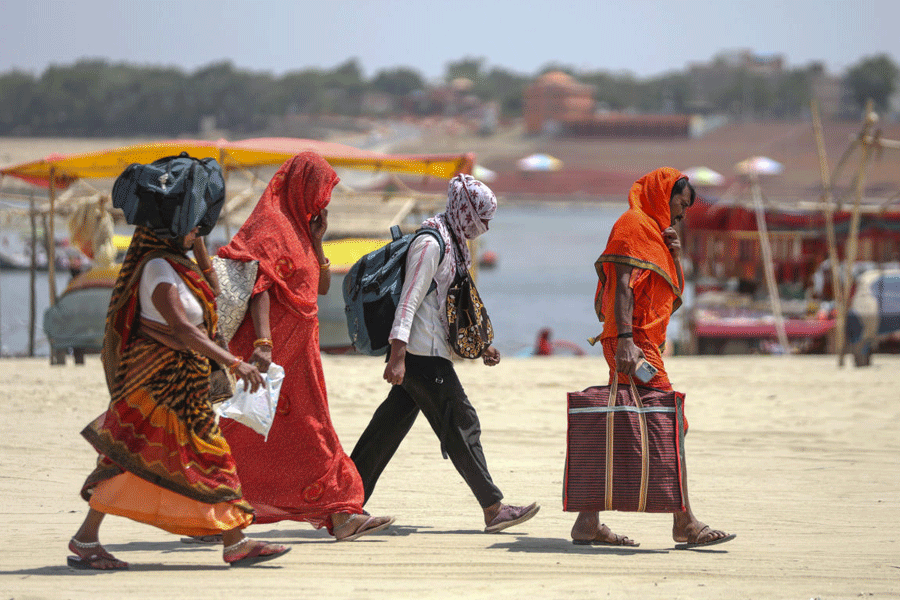
In India, very hot weather called a heatwave can make people sick, especially those who work outside or live without fans and cool air.
On August 4, the Indian government officially said that heatwaves are a natural calamity, like floods or earthquakes.
This is a big deal because it lets states use special government money to help people during very hot days.
Cities can build cooling shelters, add more water points, and make public places cooler.
Before this, states could only use a small part of this money for heatwaves.
Experts say people who work outdoors, like builders and farm workers, suffer the most from the heat.
The money acts like seed money to start heat action plans that protect people.
Doctors say hospitals and health systems also need to be ready.
The goal is to protect everyone, especially poor and vulnerable people, from dangerous heat.

The Indian government recognised heatwaves as a notified natural calamity on August 4.
States can now access the State Disaster Response Fund (SDRF) and State Disaster Mitigation Fund (SDMF) to respond to heatwaves and lightning.
The funding is intended as seed money to help cities establish heat action plans (HAPs) and attract additional resources.
Experts say heat stress is an economic calamity that hits workforce productivity, especially outdoor and informal labour.
Before the notification, states could draw only about 10 per cent of the SDRF and 20 per cent of the SDMF for heatwaves.
- Who
- India's central government, which notified heatwaves as a natural calamity; NDMA official Krishna S. Vatsa and experts from CEEW, AIIMS, and NRDC commented on the decision.
- What
- Heatwaves were notified as a natural calamity, allowing states to access disaster funds for heat action plans.
- Where
- India.
- When
- August 4.
- Why
- To give states dedicated financial backing to shield vulnerable populations from heatwaves, which have become an increasingly prominent hazard.
Key facts
- Notification date
- August 4
- Hazards covered
- Heatwaves and lightning
- Funds accessible
- State Disaster Response Fund (SDRF) and State Disaster Mitigation Fund (SDMF)
- Previous limits
- About 10% of SDRF and 20% of SDMF for heatwaves
- Implementation
- District administrations and municipal corporations via Heat Action Plans (HAPs)
- States with prior local notification
- Around 11 to 12 states
- Funding role
- Seed or catalytic assistance to attract additional resources from CSR and other schemes
Quotes
Harshal Ramesh Salve
Physician at All India Institute of Medical Sciences
“Once notified as hazards, states will be able to access the State Disaster Response Fund and State Disaster Mitigation Fund to respond to and mitigate both lightning and heatwaves. As these hazards have grown increasingly prominent in recent times, it's important for the government at all levels to address them on a long‑term basis, backed by adequate resources, a step that will have a lasting, positive impact.”
 telegraphindia.com
“There's a poverty‑health cycle, where people spend most of their money out of pocket to access healthcare. Providing financial support or rehabilitation through state‑sponsored schemes can improve the economic status of affected individuals while preventing financial hardship caused by illness, ultimately contributing to a healthier population overall.”
telegraphindia.com
Sources
Related news

South Korea heatwave declared national disaster as deaths hit 19

Uttar Pradesh Modernises Disaster Response With Faster Relief

Maharashtra Approves ₹86.65 Crore Relief For Kharif Losses

Climate Heat Stress Threatens India’s Children and Elderly

Jane Fonda's 'Gaslit' Documentary Highlights Gulf Coast Environmental Fight

Anti-Aging Biohacker Criticizes Taco Bell's Crunchwrap Supreme