1 week ago
Tamil Nadu Reverses Third-Child Leave Amid Demographic and Political Concerns
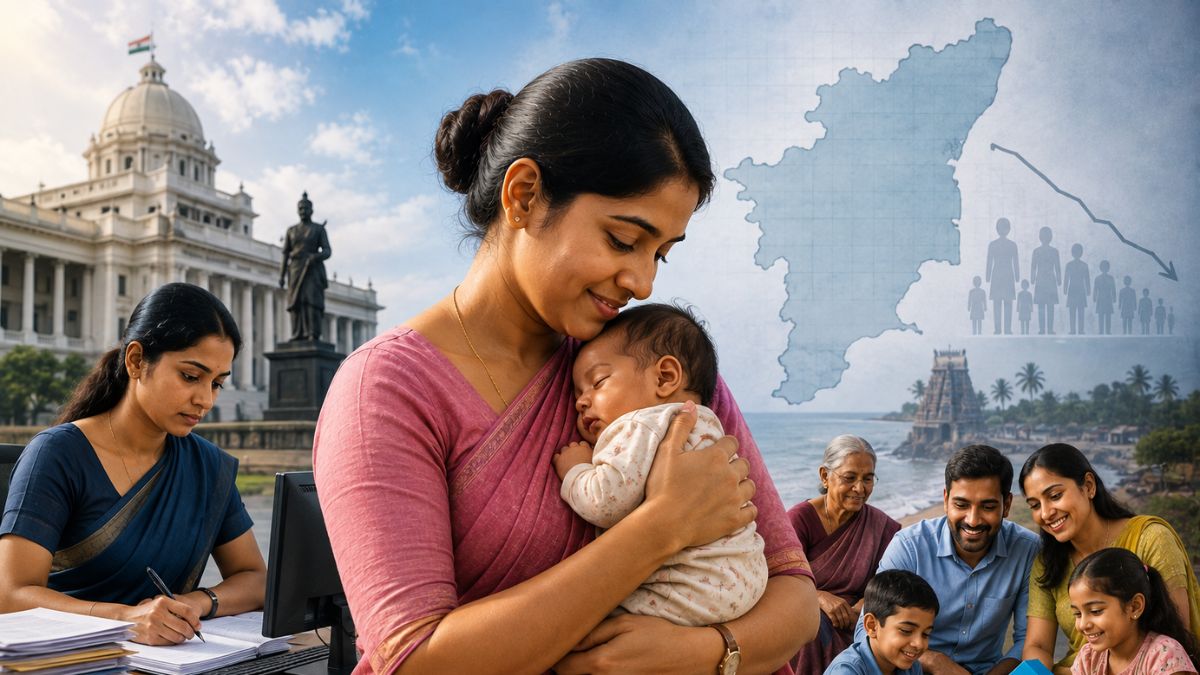
Tamil Nadu has changed a rule about maternity leave for government employees.
Women having a third child can now receive up to 365 days of leave, instead of only 12 weeks.
The state once encouraged families to have fewer children.
Now, fewer babies are being born, and the population is getting older.
This could mean fewer working-age people in the future to support older residents.
Tamil Nadu is also worried that population-based changes to political districts could reduce its influence in Parliament.
Some court decisions disagreed about whether the shorter leave rule was valid.
The longer leave may help women care for babies without leaving government jobs.
However, it is not a benefit offered to every woman in Tamil Nadu and is not officially presented as a programme to increase births.

Tamil Nadu restored 365 days of maternity leave for state employees having a third child.
The policy reverses a March 2026 rule that had limited such leave to 12 weeks.
The change comes as Tamil Nadu’s fertility rate falls below replacement level and its elderly population grows.
State leaders are also concerned that future delimitation could reduce Tamil Nadu’s relative representation in the Lok Sabha.
The leave policy supports working mothers, but the government has not described it as a direct population-growth programme.
- Who
- The Tamil Nadu government and women employed by the state government are directly involved; state ministers, courts and political parties are also part of the broader debate.
- What
- Tamil Nadu restored one year of maternity leave for government employees having a third child after previously imposing a 12-week limit.
- Where
- Tamil Nadu, with related delimitation concerns discussed in the Lok Sabha and at an all-party meeting in Chennai.
- When
- The restoration was announced on August 18, 2026; the restrictive rule had been introduced in March 2026.
- Why
- The decision reverses a recent administrative restriction and supports women combining childbirth with government employment amid concerns about low fertility and population ageing.
Supporters of Restoration
Supporters of Restriction
Length of third-child leave
Supporters of Restoration
A full year treats third-child pregnancies like the first two and gives women more time for post-natal care while remaining in government employment.
Supporters of Restriction
The previous 12-week limit reflected the March 2026 administrative rule for employees with two or more surviving children.
Demographic policy
Supporters of Restoration
With fertility below replacement level and the elderly population increasing, policies that make childbearing compatible with work may support demographic sustainability.
Supporters of Restriction
Maternity leave is limited to state employees and has not been presented by the government as a universal fertility incentive or population-growth programme.
Population and political representation
Supporters of Restoration
Tamil Nadu argues that states that successfully reduced fertility should not lose political representation through population-based delimitation.
Supporters of Restriction
Redistributing seats according to population could increase representation for faster-growing states, although the precise outcome remains unsettled after the proposed expansion bill failed.
Key facts
- Restored leave
- 365 days for Tamil Nadu state government employees having a third child.
- Previous limit
- 12 weeks under a March 2026 rule applying to employees with two or more surviving children.
- Tamil Nadu fertility rate
- 1.7 children per woman in NFHS-6 (2023-24), down from 1.8 in NFHS-5 (2019-21).
- Elderly population
- People aged 60 and above made up 13.6% of Tamil Nadu’s population in 2021 and are projected to represent 18.2% by 2031.
- Court rulings
- A Madras High Court Division Bench set aside the restriction in April 2026, while another Division Bench upheld the 12-week limit in June.
- Delimitation bill
- The Constitution (131st Amendment) Bill, 2026, was defeated in the Lok Sabha on April 17, 2026, receiving 298 votes against the 352 required.
- Potential seat change
- A PRS Legislative Research projection said Tamil Nadu could fall from 39 to 32 seats under one population-based scenario, while Amit Shah cited a different 39-to-59 projection based on an expansion bill that failed.
Sources
Related news

Tamil Nadu Maternity Leave Highlights South India's Fertility Challenge

Tamil Nadu Third-Child Maternity Leave Plan Sparks Political Debate

Tamil Nadu Extends Paid Maternity Leave for Third Child
Tamil Nadu weighs incentives for larger families as fertility declines
Tamil Nadu Third-Child Leave Plan Sparks Large-Family Debate
Tamil Nadu Shifts Family Planning From Population Control to Well-Being

Two Years After RG Kar Doctor's Rape-Murder, Case Remains Unresolved

ED widens Chhattisgarh probes with two arrests and searches

Delhi High Court Orders Madhya Pradesh to Pay Advocate Dues
Haryana sanitation workers’ strike puts BJP government under pressure

Orissa High Court Says Brothel Customers Cannot Face Trafficking Charges