

1 month ago
India's Education System Emphasizes Industry-Academia Collaboration
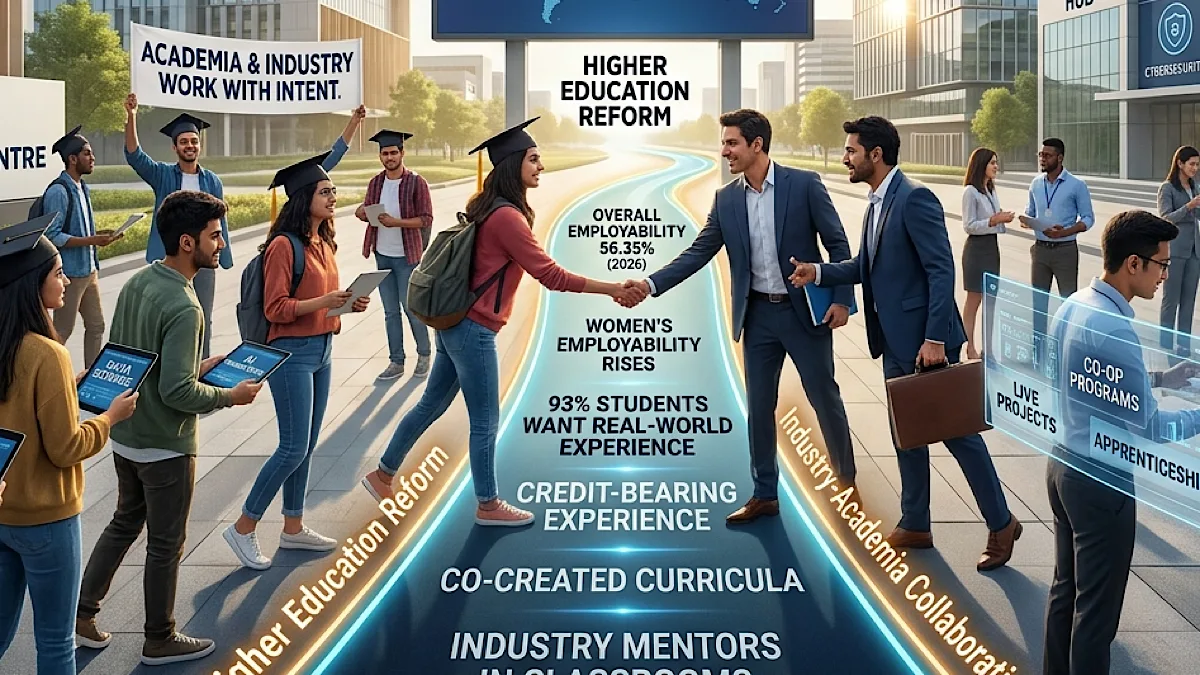
In India, universities and industries are realizing they need to work together more closely.
Right now, students learn a lot in school, but when they start jobs, they often find that what they learned doesn't match what companies need.
This is because the world is changing so fast that schools can't keep up.
Other countries, like Canada and Germany, have already started mixing school learning with real-world work experience.
In India, more students are getting jobs, but many still struggle to find work because their skills don't match what companies want.
To fix this, schools and companies need to work together to create better courses, offer more internships, and bring industry experts into the classroom.
This way, students will be better prepared for the real world when they graduate.

India's employability rate has improved to 56.35% in 2026, but there's still a gap between academic knowledge and industry needs.
Women's employability has surpassed men's for the first time in five years, aided by hybrid work and digital skilling.
93% of students want internships and real-world experience, highlighting the need for more practical learning opportunities.
Collaboration between academia and industry includes co-created curricula, credit-bearing internships, and industry mentors.
India's National Education Policy supports multidisciplinary learning and vocational integration, but implementation requires sustained effort.
- Who
- Indian universities, industry leaders, students
- What
- The need for stronger collaboration between academia and industry in India's education system
- Where
- India
- When
- Ongoing, with recent improvements and future reforms
- Why
- To bridge the gap between theoretical knowledge and practical skills, ensuring graduates are job-ready
Traditional Education System
Industry-Academia Collaboration
Curriculum Relevance
Traditional Education System
Traditional curricula are designed by academics and may not keep up with rapid industry changes.
Industry-Academia Collaboration
Co-created curricula with industry practitioners ensure relevance and up-to-date knowledge.
Student Experience
Traditional Education System
Students gain theoretical knowledge but may lack practical skills needed in the workplace.
Industry-Academia Collaboration
Embedded, credit-bearing internships and live projects provide real-world experience.
Research Focus
Traditional Education System
Academic research may be disconnected from real-world problems, lacking practical application.
Industry-Academia Collaboration
Collaborative research addresses actual industry and societal challenges, enhancing its impact.
Key facts
- Overall Employability in India
- 56.35% in 2026
- Women's Employability
- Overtaken men's for the first time in five years
- Students Wanting Internships
- 93%
- Key Collaboration Practices
- Co-created curricula, embedded internships, industry mentors
- National Education Policy
- Supports multidisciplinary learning and vocational integration
Sources
Related news

Trump to meet mining CEOs in critical minerals push

UK and Ukraine Open Battlefield AI Partnership Amid War

Andhra Pradesh steps up lithium, gallium exploration in Kadapa basin

Trump administration promises $3 billion for critical minerals and batteries

Andhra Pradesh's lithium and gallium exploration expands critical mineral push

NCERT Prepares Classes 10-12 Textbooks For Responsible AI Use

Ramesh Seeks Funds for 13 JNVs and Two AIIMS

Andhra Pradesh Government Schools Told to Prioritize Practical Skills

West Bengal, UNICEF Begin Workshop on Inclusive Education

India’s Exam Reform Must Begin in the Classroom
