1 hr ago
Gujarat Has Potential to Lead India’s Renewable Hydrogen Production
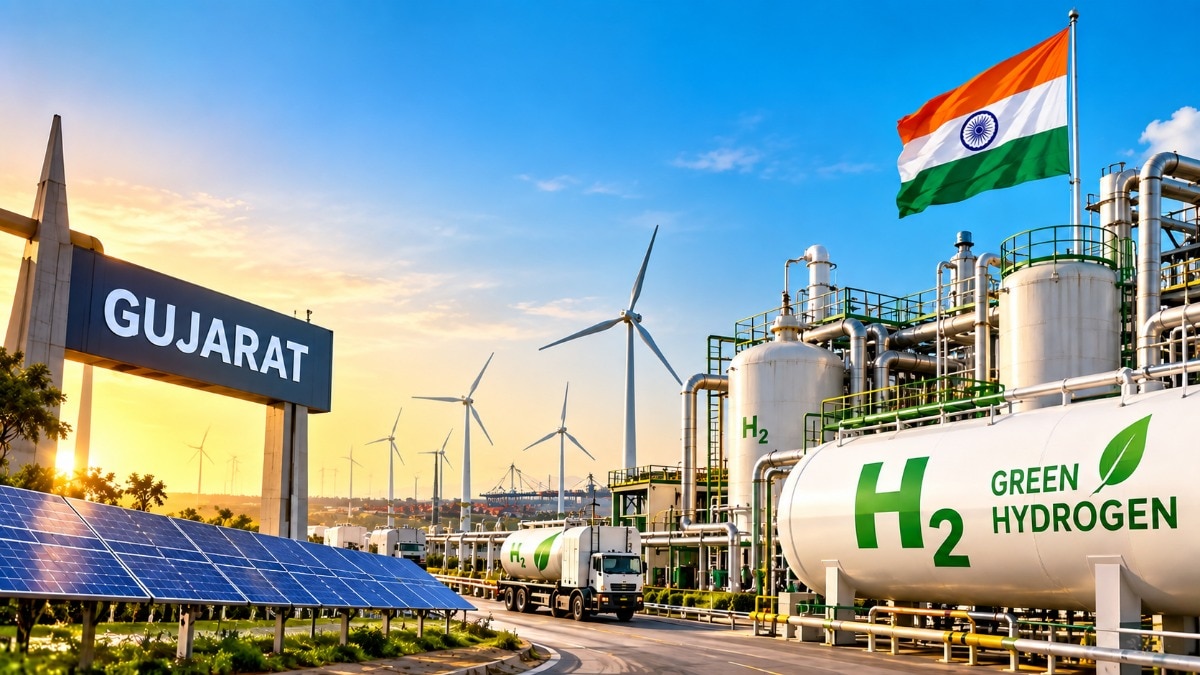
Gujarat wants to become an important producer of renewable hydrogen and ammonia.
Its policy is newer than policies in some other Indian states.
The target is seen as realistic compared with others, but it will still be difficult to achieve.
Gujarat already has many refineries and ammonia plants.
It also has a large amount of solar and wind power.
This electricity can help machines called electrolysers produce hydrogen.
Existing gas pipelines, power lines and ports could make transport easier.
However, Gujarat would need government support because Middle Eastern products can cost less in European markets.

Gujarat’s newer renewable hydrogen policy is considered more realistic than similar targets elsewhere, though highly ambitious.
The state has about 40% of India’s refinery capacity and roughly 30% of its ammonia capacity.
Nearly 50 gigawatts of combined solar and wind capacity could support electrolyser operations.
Existing gas networks, electricity infrastructure, ports and transmission lines could help expand hydrogen production and distribution.
Government grants and incentives may be needed because Middle Eastern exports are cheaper in Europe.
- Who
- Gujarat, with support from the state and Indian governments, is the focus of the renewable hydrogen expansion.
- What
- The state is seeking to develop large-scale renewable hydrogen and renewable ammonia production.
- Where
- Gujarat, with potential exports to Europe.
- When
- The assessment refers to Gujarat’s recent policy and recent Solar Energy Corporation of India Ltd. tenders.
- Why
- The state has substantial refinery, ammonia, renewable-energy, electricity, gas-network and port infrastructure, but financial support is needed to remain competitive.
Reasons for optimism
Reasons for caution
Policy ambition
Reasons for optimism
Gujarat’s more recent state policy is considered more realistic than targets set under older policies in other states.
Reasons for caution
The target remains highly ambitious even if it is viewed as comparatively realistic.
Infrastructure
Reasons for optimism
Existing natural-gas networks, electricity infrastructure, transmission lines and ports could support hydrogen production, transport and exports.
Reasons for caution
Infrastructure alone may not ensure success, and domestic production incentives would still be required.
International competitiveness
Reasons for optimism
Gujarat’s west-coast location offers ammonia shipping costs of $30-$40 per metric ton to Europe.
Reasons for caution
Middle Eastern products are reportedly $30-$40 per metric ton cheaper in Europe, requiring state grants and federal support.
Key facts
- Refinery capacity
- Approximately 40% of India’s refinery capacity is located in Gujarat.
- Ammonia capacity
- About 30% of India’s ammonia capacity is based in Gujarat.
- Renewable capacity
- Gujarat has nearly 50 gigawatts of combined solar and wind capacity.
- Electricity infrastructure
- The state has the highest electricity generation capacity among Indian states.
- Maritime trade
- At least 40% of India’s maritime trade enters through ports in Gujarat.
- West-coast freight
- Ammonia freight from India’s west coast to Europe costs $30-$40 per metric ton.
- Competitive challenge
- Middle Eastern products are reported to be $30-$40 per metric ton cheaper in Europe.
Quotes
The cited policy analysis
An unnamed analysis cited in the article assessing Gujarat’s hydrogen policy and targets
“Gujarat’s state policy is more recent than legislation from other states, so this target is likely more realistic than others, but is still highly ambitious.”
 businesstoday.in
Sources
Related news
Gujarat’s ₹5,300-Crore Grid Project Targets 14 GW Renewable Power
Green Hydrogen Could Recast India-EU CBAM Challenge Into Opportunity
Gujarat Courts Investors as Trusted Partners Ahead of 2027 Summit

Gujarat CM Meets Ambanis Ahead of 2027 Global Summit

Brookfield’s $600 Million Bet Targets India’s Green-Molecule Scale-Up
Rajasthan Targets 125 GW Renewable Capacity by 2030

Mafalda Finally Breaks Through In English After 62 Years
Suzlon Targets India’s 30 GW Wind Repowering Opportunity

Lord's Mark Advances AI Breast Screening Toward Final Trials
Hyderabad, Brussels Airports Sign MoU to Expand Cargo Links