

1 day ago
Bond Yields Hit Three-Year High: Should Investors Shift SIPs?
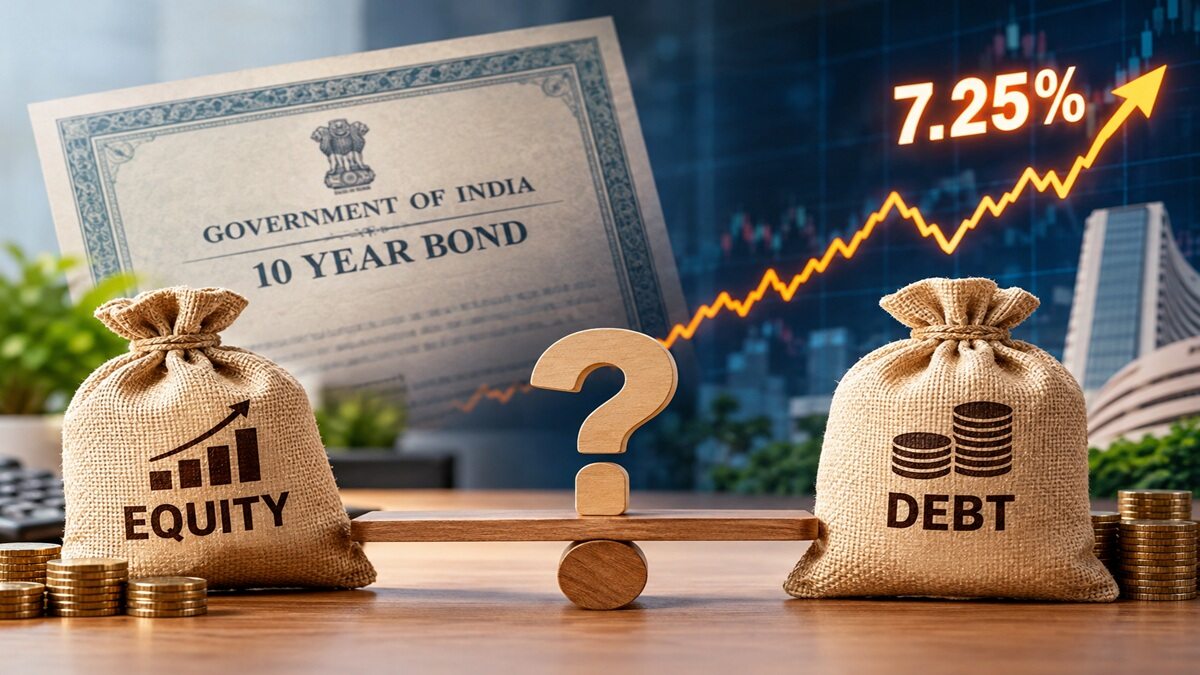
Government bond yields in India have risen to their highest level in nearly three years.
A higher yield can make new bonds and some debt investments more appealing.
But when interest rates rise, older bonds can lose value, which may lower the value of debt funds that own them.
Funds with longer-term bonds can move up and down more than funds with shorter-term bonds.
Shares and bonds serve different purposes in a savings plan.
The article says investors should not stop long-term share investments just because bond yields are higher.
Instead, they can check whether their mix of shares and bonds still fits their goals.
Some investors may choose to add money to bonds gradually, while keeping in mind that yields could rise further.

India’s 10-year government bond yield reached 7.28%, its highest level in nearly three years.
The Reserve Bank of India raised its repo rate by 25 basis points to 5.50% and shifted its stance to calibrated tightening.
Higher yields can make fresh fixed-income investments more attractive, but bond prices and debt-fund NAVs can fall if yields rise further.
Long-duration and gilt funds are more sensitive to interest-rate changes than short-duration funds.
Experts advise reviewing target allocations and rebalancing gradually, rather than stopping long-term equity SIPs solely because yields are high.
- Who
- Indian retail investors, equity SIP investors, and fixed-income investors.
- What
- The 10-year government bond yield rose to 7.28%, prompting discussion of debt investments, bond risks, and whether investors should change equity SIPs.
- Where
- India, with global bond-market conditions, including US Treasury yields, also affecting the outlook.
- When
- The yield was reported at 7.28%; the RBI raised its repo rate on October 7 and announced liquidity measures on October 9.
- Why
- Inflation concerns, higher crude oil prices, rupee pressure, global borrowing costs, RBI policy, and government bond supply are contributing to higher yields.
Reasons to consider debt investments
Reasons for caution
Attractiveness of current yields
Reasons to consider debt investments
The yield above 7.25% improves the starting point for fresh fixed-income investments and may make government securities and debt funds more appealing.
Reasons for caution
A high yield does not establish that yields have peaked; inflation, oil prices, RBI policy, and global yields could keep them volatile or push them higher.
Changing equity SIPs
Reasons to consider debt investments
Investors whose portfolios have drifted above their intended equity allocation, or who are nearing a goal, may rebalance some money towards debt.
Reasons for caution
A higher bond yield alone is not a reason to stop a long-term equity SIP; equities and debt have different roles and allocations should reflect goals and risk tolerance.
Choosing longer-duration debt
Reasons to consider debt investments
Longer-duration bonds offer higher yields, and their prices may rise if yields fall.
Reasons for caution
Their prices and fund NAVs can fall more sharply if yields rise further; short-duration funds are generally less sensitive, though not risk-free.
Key facts
- India 10-year government bond yield
- 7.28%, its highest level in nearly three years
- RBI repo rate
- Raised by 25 basis points to 5.50% on October 7
- RBI policy stance
- Changed from neutral to calibrated tightening
- Inflation forecast
- Raised to 5.2% for the current financial year, from 5% earlier
- GDP growth forecast
- Raised to 7.1%, from 6.7% earlier
- RBI bond sale plan
- Announced sale of Rs 25,000 crore of government bonds through open market operations on October 9
- Bank cash reserve requirement
- Daily CRR maintenance requirement to rise from 90% to 99%, effective October 16
- US 10-year Treasury yield
- Around 5.23% as of October 9
Sources
Related news

US Bond Yields Rise, Creating NPS Debt Volatility

India bond yields above 7% make 3–5-year debt attractive

RBI Rate Hike Puts 7.25% Bond Yield Level in Focus

High-Yield Long-Duration Funds Face Risk From Further Rate Hikes

RBI Rate Hike Spurs Preference for Shorter-Term Debt Funds
7% Government Bonds Versus FDs: Which Suits Conservative Investors?

Ansar Shaikh’s Journey From Hardship to IAS Perseverance

Supreme Court Promises Hearing for All Over Delhi Protest Clampdown

Punjab Cricketer Nikhil Chaudhary's Unforeseen Journey to Australia

India Cuts Child Marriage, but Millions of Girls Remain at Risk

Honda 0 Alpha EV Set for Global Launch in 2027
