

1 day ago
Chhattisgarh High Court Rejects Plea To Replace ED-Attached Properties

The Enforcement Directorate had attached six properties connected to an investigation into alleged misuse of District Mineral Fund money.
Hrishabh Soni and Komal Soni asked to replace those properties with a fixed deposit worth Rs 4.36 crore.
They said keeping the properties attached was hurting their business.
The Enforcement Directorate opposed the request.
It said the law does not generally allow attached property to be exchanged for a fixed deposit.
The High Court agreed that the couple had no legal right to demand this substitution.
The court also said one rule allows limited substitutions only at the authorities’ discretion.
Because the attachment is still being challenged before the specialist tribunal, the High Court dismissed the petition.

The Chhattisgarh High Court dismissed Hrishabh and Komal Soni’s plea to replace six attached properties with a Rs 4.36-crore fixed deposit.
The properties were provisionally attached by the Enforcement Directorate on December 9, 2024, over alleged District Mineral Fund irregularities.
The attachment was confirmed by the Adjudicating Authority on May 23, 2025, and challenges remain pending before the PMLA Appellate Tribunal.
The court held that the Prevention of Money Laundering Act and its rules provide no general right to substitute attached property with a fixed deposit.
It said financial hardship and an offer of equivalent security could not override the statutory scheme or justify intervention under Article 226.
- Who
- Hrishabh Soni and Komal Soni sought relief against the Enforcement Directorate’s property attachment; the Enforcement Directorate opposed the plea.
- What
- The Chhattisgarh High Court dismissed a petition seeking to replace six attached properties with a fixed deposit of Rs 4.36 crore.
- Where
- The case was decided by the Chhattisgarh High Court in Bilaspur.
- When
- The properties were provisionally attached on December 9, 2024; the attachment was confirmed on May 23, 2025; the High Court dismissed the writ petition after the Tribunal rejected substitution applications on April 7, 2026.
- Why
- The court held that the Prevention of Money Laundering Act and its rules do not create a general right to substitute attached immovable property with a fixed deposit.
Petitioners’ position
Enforcement Directorate and court’s position
Replacing the properties
Petitioners’ position
The petitioners offered a liquid fixed deposit of equal value and argued that the properties were attached only as equivalent value, not as direct proceeds of crime.
Enforcement Directorate and court’s position
The Enforcement Directorate said there is no general statutory provision permitting such substitution, and the court held that an equivalent deposit does not create a legal right to replacement.
Financial hardship
Petitioners’ position
The petitioners said continued attachment was causing financial hardship and impairing their business activities.
Enforcement Directorate and court’s position
The court held that hardship alone cannot override the statutory scheme, particularly while the validity of the attachment remains pending before the Tribunal.
High Court intervention
Petitioners’ position
The petitioners argued that the High Court could mould relief under Article 226 even if the Tribunal lacked the power to order substitution.
Enforcement Directorate and court’s position
The Enforcement Directorate said the petitioners should have used the statutory appeal under Section 42 of the PMLA, and the court relied on the principle that an efficacious special-statute remedy ordinarily limits Article 226 intervention.
Key facts
- Attached properties
- Six immovable properties
- Proposed substitute
- A fixed deposit worth Rs 4.36 crore
- Provisional attachment
- December 9, 2024
- Attachment confirmation
- May 23, 2025, by the Adjudicating Authority
- Tribunal decision
- The PMLA Appellate Tribunal rejected the substitution applications on April 7, 2026
- Court outcome
- Writ petition dismissed with no order as to costs
- Relevant law
- Prevention of Money Laundering Act and Rule 5(5) of the 2013 Rules
Sources
Related news

Mumbai Court Allows ₹33.02 Crore Choksi Rental Income Fixed Deposit

Delhi High Court Says ED Cannot Revive Closed PMLA Case
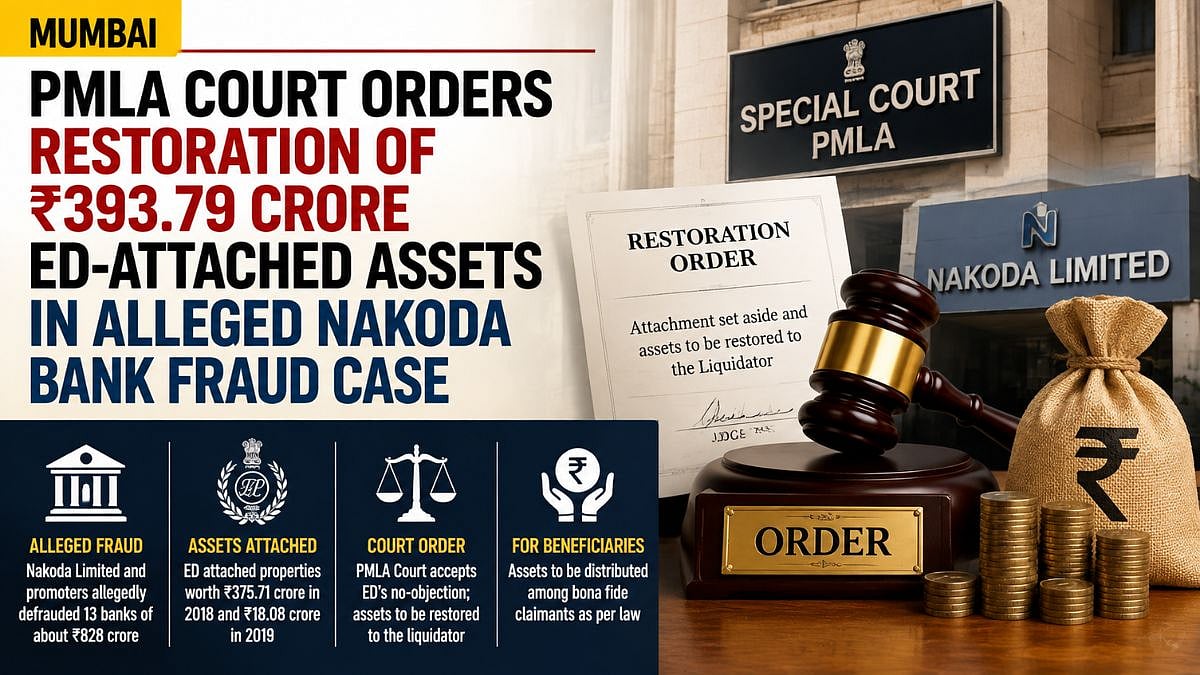
Mumbai PMLA Court Orders Restoration of ₹393.79 Crore ED-Attached Assets

ED Freezes Rs 51.75 Crore Deposit in DHFL Fraud Probe

Bombay HC says Vijay Mallya asset dispute should end
Businessman arrested in Chhattisgarh DMF money laundering case

ED widens Chhattisgarh probes with two arrests and searches

Four-Time India Gold Medallist Drives Cab Amid Support Wait

BJP opposes Kerala CM’s promise to Dalit Christians

Heavy Rain Threatens Central India as Cities Expect Showers
