

2 weeks ago
Knowing a Story Is AI-Generated Ruins Reader Enjoyment, Study Finds
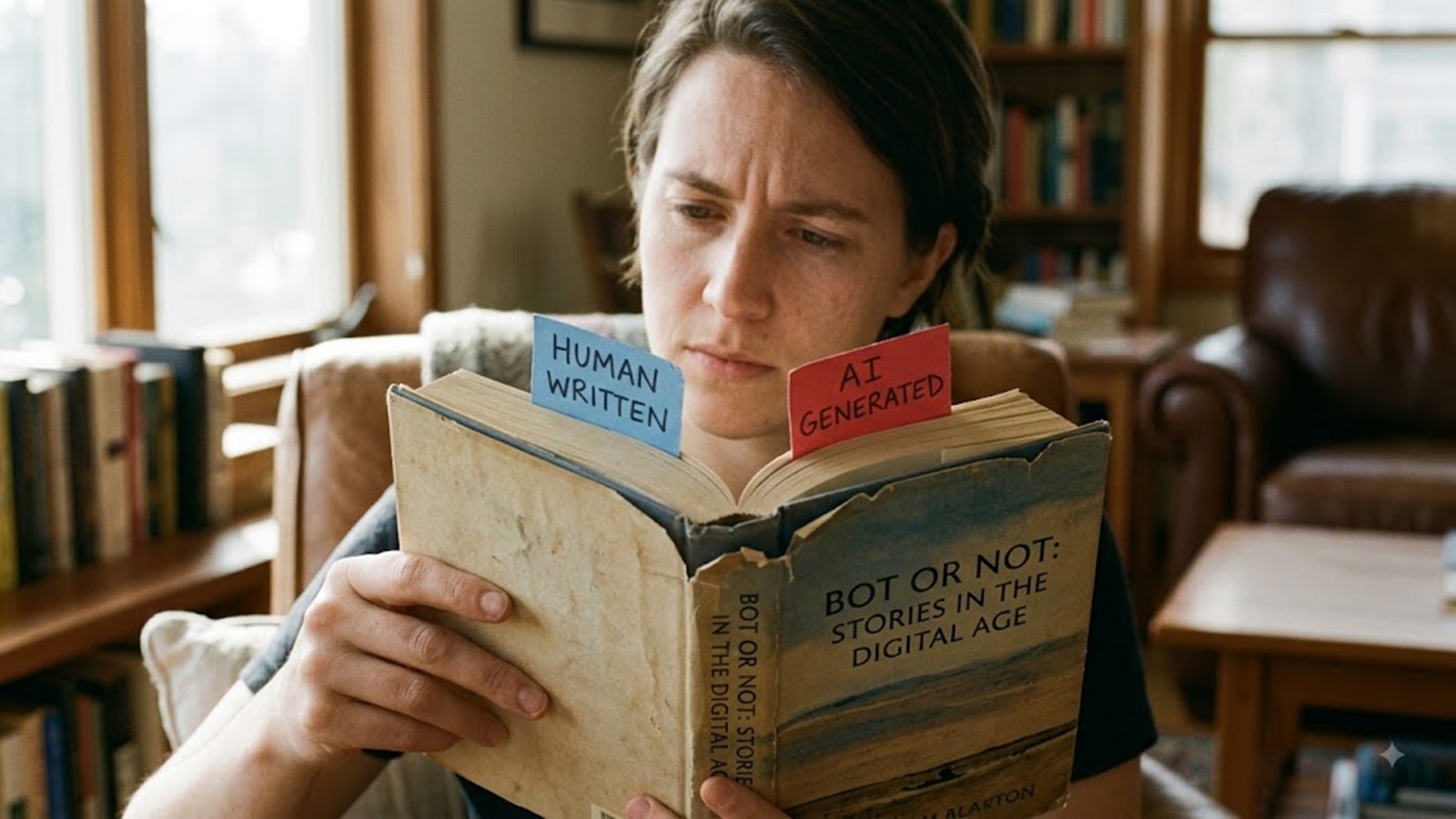
Scientists wanted to know if people can tell whether a story was written by a human or by a computer.
They asked almost 2,600 people to read short stories.
Some stories were written by people, and some were made by a computer.
Most people could not tell which was which.
In fact, people liked the computer stories a little more!
But when people were told that a story was made by a computer, they liked it less.
This is called 'algorithm aversion' — we trust machines less than we trust people.
It is like a robot baking a delicious cake; the cake might taste great, but knowing a robot made it can change how you enjoy it.
People value human effort, feelings, and real experiences when they read.
Computers can write smoothly, but smooth words are not the same as meaning.
Grown-ups are still figuring out how to handle computer-written stories in books and magazines.

A study of 2,587 people in the United States found readers rated AI-generated short stories higher than human-written ones when they did not know the origin.
Once participants were told a story was AI-generated, they penalised it, a pattern researchers described as a textbook case of 'algorithm aversion'.
Participants could not reliably tell human from AI fiction: 39.4 per cent guessed correctly in one experiment and performance was effectively random at 52 per cent in another.
Researchers suggested AI stories were preferred because they are more fluent, easier to comprehend, and more emotionally upbeat than human texts.
The study follows AI literary controversies, including alleged AI use by Commonwealth Short Story Prize finalists and debate over detection tools like Pangram.
- Who
- Researchers Sydney Sears and Dr Deena Skolnick Weisberg of Villanova University, along with 2,587 participants from the United States.
- What
- A study found readers preferred AI-generated short stories over human-written ones unless they knew the stories were AI-made, and could not reliably tell the difference between the two.
- Where
- The United States, where all participants were recruited; the study was published by Cambridge University Press.
- When
- Published online on August 5 in the journal Judgment and Decision Making.
- Why
- To test whether people can distinguish human-written from AI-generated stories and how knowing a story's origin affects their judgement of it.
Human-Writing Advocates
AI-Writing Supporters
Quality of AI fiction
Human-Writing Advocates
Human writing reflects real experiences, emotions, and personal stakes; imperfections signal individuality and sincerity, and effort itself has meaning.
AI-Writing Supporters
Readers rated AI-generated stories as superior in quality and more absorbing when they did not know the origin; AI text tends to be more fluent, easier to comprehend, and more upbeat.
AI detection in publishing
Human-Writing Advocates
Authors can face damaging false accusations - such as the controversy around Daggermouth author H M Wolfe - even when publishers and fans back them.
AI-Writing Supporters
Figures like Jane Friedman expect more literary agencies to use AI detection tools such as Pangram, describing it partly as a protective action for everyone involved, with disclosure on submission guidelines pages.
Ability to spot AI writing
Human-Writing Advocates
Experienced readers such as content producer Sneha Sharma say people can immediately identify AI writing because it has easily identifiable tells and lacks human quirkiness.
AI-Writing Supporters
Controlled experiments found no general evidence that participants could distinguish human-written from AI-generated stories, with accuracy near random levels.
Key facts
- Study title
- Bot or not: Can people tell the difference between stories written by a human or by an AI system?
- Journal
- Judgment and Decision Making (Cambridge University Press)
- Publication date
- August 5
- Researchers
- Sydney Sears and Dr Deena Skolnick Weisberg, Villanova University
- Participants
- 2,587 people from the United States
- AI model used
- OpenAI's ChatGPT 4.0
- Identification accuracy
- 39.4% in one experiment; 52% (effectively random) in another
- Key finding
- Readers prefer AI-generated stories while believing these stories are worse
Quotes
Dr. Munia Bhattacharya
Senior consultant psychologist and department head at Marengo Asia Hospital
“"People’s distrust is embedded in the word ‘artificial’, and an inherent denial that the machine might be able to outdo a human being when it comes to creativity."”
 indianexpress.com
“"AI is driven by data, not personal experience. That feels alien to us."”
indianexpress.com
Sydney Sears
University professor and study author
“"People actually prefer AI-generated stories while believing that these stories are worse"”
indianexpress.com
Sources
Related news

Study Finds AI-Generated Stories Rated More Engaging Than Human Ones

AI accusations against authors of colour spark publishing bias debate
AI Detection Tools Bring Accuracy Questions and Distrust to Writing

Writers Fear AI Accusations More Than Blank Pages
AI Slop Detector Excels at Text, Struggles With Images
