1 hr ago
Waste Cooking Oil May Enable More Recycled Asphalt in Roads
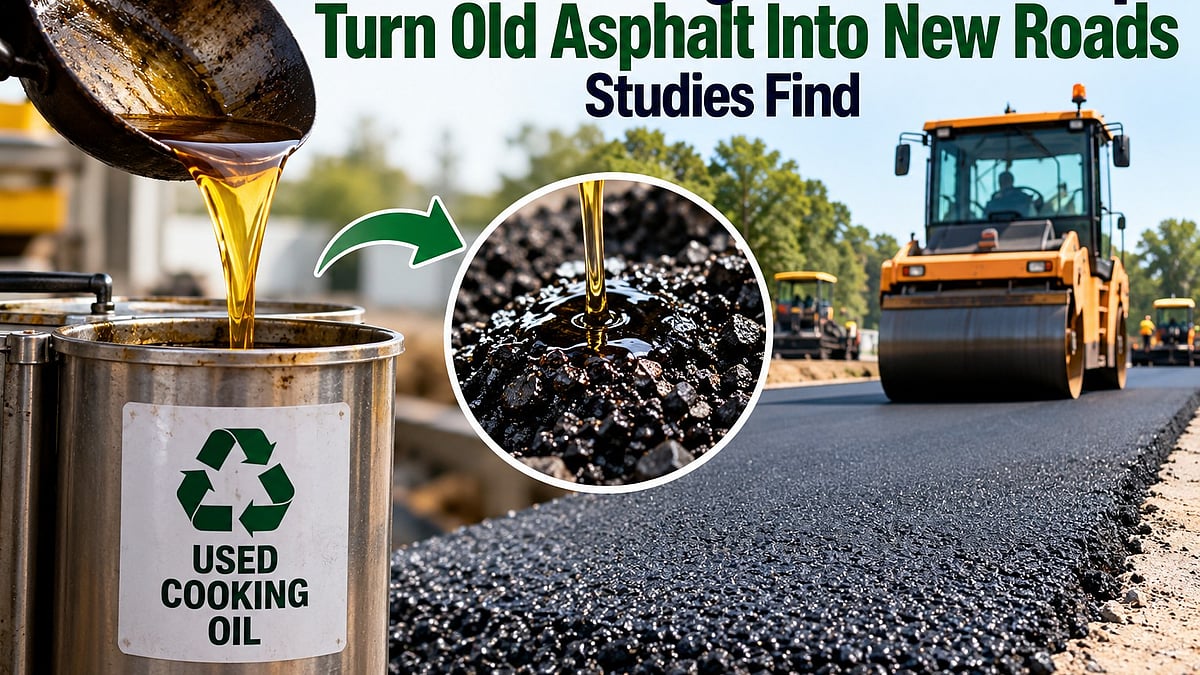
Old road asphalt becomes hard and can be difficult to reuse.
Scientists tested whether used cooking oil could soften it.
This may allow new roads to contain more recycled pavement.
A 2019 study tested mixtures with as much as 100% recycled material.
The right amount of oil improved performance in cold temperatures and helped compact the mixtures.
Too much oil made the asphalt weaker against tire grooves, water, and ageing.
Rubber from recycled tires and special additives helped address some problems.
More testing on real roads is needed before this method can be widely used.

Laboratory studies found waste cooking oil can soften aged asphalt binder.
A 2019 study designed mixtures containing 60% to 100% recycled material.
Adding 10% to 16% oil improved aged binder’s low-temperature properties.
Excessive oil reduced resistance to rutting, moisture, and long-term ageing.
A 2025 study found optimum formulations could match conventional asphalt under laboratory conditions.
- Who
- Researchers Hamed Majidifard, Nader Tabatabaee, William Buttlar, Shobhit Jain, and Anush K Chandrappa conducted the cited studies.
- What
- Laboratory studies examined whether waste cooking oil could soften aged asphalt and increase the amount of recycled pavement in new road mixtures.
- Where
- Testing was conducted in laboratories, including the Asphalt Pavement Lab at Sharif University of Technology in Iran.
- When
- The studies were published in 2019 and 2025.
- Why
- Researchers sought to reuse waste cooking oil, reduce demand for new asphalt materials, and enable higher recycled content in pavement.
Potential Benefits
Performance Concerns
Higher recycled content
Potential Benefits
Waste cooking oil can soften aged asphalt binder, helping mixtures incorporate large amounts of reclaimed pavement.
Performance Concerns
The suitable oil quantity depends on the materials and conditions, and adding more oil does not automatically improve the mixture.
Pavement performance
Potential Benefits
Optimum oil levels improved low-temperature properties, and the 2025 study found comparable rutting and cracking resistance to conventional hot-mix asphalt under tested conditions.
Performance Concerns
Higher oil levels reduced rutting and moisture resistance, while acidic oil increased moisture susceptibility in the 2025 tests.
Readiness for road use
Potential Benefits
Crumb rubber and antistripping agents improved some weaknesses, suggesting formulations can balance competing performance requirements.
Performance Concerns
The findings come from laboratory tests, so field studies are still needed to assess traffic, weather, seasonal temperatures, and long-term ageing.
Key facts
- 2019 study
- Tested asphalt mixtures containing 60% to 100% recycled material with waste cooking oil.
- 2025 study
- Assessed rutting, fatigue, durability, and moisture susceptibility in recycled asphalt mixtures.
- Low-temperature improvement
- Adding 10% to 16% oil shifted the aged binder’s low-temperature grade from about −10°C to between −22°C and −28°C.
- Major trade-off
- A mixture containing 16% oil lost about 43% of its wet tensile strength compared with a corresponding mixture without oil.
- Rubber addition
- Crumb rubber from recycled tires improved rutting and moisture resistance in tested mixtures.
- Ageing result
- A recycled binder containing 2.9% oil reached a specified cold-cracking threshold after 51 hours of simulated ageing, compared with 80 hours for fresh binder.
- Research limitation
- Both cited studies were laboratory-based and did not establish long-term performance on actual roads.
Sources
Related news
Hawaii Tests Recycled Plastic Asphalt on Oahu Road

Andhra Pradesh Tests Danish Fibre Technology Against Potholes

NIT Rourkela Develops Coal-Waste Material for Stronger Roads

PETRONAS Lubricants India, Tata Motors Sign Used-Oil Recycling MoU
Damaged Barkatpura Road Triggers Jams and Accident Concerns

Jindal Steel builds world's longest steel slag road in India