2 days ago
Chimp Interactions Offer Clues to the Origins of Pet-Keeping
Scientists saw two young chimpanzees gently combing a monkey’s tail in Uganda.
Chimpanzees often act aggressively toward other species, so this was unusual.
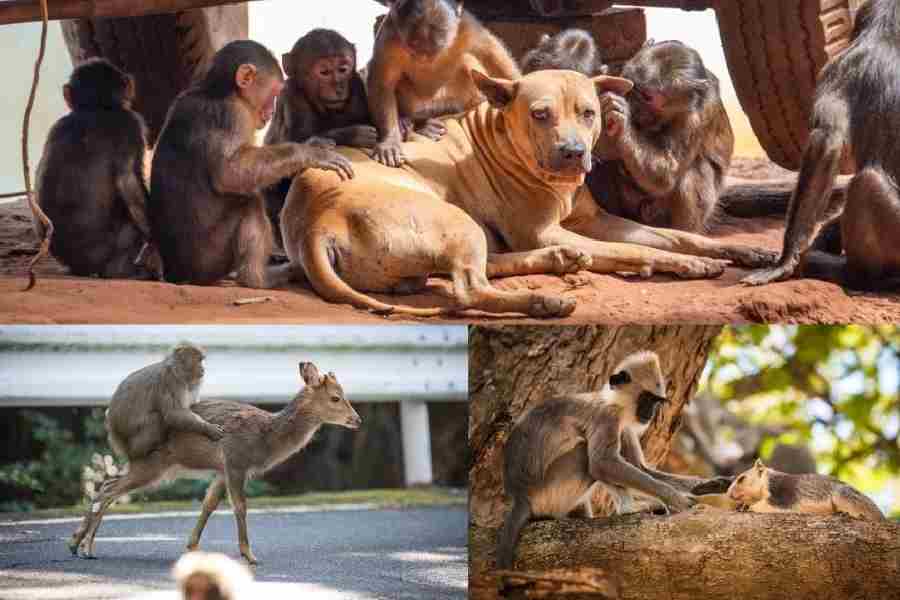
Researchers collected 427 examples of primates interacting with animals from other species.
These interactions included playing, grooming, nursing, and sometimes caring for young animals.
Some monkeys even formed strong bonds with animals such as chickens or baby marmosets.
The scientists think these behaviors could show how caring for other animals developed.
However, wild primates do not keep pets in homes the way people do.
The animals may sometimes seek friendship or comfort when they feel lonely.
Studying them could help explain why humans enjoy having animal companions.

Researchers observed young chimpanzees in Uganda grooming a red-tailed monkey instead of attacking it.
A study in Primates analyzed 427 reports involving 88 primate species and unrelated animals.
The interactions included grooming, play, nursing, adoption-like care, and occasional aggression.
Researchers say these behaviors may reveal ingredients of pet-keeping but are not equivalent to human pets.
Possible motivations include loneliness, social connection, novelty, usefulness, and a tendency to care for other beings.
- Who
- Researchers led by Cyril Grueter studied interactions involving chimpanzees, monkeys, apes, and other animals.
- What
- The study examined whether interspecies primate interactions could offer clues about the origins of pet-keeping.
- Where
- The featured chimpanzee interaction occurred in a reserve in Uganda, while the evidence came from reports and literature involving wild and captive primates.
- When
- The study was published recently in the journal Primates; the observation’s exact date was not given.
- Why
- Researchers wanted to understand the evolutionary roots of humans’ tendency to bond with and care for animals.
Possible Roots of Pet-Keeping
Limits of the Comparison
Meaning of interspecies care
Possible Roots of Pet-Keeping
Grooming, playing with, nursing, or adopting animals from another species may represent early ingredients of pet-keeping and may reflect a desire for companionship or intimacy.
Limits of the Comparison
The observed relationships were usually brief, and researchers said there is no real equivalent of human pet-keeping among nonhuman primates.
Why animals form these bonds
Possible Roots of Pet-Keeping
Loneliness, social connection, and a natural tendency to care for other living beings may motivate the behavior.
Limits of the Comparison
The available examples do not establish a single explanation; animals may also interact because of usefulness, novelty, or other individual circumstances.
Evolutionary significance
Possible Roots of Pet-Keeping
Studying primate interactions could help explain how humans’ relationships with animals developed beyond practical uses such as hunting or protection.
Limits of the Comparison
Researchers lack enough historical evidence to determine when human pet-keeping began or whether these primate behaviors directly led to it.
Key facts
- Study journal
- Primates
- Evidence collected
- 427 recorded interactions
- Primate species covered
- 88 species
- Featured animals
- Ishe and Dembe, two young eastern chimpanzees, and a red-tailed monkey
- Common behaviors
- Play and grooming
- Other reported behaviors
- Nursing, adoption-like care, social bonding, and aggression
- Earliest archaeological evidence of pets
- A 14,000-year-old German grave containing a man, a woman, and a dog
Quotes
Cyril Grueter
Biological anthropologist and primatologist at the University of Oxford
“Lavishing resources on members of other species we have no evolutionary stake in seems to make no evolutionary sense.”
 telegraphindia.com
“There’s no real equivalent of pet-keeping in nonhuman primates”
telegraphindia.com
Zoë Goldsborough
Behavioural ecologist at the Max Planck Institute of Animal Behavior
“There are theories that pet-keeping began either because animals were useful for tasks like hunting and protection or because humans have a natural tendency to care for and bond with other living beings.”
telegraphindia.com
Sources
Related news

Advocate’s Journey From Not a Pet Person to Cat Parent

Sleeping With Your Dog May Boost Happiness, Raise Hygiene Concerns

Dog brains evolved to understand humans, Harvard study finds
World Elephant Day: Seven Human-Like Behaviours That Make Elephants Extraordinary

Grieving Dolphin Fraggle Carries Deceased Calf in Viral Video
At Kerala Temple, Monkeys Receive Royal Onam Feast

Telangana Plans Hyderabad Global Knowledge Hub With Foreign Universities

Sara Taseer Says Pakistan Punishes Oxford-Educated Prime Ministers

Telangana Secures Major Global University Partnerships for Hyderabad

Indian Professional Warns Students Against Moving to US Amid Uncertainty