1 hr ago
Brokerages See Hospital Stocks Rising Despite Supreme Court Scrutiny
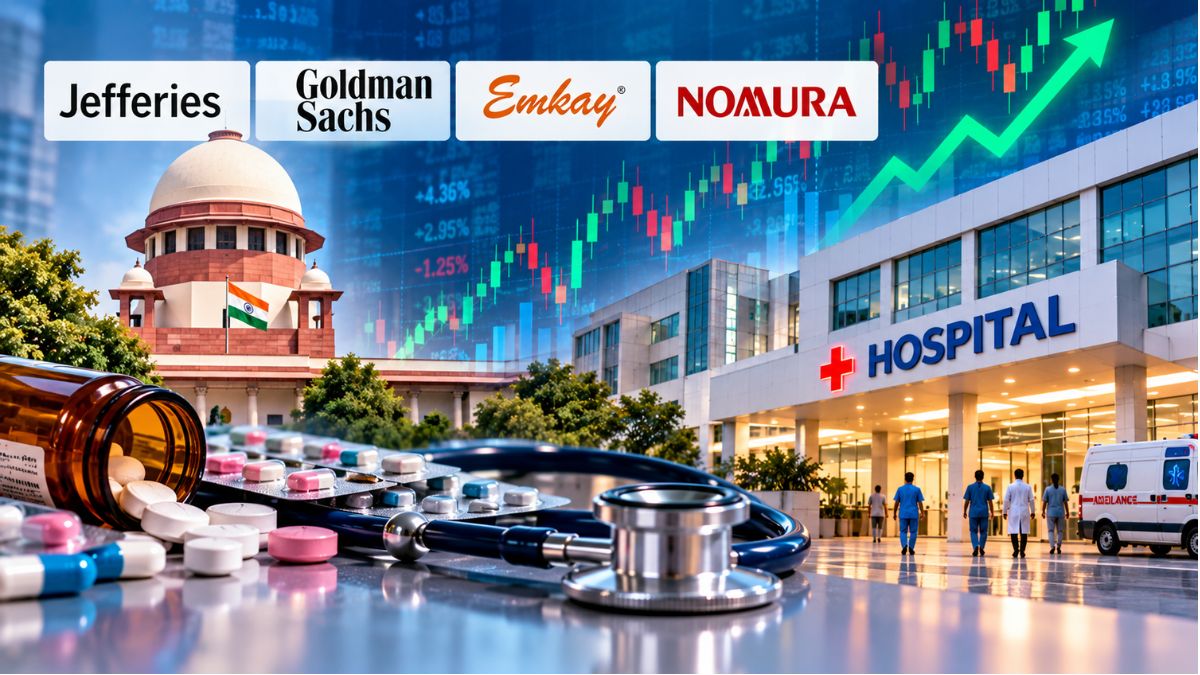
India’s Supreme Court is examining how much private hospitals charge for some medicines and medical supplies.
The court is concerned that hospitals may charge much more than they paid to buy these items.
This could reduce some hospitals’ profits if new price limits are introduced.
Jefferies estimates a possible 2-5% profit impact, while Goldman Sachs estimates 2-7% without corrective action.
The brokerages say hospitals could respond by changing procedure prices, using package bills or cutting costs.
Package pricing means patients pay one combined amount for treatment instead of separate prices for every item.
Some analysts think insurance and government health schemes already use such packages, limiting the effect.
Nomura is more worried that regulation could reduce how highly investors value hospital companies.
The Supreme Court is expected to consider the issue again on October 12, 2026.

The Supreme Court questioned steep mark-ups on medicines and consumables sold through private hospitals, with the next hearing set for October 12, 2026.
Goldman Sachs estimates a potential 2-7% EBITDA reduction without mitigation, while Jefferies projects a 2-5% impact under its assumptions.
Brokerages say package pricing, higher procedure charges and cost controls could offset some pressure on hospital profitability.
Goldman Sachs, Jefferies, BofA Securities and Emkay remain broadly constructive, while Nomura focuses on possible valuation-multiple pressure.
Target prices imply upside of up to 46%, with Jefferies assigning that potential to Fortis Healthcare.
- Who
- The Supreme Court of India, the Indian government, private hospitals and brokerages including Goldman Sachs, Jefferies, BofA Securities, Emkay Research and Nomura.
- What
- The court is examining mark-ups on medicines and medical consumables sold or administered through private hospitals, and analysts are assessing the possible effect on hospital earnings and valuations.
- Where
- India, including its private hospital sector.
- When
- The Supreme Court’s observations followed proceedings on September 29; the next hearing is scheduled for October 12, 2026.
- Why
- The court questioned the gap between hospitals’ procurement costs and the prices charged for certain medicines and supplies.
Constructive outlook
Cautious outlook
Earnings effect
Constructive outlook
Jefferies, Goldman Sachs and Emkay Research expect hospitals to absorb or offset much of the potential margin pressure through pricing, package billing and cost management.
Cautious outlook
Nomura says the earnings impact remains uncertain and warns that tighter regulation could pressure hospital valuation multiples.
Market reaction
Constructive outlook
BofA Securities says previous regulatory episodes suggest share-price corrections can be short-lived if eventual measures remain limited or manageable.
Cautious outlook
Nomura highlights that Indian hospital valuation multiples rose substantially relative to international peers, leaving the sector more exposed to regulatory disappointment.
Ability to recover margins
Constructive outlook
Brokerages point to procedure-price changes, negotiated packages, payer mix and cost rationalisation as possible ways to protect profitability.
Cautious outlook
The effectiveness of these measures may be constrained by competition, insurer contracts, the final regulatory framework and the specific medicines or consumables covered.
Key facts
- Potential EBITDA impact
- Jefferies estimates 2-5%; Goldman Sachs estimates 2-7% if hospitals take no mitigating action.
- Existing scheduled-medicine margin
- Scheduled medicines already carry a 16% retail margin under the Drugs (Prices Control) Order, 2013.
- Non-scheduled medicines
- About 80-82% of medicines fall outside the current price-control framework, according to the article.
- Package pricing
- Package pricing represented 52% of private hospitalisation expenses in December 2025, up from 40% in June 2018.
- Medicine contribution
- Medicines accounted for 14% of private hospitalisation expenses in December 2025, down from 18% in June 2018.
- Highest cited upside
- Jefferies’ target price for Fortis Healthcare implies 46% upside.
- Next court hearing
- October 12, 2026.
Quotes

Goldman Sachs
Global investment bank and hospital-sector research provider
“We estimate 2-5% impact on hospital EBITDA: Assuming margin caps of 16% on oncology drugs and 5% margin for consumables (high-ticket consumables like stents and implants under price controls since 2017), we estimate ~2-5% hit to EBITDA. Multiple levers to negate impact of price cuts: Nearly a decade ago, prices for cardiac stents and orthopaedic knee implants were reduced by a remarkable 70-85%.”
 financialexpress.com
“In all the three scenarios we assume no mitigatory actions on part of the Hospitals to recoup margins. The sensitivity implies approximately 2% to 7% potential EBITDA cuts based on existing mark-ups. We, however, would like to highlight two potential mitigants apart from the industry pushing back on any such litigation.”
financialexpress.com
Sources
Related news

Jefferies Sees 22-46% Upside in Major Hospital Stocks

Nomura Maintains Neutral Fortis Healthcare Rating Amid Growth Concerns

Jefferies names four healthcare stocks with earnings upside

Max Healthcare Says Rising Costs Complicate Hospital Price Regulation

PL Capital Recommends Fortis Healthcare Shares, Sets ₹1,050 Target

Moneyview Shares Debut 64% Above IPO Price After Strong Demand

Bankrupt Fund Founder Weiss to Auction Art Through Sotheby’s

Moneyview IPO Draws 98.5x Subscription, GMP Signals 41% Premium

Funflation Explains Pricier Hobbies As Consumers Keep Spending