1 hr ago
How Kolkata’s Chinese Community Shaped the City’s History and Culture

Kolkata has been home to a Chinese community for a long time.
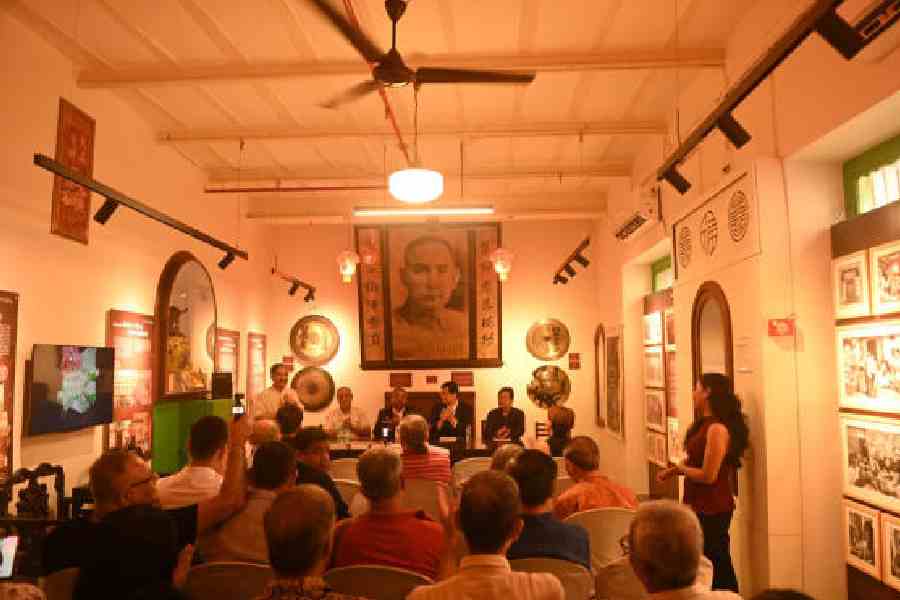
A new gallery in Tiretta Bazaar shares the community’s history through photographs, tools and other objects.
Chinese migrants worked in trades such as carpentry, dentistry, shoemaking and tanning.
Their associations, called huiguans, provided places to meet, worship and support one another.
The community has become smaller, and some languages and traditions are at risk of being forgotten.
Researchers are studying old inscriptions and government records to learn more.
The gallery is part of a community space, not just a museum.
Its organizers are also planning another gallery in Tangra.

The Cheenapara Heritage Gallery opened last month at Huining Huiguan, a Chinese association and temple established in 1908.
The gallery displays photographs, donated artefacts and records documenting Chinese community life, work and culture in Kolkata.
Chinese migration to Kolkata grew from the late 18th century, and increased after the First Opium War.
Cantonese, Hubeinese, Shandong and Hakka migrants built livelihoods in trades including carpentry, dentistry, retail, shoemaking and tanning.
Researchers are using inscriptions and colonial archives to improve the historical record; a second gallery is planned in Tangra.
- Who
- Kolkata’s Chinese community; the gallery project is led by Prof. Tansen Sen with heritage and urban-design partners.
- What
- The Cheenapara Heritage Gallery opened to document and preserve the history and culture of the Chinese community in Kolkata.
- Where
- Huining Huiguan, 17 Blackburn Lane, in Tiretta Bazaar, Kolkata.
- When
- The gallery opened last month; Huining Huiguan was established in 1908.
- Why
- To preserve and share the community’s history, livelihoods and cultural heritage as its population and language use decline.
Key facts
- Gallery
- Cheenapara Heritage Gallery
- Location
- Huining Huiguan, 17 Blackburn Lane, Tiretta Bazaar, Kolkata
- Association founded
- Huining Huiguan was established in 1908 by migrants from Sihui.
- Early migration
- Chinese trader Atchew received land from Warren Hastings in 1778 for a sugar plantation near the Hooghly River.
- Migration increase
- Migration to Kolkata increased after the First Opium War (1839–1842), particularly from Guangdong.
- Native-place associations
- Six are currently in Kolkata, according to the article.
- Archive research
- The research team found nearly 200 Intelligence Bureau files on the Chinese community, dating from 1910 onwards.
- Future plans
- The project team is planning another gallery in Tangra.
Quotes
Rinkoo Bhowmik
Founder of the CHA Project
“These languages need to be preserved, documented and studied. At the same time, knowledge of Chinese more broadly within the community is also in decline as reflected in the disappearance of Chinese-language newspapers that were once published.”
 livemint.com
“Few know there are six functioning Chinese temples in Tiretta Bazaar. We wanted to create awareness of adaptive reuse of such heritage buildings.”
livemint.com
Sources
Related news
Calcutta’s Chinatowns Offer India-China Heritage Beyond Modern Borders
Rajasthan Woos Calcutta Business Diaspora for Industrial Growth
Harakutir Bari’s Durga Puja Evolves From Baithaks to Reels

Hooghly River Reveals Bengal’s Layered European Colonial History
A Heritage Walk Reveals Kumartuli Beyond Durga Idol Workshops

Harry Kosato Brings Kolkata Chefs Together Over Chinese Cuisine
Kolkata General Post Office Traces Its History to 1774
New gallery preserves Calcutta’s 200-year Chinese community history
Eastern Railway celebrates 164th anniversary of heritage Barrackpore station
Kolkata Exhibition Showcases Rare Autographs, from Tagore to Ray