

1 week ago
How Baroda’s Art School Took Indian Modernism Global
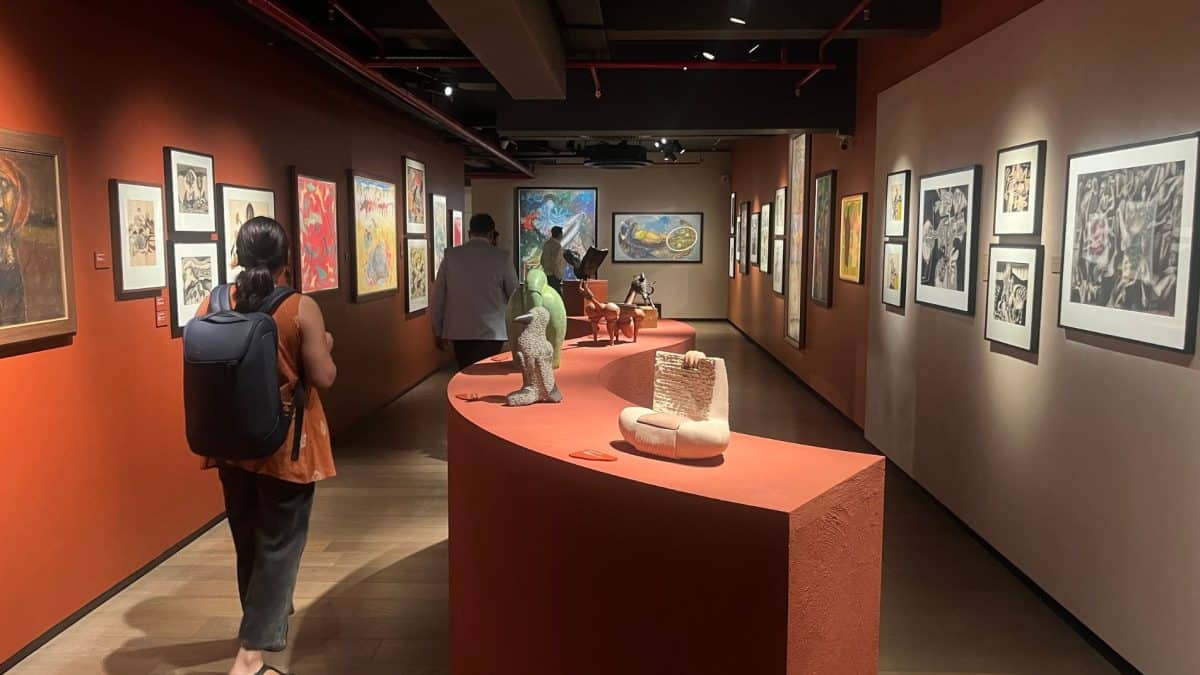
After India became independent, Hansa Mehta helped create a new art school in Baroda in 1950.
She wanted artists to learn in ways that matched Indian life instead of following old British rules.
Important artists such as N S Bendre, Sankho Chaudhuri and K G Subramanyan helped lead the school.
Teachers and students experimented with many different kinds of art.
They explored modern ideas while also using Indian traditions and materials.
Some artists also made work about social, economic and political issues.
Many students later became teachers and influenced art education across India.
A new exhibition in New Delhi shows more than 200 works connected to the school.
It explains how Baroda helped Indian art become known both in India and around the world.

Hansa Mehta established the Faculty of Fine Arts at Maharaja Sayajirao University of Baroda in 1950.
The school was designed to move beyond restrictive British-era art education and reflect Indian society.
Artists N S Bendre, Sankho Chaudhuri and K G Subramanyan helped shape its influential teaching model.
Baroda became a center for experimental art, modernism and engagement with India’s social and political realities.
The exhibition Freedom to Form: Baroda Modern presents more than 200 works at DAG in New Delhi.
- Who
- Hansa Mehta, the Faculty of Fine Arts, its teachers and students, and artists associated with Baroda.
- What
- The Faculty of Fine Arts transformed Indian art education and helped develop modern and experimental Indian art.
- Where
- At Maharaja Sayajirao University of Baroda in Gujarat, with the exhibition at DAG in New Delhi.
- When
- The faculty was founded in 1950; the exhibition opened on August 22 and runs until October 3.
- Why
- Mehta wanted to create an art school free from outdated British-era teaching and connected to Indian society.
Key facts
- University
- Maharaja Sayajirao University of Baroda was created in 1949 from Baroda College, founded in 1881.
- Art faculty founded
- The Faculty of Fine Arts was established in 1950.
- Founder
- Hansa Mehta, the university’s first Vice-Chancellor, planned the art school.
- Early leaders
- N S Bendre and Sankho Chaudhuri were brought in to lead the faculty, with K G Subramanyan joining soon afterward.
- Exhibition
- Freedom to Form: Baroda Modern examines the institution through works by its students and teachers.
- Number of works
- The exhibition includes more than 200 works across multiple media.
- Exhibition venue
- The exhibition is being held at DAG, formerly Delhi Art Gallery, in New Delhi.
Quotes
Ashish Anand
CEO and managing director of DAG, discussing the exhibition and the Faculty of Fine Arts
“When Hansa Mehta established the Faculty of Fine Arts (FFA) at Maharaja Sayajirao University in 1950 and brought in (famous artists) N S Bendre and Sankho Chaudhuri to lead it, the FFA became India’s first post-Independence art school”
 firstpost.com
“Its earliest students, such as Gulammohammed Sheikh and Jyoti Bhatt, became teachers, reshaping academic discourse across Gujarat and the country”
firstpost.com
Kathleen L Wyma
Art historian and University of Hong Kong Department of Fine Arts teacher
“Marked by intense experimentation, the FFA emerged as a hub for artists and scholars seeking a modern visual language that resonated both locally and globally”
firstpost.com
Sources
Related news

JJ School of Art Legacy Celebrated Through Nationalist Exhibition

DAVV Indore To Launch Four-Year Performing Arts Course In 2026

Visva-Bharati's Kala Bhavana and University of Greenwich sign MoU

Dr Rakhshanda Hani Becomes First Woman to Lead Maharashtra College
David Malaker’s Nocturnal Paintings Trace Freedom, Cities and Identity
Hemang Joshi to Take Charge as BJYM National President
PM Modi's Expected Gujarat Visit Prompts Vadodara, Navsari Preparations
BJP Appoints Hemang Joshi as Youth Wing National President
Heritage autorickshaws, reels spotlight Modi's hometown ahead of birthday
