

1 week ago
Why the Number 1729 Became the Hardy-Ramanujan Number

The number 1729 looks ordinary, but it has a special mathematical feature.
It can be made by adding two cubes in two different ways.
Those ways are 1³ + 12³ and 9³ + 10³.
No smaller positive number has this same property.
That is why mathematicians call it a taxicab number.
The number became famous through a story involving Ramanujan and Hardy.
Hardy saw 1729 as a taxi’s registration number, while Ramanujan immediately noticed its unusual pattern.
The story shows how quickly Ramanujan could recognize mathematical connections.
The number also has other properties, including being a Carmichael number and equaling 7 × 13 × 19.

1729 equals both 1³ + 12³ and 9³ + 10³, making it the smallest number with two distinct positive-cube representations.
The number is known as the Hardy-Ramanujan number and the first non-trivial taxicab number, Ta(2).
The smallest number expressible as two positive cubes in three different ways is 87,539,319.
The famous taxi story is remembered as an example of Ramanujan’s ability to see hidden patterns in numbers.
1729 is also a Carmichael number and factors as 7 × 13 × 19.
- Who
- Mathematicians Ramanujan and Hardy are associated with the famous observation about 1729.
- What
- 1729 is the smallest positive integer expressible as the sum of two positive cubes in two distinct ways.
- Where
- When
- Why
- It became famous because Ramanujan recognized its unusual cube representations and because of the story about Hardy’s taxi registration number.
Key facts
- Cube representations
- 1729 = 1³ + 12³ = 9³ + 10³
- Mathematical name
- The Hardy-Ramanujan number
- Taxicab classification
- The first non-trivial taxicab number, commonly written as Ta(2)
- Next three-way example
- 87,539,319 is the smallest number expressible as two positive cubes in three different ways
- Other classification
- 1729 is a Carmichael number
- Prime factorization
- 1729 = 7 × 13 × 19
Sources
Related news

Sujatha Ramdorai’s Journey from Number Plates to Number Theory
Why India's contribution to mathematics of zero is remarkable
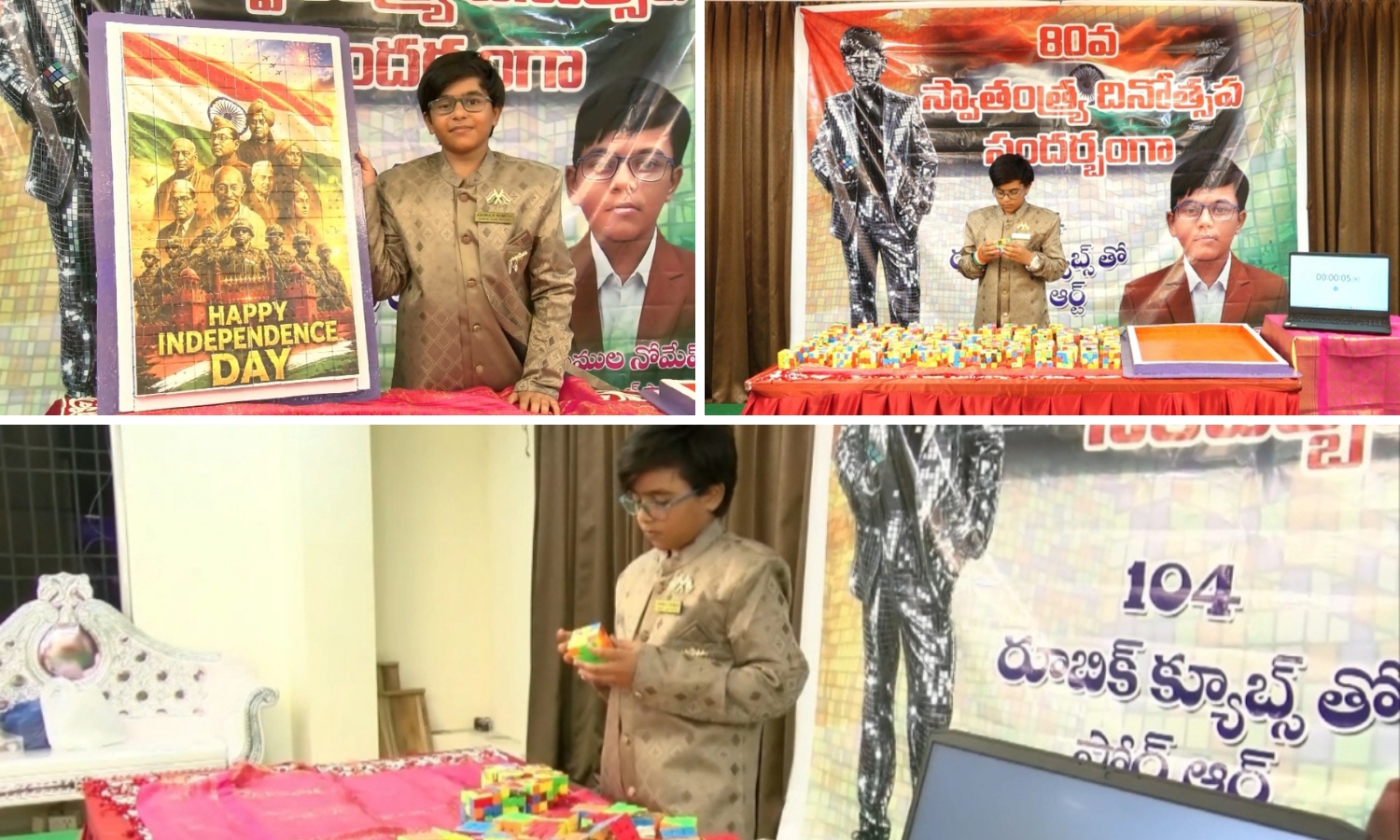
Nellore Boy Creates Patriotic Artwork from 104 Rubik's Cubes

Rajasthan Professor Turns Physics Concepts Into Hindi Poetry

Smarthveer Sidana: Rare Poet and Quant Leader
