46 mins ago
Before Kashmir War, Pressure, Blockade and Covert Mobilisation Intensified
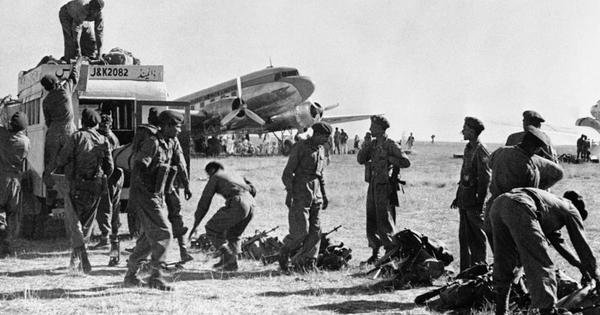
The book says Jammu and Kashmir was placed under heavy pressure before the first Kashmir war began.
Fighting and communal violence spread into Jammu after the Partition of British India.
At the same time, some former soldiers began organising an armed revolt against the maharaja.
Important supplies, trains, mail and military equipment moving through Pakistan were stopped or delayed.
Pakistan-based officials and military figures are described as helping prepare fighters and collect weapons.
Indian officials received warnings, but they did not initially treat the danger as a full invasion plan.
Pakistani leaders publicly denied involvement, although the book presents testimony and records suggesting official support.
India and the maharaja’s government disagreed over how to respond and over Sheikh Abdullah’s political role.
On October 22, 1947, tribal fighters crossed the frontier after weeks of mounting pressure and preparation.

A new book argues that Jammu and Kashmir was weakened through political unrest, economic pressure and covert military preparations before the October 1947 invasion.
Violence intensified in Jammu Province after Partition, while the Kashmir Valley and Ladakh remained relatively calm during August and September.
Sardar Muhammad Ibrahim Khan organised former soldiers and sought arms from Pakistan-based supporters for an uprising in the Mirpur–Poonch region.
Pakistan disrupted rail, postal, supply and military-communications links with Jammu and Kashmir, creating what the book describes as an economic blockade.
The first tribal columns crossed into Jammu and Kashmir on October 22, 1947, amid preparations involving tribal fighters, ex-servicemen and Pakistan Army personnel.
- Who
- The Jammu and Kashmir government, Pakistan-based organisers, tribal fighters, former soldiers, Pakistan Army personnel and Indian officials were involved in the events described.
- What
- Political mobilisation, an economic blockade and covert military preparations weakened Jammu and Kashmir before the first Kashmir war.
- Where
- The main areas included Jammu Province, the Mirpur–Poonch belt, Pakistan, Rawalpindi, Murree, Muzaffarabad and the route toward Baramulla.
- When
- Preparations intensified from late summer 1947; the first tribal columns crossed the frontier on October 22, 1947.
- Why
- The book argues that the objective was to destabilise the maharaja’s government and create conditions for an intervention; Pakistani figures also justified action by citing Kashmir’s Muslim majority.
Evidence of Coordinated Pakistani Preparation
Public Denials and Alternative Framing
Nature of the invasion
Evidence of Coordinated Pakistani Preparation
The book cites memoirs, testimony, official records and journalist accounts to argue that the raids involved coordinated political, administrative, military and logistical preparation rather than a spontaneous tribal reaction.
Public Denials and Alternative Framing
Senior Pakistani leaders publicly denied involvement, while the raids were presented as a communal response to alleged oppression in Jammu and Kashmir.
Reason for intervention
Evidence of Coordinated Pakistani Preparation
The account argues that unrest and an economic blockade were used to weaken the state internally and facilitate a wider intervention.
Public Denials and Alternative Framing
Pakistani figures such as Abdul Qayyum Khan argued that Kashmir’s Muslim majority made it part of Pakistan, providing a political justification for action.
Indian political response
Evidence of Coordinated Pakistani Preparation
The book portrays New Delhi’s caution, supply conditions and pressure surrounding Sheikh Abdullah as factors that left the maharaja politically isolated during the crisis.
Public Denials and Alternative Framing
India responded positively in principle to requests for assistance, including appointing Kashmir Singh Katoch as military adviser, but remained constrained by political and constitutional uncertainty.
Key facts
- Book
- 1947: The Battle of Badgam and Shalateng
- Authors
- Ajay Kumar Raina with Shiv Kunal Verma
- First tribal crossing
- October 22, 1947
- Early organiser
- Sardar Muhammad Ibrahim Khan organised former servicemen and operated from Murree.
- Reported arms diversion
- Akbar Khan’s memoir records the diversion of approximately 4,000 rifles originally allocated to police forces.
- State response
- Jammu and Kashmir requested Lieutenant Colonel Kashmir Singh Katoch as military adviser on September 13, 1947.
- Major disruption
- Rail, postal, supply and communications links between Pakistan and Jammu and Kashmir were curtailed or blocked.
Sources
Related news
Remembering the Punjab Boundary Force and the Shadow of Partition
Officials Warn Kashmir Threats May Mask Rebuilt Terror Networks

Pakistani LeT Terrorist Killed in High-Altitude Budgam Operation

Officials Warn of JeM-AQIS Plans to Spread Mass Unrest
ISI Reduces Local Recruitment in J&K