1 year ago
Human-Wildlife Conflict Likely in Telangana, Andhra Tiger Reserves
Imagine tigers are having trouble finding enough to eat in some forests.
The government says this could lead to more tigers and people bumping into each other.
Scientists are worried about this in places like Amrabad, NSTR, and GBM.
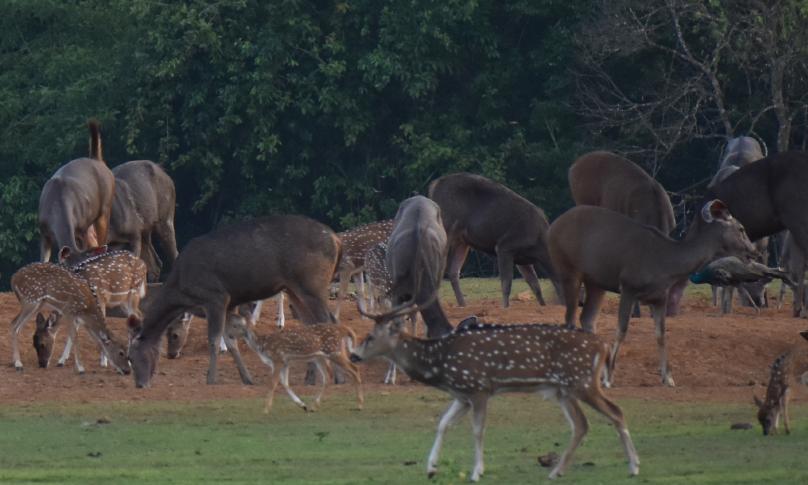
To help, they're planning to bring in more deer for the tigers to eat.
They're also thinking of using cameras to count the animals better.
The goal is to keep the tigers healthy and safe while also keeping people safe.

NTCA warns of rising human-wildlife conflict in Telangana and Andhra Pradesh tiger reserves.
Amrabad, NSTR, and GBM reserves face increasing tiger populations with low prey density.
Kawal tiger reserve has higher prey density due to lack of resident tigers.
Forest department plans to augment prey through a 100-acre enclosure in Amrabad.
Camera trapping may be used for more accurate prey animal estimates.
- Who
- National Tiger Conservation Authority (NTCA) and Telangana Forest Department.
- What
- Rising human-wildlife conflict expected in Telangana and Andhra Pradesh tiger reserves.
- Where
- Telangana and Andhra Pradesh, specifically Amrabad, NSTR, GBM, and Kawal tiger reserves.
- When
- Ongoing concern, with plans for prey augmentation.
- Why
- Due to increasing tiger population and low prey density leading to potential human-wildlife conflicts.
Scientists' Concerns
Management's Actions
Accuracy of Prey Estimates
Scientists' Concerns
Some experts suggest the line transect method, traditionally used to estimate the prey population, may not be providing an accurate picture.
Management's Actions
Camera trapping methods could provide a more accurate picture of the prey population.
Key facts
- Concern
- Rising human-wildlife conflict
- Affected Regions
- Telangana and Andhra Pradesh
- Reserves Mentioned
- Amrabad, NSTR, GBM, Kawal
- Prey Species
- Deer, antelope, wild pig
- Proposed Solution
- Prey augmentation, camera trapping
- Prey Density (Kawal)
- Around 12 per sq km
- Prey Density (Amrabad)
- Around 8 per sq km