2 hrs ago
E.C.G. Sudarshan’s Physics Legacy Outshone by Nobel Recognition Gaps
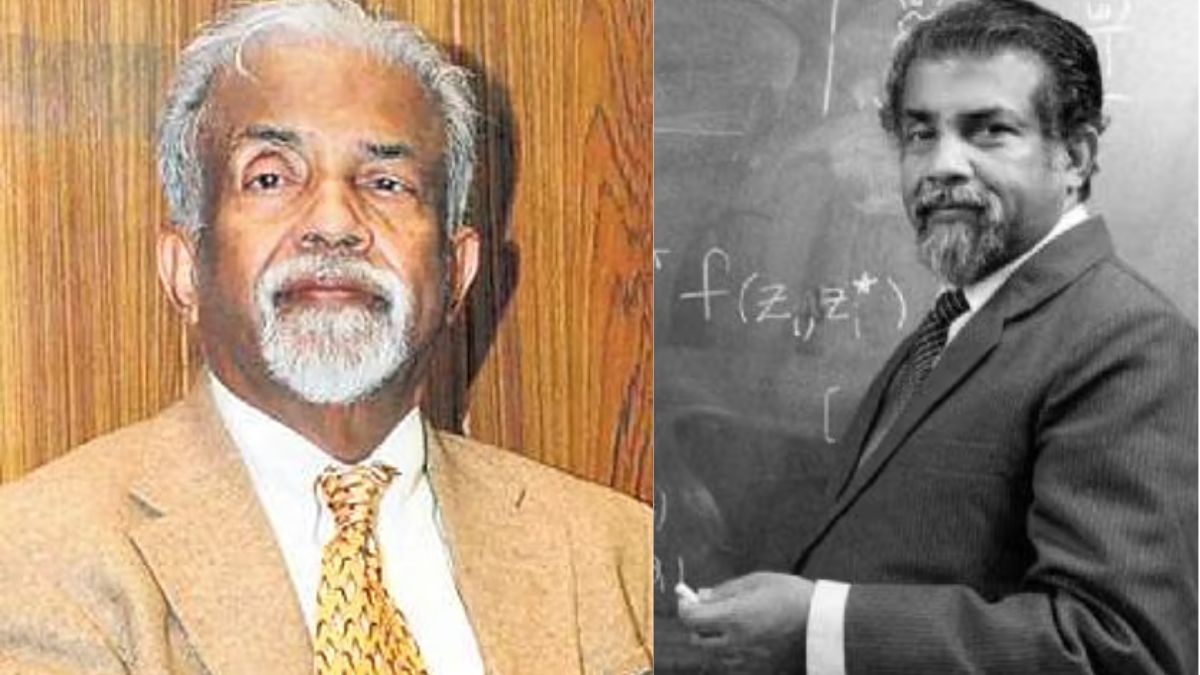
E.C.G. Sudarshan was a physicist from Kerala who studied how nature and light work.
He read many books as a child and later worked with famous scientists.
He helped create an important theory about a force involved in radioactive decay.
That theory became part of a bigger theory that later won a Nobel Prize for other scientists.
He also developed a way to describe light that became important in quantum optics.
Another of his ideas, the quantum Zeno effect, showed that watching a tiny quantum system can affect it.
Supporters say his work deserved more credit and possibly several Nobel Prizes.
Sudarshan never won the Nobel, although he was reportedly nominated nine times.
He continued teaching students and supporting scientific institutions in India and the United States.

E.C.G. Sudarshan made major contributions to particle physics, quantum optics and open quantum systems.
His V-A theory with Robert Marshak helped lay groundwork for electroweak theory, later recognized with the 1979 Nobel Prize.
His Sudarshan representation of light influenced quantum optics and later developments involving lasers.
Sudarshan was reportedly nominated for the Nobel Prize nine times but never received it.
Despite spending decades at the University of Texas at Austin, he continued teaching, researching and building institutions in India.
- Who
- E.C.G. Sudarshan, Robert Marshak, and the scientists who later developed related theories, including Richard Feynman, Murray Gell-Mann, Roy Glauber and the 1979 Nobel laureates.
- What
- A retrospective on Sudarshan’s scientific contributions, career, institutional work and the debate over whether he received adequate credit, including Nobel recognition.
- Where
- He began in Kottayam and other Indian institutions, worked at the Tata Institute of Fundamental Research, and spent nearly five decades at the University of Texas at Austin.
- When
- Sudarshan was born in 1931, began major research in the 1950s, and died in 2018; the article discusses Nobel awards in 1979 and 2005.
- Why
- Supporters attribute the recognition gap partly to delayed or less prominent publication of his work and to later researchers receiving credit for related developments.
Sudarshan’s supporters
Recognition and attribution account
Credit for electroweak theory
Sudarshan’s supporters
Supporters say Sudarshan and Robert Marshak’s V-A theory was a foundational contribution later developed by other scientists and should have received direct recognition.
Recognition and attribution account
The article says Sudarshan and Marshak’s work appeared in conference proceedings, while a related paper by Richard Feynman and Murray Gell-Mann was published quickly in Physical Review; the Nobel Committee ultimately recognized later electroweak work.
Credit for quantum optics
Sudarshan’s supporters
P.J. Kurian and Anil Shaji argue that Sudarshan’s representation of light was central to later quantum-optics developments and that he deserved recognition for it.
Recognition and attribution account
Roy Glauber received the 2005 Nobel Prize for work related to quantum optics; the article reports that supporters believed his representation built on Sudarshan’s earlier work, while the Nobel Committee did not alter the award.
Possible reasons for missed Nobel awards
Sudarshan’s supporters
Supporters say Sudarshan’s wide-ranging research and repeated contributions made him deserving of the Nobel Prize, possibly on several occasions.
Recognition and attribution account
The article does not establish an official reason for his non-selection; it presents publication timing, attribution disputes and his broad research interests as explanations offered by supporters and colleagues.
Key facts
- Birth and death
- Born in 1931; died in 2018.
- Reported Nobel nominations
- Nine nominations across different areas of physics.
- V-A theory
- Developed by Sudarshan and Robert Marshak as a theory of weak interactions.
- Electroweak Nobel
- The 1979 Physics Nobel went to Sheldon Glashow, Abdus Salam and Steven Weinberg for electroweak theory.
- Quantum optics
- His 1963 Diagonal Coherent State Representation became known as the Sudarshan or P-Representation.
- University of Texas
- He joined the University of Texas at Austin in 1969 and remained there for nearly five decades.
- Indian honours
- He received the Padma Bhushan in 1976 and Padma Vibhushan in 2007.
Quotes
P.J. Kurian
Author of Sudarshan’s Malayalam biography
“The Universal Four-Fermi interaction proposed by Sudarshan was, without question, an addition of the most fundamental nature to our understanding of the workings of the physical universe.”
 financialexpress.com
“Even while he was an international scientist in America, his Indian connection remained strong until his death.”
financialexpress.com
Sources
Related news
Indian Physicist Deepak Dhar Wins Prestigious 2026 Dirac Medal

Pawan Kalyan Pays Tribute to Chandrasekhar, Bismillah Khan

How DD Kosambi envisioned higher science education in India

Deepak Dhar Wins 2026 Dirac Medal for Statistical Mechanics Work

Rajasthan Professor Turns Physics Concepts Into Hindi Poetry
KBC 18 Contestant Quits Rs 1 Crore Pythagoras Question
IISc discovers protein protecting tuberculosis bacteria