6 days ago
Telangana High Court Upholds WhatsApp Divorce Notice Against Dubai-Based Man

A woman asked a court to end her marriage after alleging that her husband demanded more dowry and mistreated her.
She said he left for Dubai after she moved to her parents’ home.
The trial court sent him legal papers through WhatsApp and later granted the divorce when he did not appear.
The man said he did not receive the papers properly because he was working in Dubai.
The Telangana High Court said the WhatsApp notice had been sent to his Dubai phone number.
The court also noted that he and his mother were involved in a related criminal case.
Because of this, the judges said it was difficult to believe that he knew nothing about the dispute.
The High Court therefore left the divorce decree in place.

The Telangana High Court upheld an ex parte divorce decree issued against a Dubai-based man.
The court ruled that notice sent to his Dubai phone number through WhatsApp was valid service.
His wife alleged dowry harassment, including demands for an additional Rs 5 lakh, soon after their 2021 wedding.
The man claimed he was in Dubai, unaware of the divorce case, and that notice had been fraudulently served on someone else.
The court dismissed his challenge, noting the criminal case against him and his mother indicated awareness of the marital dispute.
- Who
- A Dubai-based man, his wife, and the Telangana High Court bench of Justices Moushumi Bhattacharya and Renuka Yara.
- What
- The High Court upheld an ex parte divorce decree and accepted WhatsApp service of notice on the man’s Dubai number in this case.
- Where
- The divorce proceedings were heard in Telangana, while the husband was based in Dubai.
- When
- The marriage took place in 2021; the ex parte divorce decree was issued on December 31, 2024, after notice was recorded as served on December 11, 2024.
- Why
- The court found that the man could not make a blanket claim of fraudulent service and that the related criminal proceedings indicated that he and his family knew about the marital dispute.
Wife’s and Court’s Position
Husband’s Position
Validity of WhatsApp service
Wife’s and Court’s Position
The wife’s side said the documents were sent to the husband through WhatsApp and received on his Dubai number; the High Court accepted the recorded service and supporting documents.
Husband’s Position
The husband argued that he was in Dubai and had not been properly served, alleging that notice was fraudulently served on another person.
Knowledge of divorce proceedings
Wife’s and Court’s Position
The court said the criminal case involving the husband and his mother made it difficult to accept that they were unaware of the matrimonial dispute or divorce proceedings.
Husband’s Position
The husband claimed he did not know about the divorce case and sought to set aside the ex parte decree.
Challenge to the decree
Wife’s and Court’s Position
The High Court found no merit in the challenge and upheld the refusal to set aside the decree.
Husband’s Position
The husband challenged the trial court’s order and also sought condonation of the 204-day delay in filing his application.
Key facts
- Court
- Telangana High Court
- Judges
- Justices Moushumi Bhattacharya and Renuka Yara
- Notice method
- WhatsApp message sent to the husband’s Dubai phone number
- Marriage
- Solemnised in 2021 under Hindu customs and traditions
- Divorce decree
- Passed ex parte by the trial court on December 31, 2024
- Delay in challenge
- The trial court refused to condone a 204-day delay
- Related allegations
- The wife alleged dowry harassment and filed proceedings under Section 498-A of the Indian Penal Code and Sections 3 and 4 of the Dowry Prohibition Act
Quotes
Telangana High Court bench
Justices Moushumi Bhattacharya and Renuka Yara of the Telangana High Court
“In view of the filing of a criminal case under Section 498-A (husband or his relative subjecting woman to cruelty) of IPC and Sections 3 and 4 of the Dowry Prohibition Act, the mother and sister of the appellant were aware of the marital disputes, and they cannot be ignorant of the divorce proceedings.”
 indianexpress.com
Sources
Related news

Telangana High Court Refuses to Quash Husband's Cruelty Case

Kerala High Court denies relief to mother-in-law over dowry harassment

Telangana High Court Cancels Parallel Child Visitation Order

Madhya Pradesh High Court rejects divorce plea based on Fatwa

Bhopal Couple Discover Fake Divorce Four Years Later
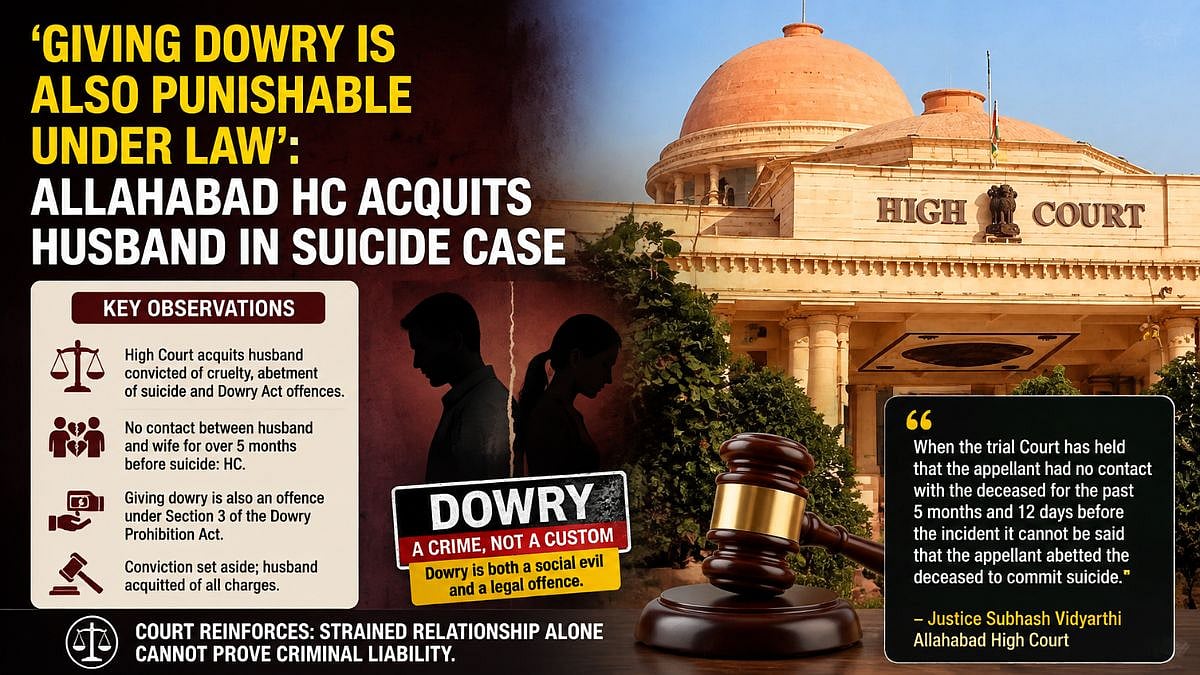
Allahabad High Court Acquits Husband in Dowry Abetment Suicide Case

Retired Mumbai LIC Employee Loses ₹97.70 Lakh in Trading Scam

Google Escapes Ad Tech Breakup as Judge Rejects DOJ Sale

Tamil Nadu Cybercrime Probe Targets Deepfake Impersonating CM Vijay

Adilabad Police Arrest Suspect in Rs 5.3 Crore Instagram Fraud

Man loses ₹3.81 lakh in alleged Kerala lottery scam