

3 hrs ago
India's Strong GDP Growth Fails to Lift Stock Markets

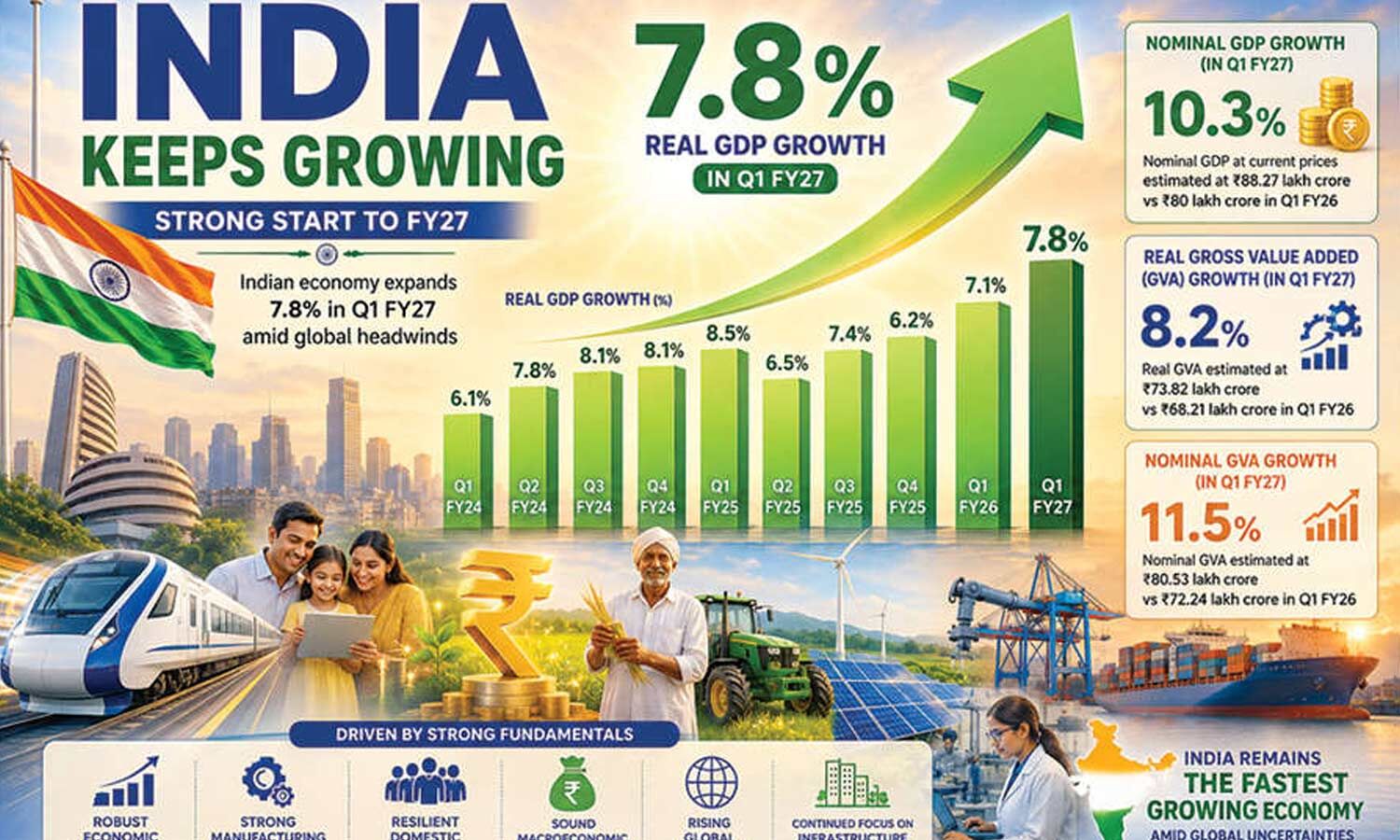
India’s economy grew strongly by 7.8% in the April–June quarter.
This means the country produced much more goods and services than before.
However, Indian shares did not rise along with the economy.
The Nifty, Sensex and Bank Nifty all lost value during 2026.
Stock markets in South Korea, Japan and Taiwan performed much better.
Experts said higher oil prices and the US–Iran conflict hurt Indian shares.
They also said technology and chip companies helped push other Asian markets higher.
Some analysts now warn that those Asian markets could fall if investors start selling their AI-related shares.

India recorded 7.8% GDP growth in the April–June quarter of FY27, despite regional conflict, monsoon delays and tariff uncertainty.
The Nifty 50 fell 8.60% year to date, while the Sensex declined more than 10% and the Bank Nifty dropped nearly 3.90%.
The KOSPI, Nikkei 225 and Taiwan Weighted Index gained about 55%, 25% and 60%, respectively, according to the article.
Analysts attributed Indian market weakness partly to crude oil prices above $90 a barrel during the continuing US–Iran conflict.
AI-driven buying in semiconductor and chip stocks helped other Asian markets, but analysts warned those markets may be overbought.
- Who
- India’s economy and stock markets, along with analysts Avinash Gorakshkar, Anuj Gupta and Sandeep Pandey.
- What
- India reported 7.8% GDP growth, while its major stock indexes declined and several other Asian markets posted large gains.
- Where
- India and major Asian markets, including South Korea, Japan and Taiwan.
- When
- The GDP figure covers April–June of FY27; the article reports market performance year to date in 2026 and says the US–Iran war began on 28 February 2026.
- Why
- Analysts cited crude oil prices above $90 a barrel, the US–Iran conflict and foreign-market trends, while AI-related buying supported semiconductor and chip stocks elsewhere in Asia.
Economic Optimism
Market Caution
GDP and future earnings
Economic Optimism
Avinash Gorakshkar said strong GDP performance normally supports the stock market and could be followed by better second-quarter results.
Market Caution
The article notes that strong GDP growth has not yet translated into gains for the Nifty 50, Sensex or Bank Nifty.
Reasons for Asian market gains
Economic Optimism
AI-led buying in semiconductor and chip stocks helped the KOSPI, Nikkei 225 and Taiwan Weighted Index rise despite broader economic pressures.
Market Caution
Sandeep Pandey said Indian technology, IT and banking shares can fall when global AI stocks weaken, leaving Indian markets exposed to overseas selling.
Near-term outlook
Economic Optimism
India’s 7.8% growth and expected second-quarter results provide a potential basis for market improvement.
Market Caution
Analysts warned that major Asian markets appear overbought and that profit-taking could further pressure the Sensex, Nifty 50 and Bank Nifty.
Key facts
- India GDP growth
- 7.8% in the April–June quarter of FY27
- Nifty 50 performance
- Down 8.60% year to date in 2026
- Sensex performance
- Down more than 10% year to date in 2026
- Bank Nifty performance
- Down nearly 3.90% in 2026
- KOSPI performance
- Up about 55%, according to the article
- Nikkei 225 performance
- Up about 25%, according to the article
- Taiwan Weighted Index performance
- Up about 60%, according to the article
- Crude oil price
- Above $90 per barrel, compared with about $65 when the conflict began
Quotes
Avinash Gorakshkar
SEBI-registered fundamental equity analyst
“Normally, the stock market is linked to the national economy. India's GDP performed well during the April to June 2026 quarter, as reflected in the Q1 2026 results. The market is expecting a similar result in the next quarter; hence, Q2 2026 results are also expected to boost the market.”
 livemint.com
“The Indian stock market was unable to sustain the soaring crude oil prices in the wake of the US-Iran war and closure of the Strait of Hormuz.”
livemint.com
Sandeep Pandey
Co-founder of Basav Capital
“We have noticed that the Indian stock market falls when the Asian or the Global markets fall, even if there is profit-booking in the AI-stocks.”
livemint.com
Sources
Related news

India’s Strong Growth Fails to Lift Stocks Amid Crude Surge

India's Q1 GDP Growth Hits 7.8% Despite Global Turmoil
India’s Q1 FY27 Growth Beats Forecast Despite Iran War Fears
India’s Q1 GDP Growth Hits 7.8%, Beats RBI Estimate

India’s GDP Grows 7.8% Despite West Asia Crisis

Sensex, Nifty Face Resistance as Asian Markets Trade Mixed

Markets Seen Opening Flat as Global Risk Appetite Weakens

Global Markets Turn Cautious as Oil and Tensions Rise

Sensex, Nifty, Bank Nifty Face Volatility as Asia Weakens
