

1 hr ago
Why Current Account Value Goes Beyond Interest Earnings
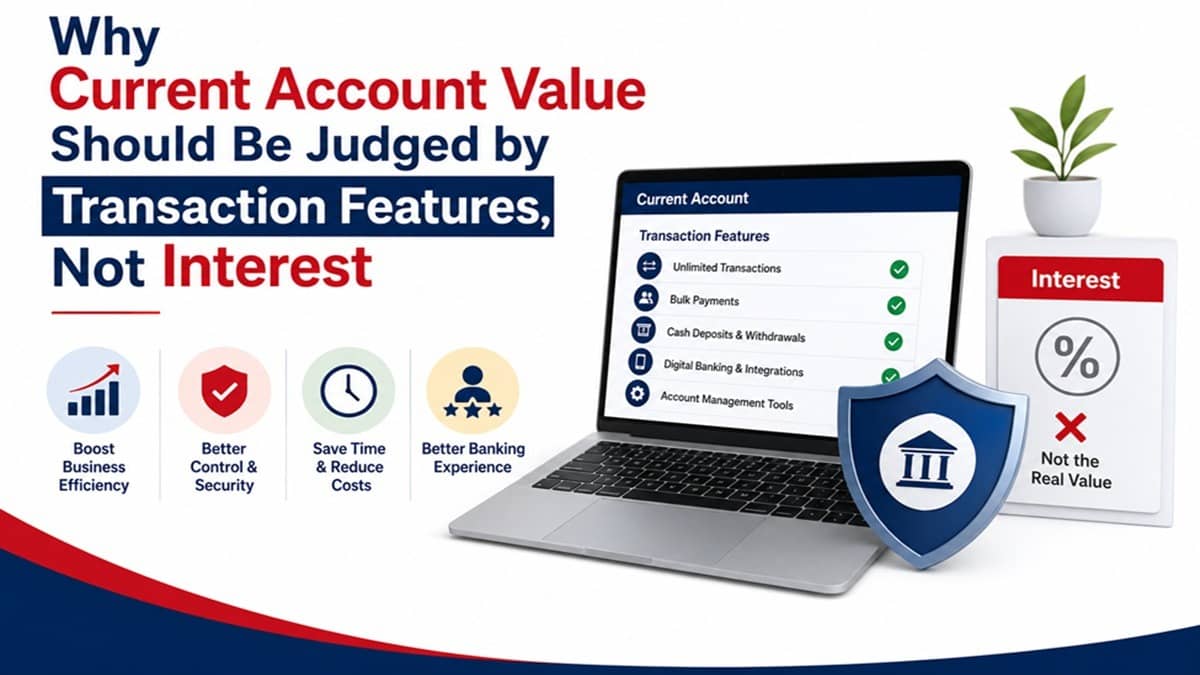
A current account is mainly a tool for running a business.
It helps money move in and out for customers, suppliers, employees, and bills.
Unlike a savings account, it is not mainly designed to earn interest.
The best account may be the one that makes payments and collections easier.
Digital banking can reduce trips to a bank branch.
Bulk payments can help businesses pay many employees or suppliers at once.
Collection tools can help track which customers have paid.
Businesses that handle cash may need special cash-management services.
To choose an account, a business should study its usual transactions and fees rather than focusing only on interest.

Current accounts are designed for frequent business transactions rather than earning interest on idle balances.
Payment options such as NEFT, RTGS, and UPI help businesses pay different types of suppliers and contractors.
Collection tools, digital banking, and bulk transactions can reduce administrative work and payment errors.
Cash management services are important for retail and trade businesses handling large physical-cash volumes.
Businesses should compare transaction charges, limits, time savings, and account-opening requirements alongside any interest offered.
- Who
- Business owners and businesses using current accounts.
- What
- The article explains how to evaluate a current account based on transaction features, efficiency, charges, and business needs rather than interest earnings.
- Where
- In business banking operations, including digital banking, bank branches, and cash-handling activities.
- When
- The article refers to reviewing the previous three months of transaction history when comparing account value.
- Why
- Current accounts are intended to support frequent business transactions, not primarily to grow idle balances through interest.
Key facts
- Primary purpose
- Supporting smooth, fast, and traceable business transactions.
- Payment options
- NEFT, RTGS, and UPI can support different payment needs.
- Collection tools
- Payment gateways, virtual accounts, and automated invoicing integrations can help track customer payments.
- Digital access
- Businesses can approve payments, check balances, download statements, and manage multiple users online.
- Bulk transactions
- Bulk uploads can simplify salary disbursals, vendor payouts, and recurring supplier payments.
- Cash management
- Retail and trade businesses may need accounts that support high cash-deposit volumes and related services.
- Comparison method
- Businesses should compare transaction patterns, fees, limits, and time savings using recent account history.
Sources
Related news

Zero-Balance or Minimum-Balance Savings Accounts: Which Costs Less?

Kotak811 Zero-Balance Account Offers Digital Banking Without Minimum Balance
RBI Highlights Zero-Balance BSBD Accounts With Essential Banking Facilities

Payments Banks Seek Pricing Flexibility as Operating Costs Rise

Five Credit Card Features for Gen Z and Millennials
