1 day ago
Sensex, Nifty Slip as Crude, US-Iran Tensions Weigh
Indian stock markets started Tuesday slightly lower.
The Sensex and Nifty are two important measures of how Indian shares are performing.
Oil prices rose above $90 per barrel, partly because of renewed tensions between the United States and Iran.
Higher oil prices can worry investors because India imports oil.
Investors also think US interest rates may stay high for longer.
That can make investors more careful about putting money into emerging markets such as India.
Strong Indian economic growth helped support the market.
However, it was not strong enough to overcome the worries about oil prices and global tensions.

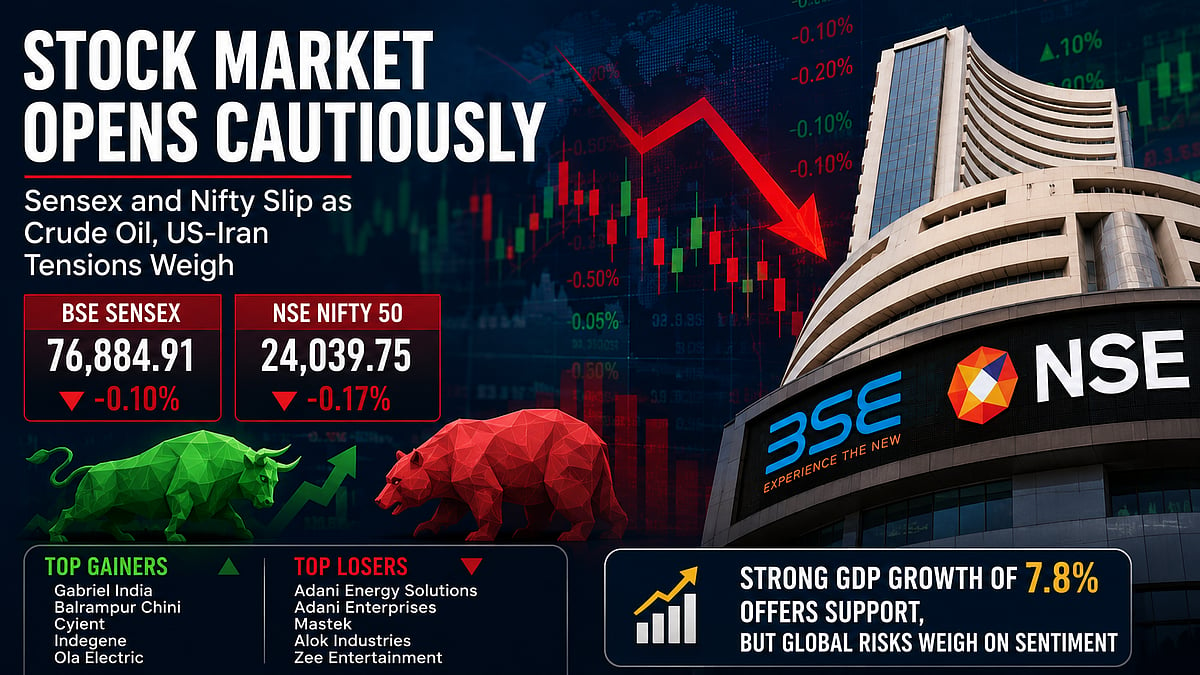
The Sensex fell 121.48 points to 76,835.79 in early trade, while the Nifty dropped 52.6 points to 24,027.80.
Brent crude rose 0.76% to $91.22 per barrel amid renewed US-Iran tensions.
Investors were also concerned that the US Federal Reserve could keep interest rates higher for longer.
India’s real GDP grew 7.8% in the April-June quarter of FY27, exceeding the Reserve Bank of India’s 7% projection.
Foreign institutional investors sold equities worth ₹7,985.88 crore on Monday, when both benchmarks also closed lower.
- Who
- Indian equity investors, foreign institutional investors, and companies listed on the BSE and NSE were involved.
- What
- The Sensex and Nifty opened lower as higher crude prices, US-Iran tensions, and expectations of prolonged tight US monetary policy weighed on sentiment.
- Where
- Indian stock exchanges, including the Bombay Stock Exchange and the National Stock Exchange; global cues came from the United States and Asian markets.
- When
- Tuesday morning; one report identifies the session as September 1. The previous trading session was Monday.
- Why
- Investors were concerned about rising crude prices, renewed US-Iran tensions, weaker global markets, and potentially higher-for-longer US interest rates, although strong Indian GDP growth provided support.
Domestic support
External pressure
Economic growth versus global risks
Domestic support
India’s real GDP grew 7.8% in the April-June quarter of FY27, exceeding expectations and the Reserve Bank of India’s 7% projection, providing some support to equities.
External pressure
Renewed US-Iran tensions and crude oil prices above $90 per barrel raised concerns for India, described as an oil-importing country, and weakened investor sentiment.
Market resilience versus cautious risk appetite
Domestic support
Strong investment, manufacturing, and consumer demand were cited as factors supporting India’s economy and markets.
External pressure
Expectations that the US Federal Reserve may keep monetary policy tighter for longer, alongside lower US and several Asian markets, encouraged caution across emerging markets.
Key facts
- Sensex early level
- 76,835.79, down 121.48 points
- Nifty early level
- 24,027.80, down 52.6 points
- Brent crude
- Up 0.76% at $91.22 per barrel
- India GDP growth
- 7.8% year-on-year in the April-June quarter of FY27
- Foreign institutional flows
- Foreign institutional investors sold ₹7,985.88 crore on Monday
- Previous close
- The Sensex fell 307.24 points to 76,957.27, while the Nifty declined 95.25 points to 24,080.40 on Monday
- Sector performance
- Twelve of 16 major sectoral indices traded lower in early deals, according to one report
Quotes
Ponmudi R
CEO of Enrich Money, an online trading and wealth-tech firm
“Indian equity markets are expected to remain cautious as renewed US-Iran tensions and the resulting rebound in crude oil prices continue to cloud investor sentiment. Adding to the cautious backdrop, growing expectations that the US Federal Reserve could keep monetary policy tighter for longer are weighing on risk appetite across emerging markets,”
 deccanchronicle.com
 telegraphindia.com
Sources
Related news
Sensex, Nifty drop as crude hits $91 on Iran-US tensions

Indian Benchmarks End Slightly Lower Amid Global Uncertainty
Sensex, Nifty Slip as US-Iran Tensions Lift Volatility

Indian Stocks Close Lower as West Asia Tensions Lift Crude

Sensex, Nifty Down as Crude Tops $90 Amid US-Iran Tensions

Indian Markets Open Lower as US-Iran Tensions Lift Oil

PVR Inox Buyback: September 3 Last Day to Buy

Augmont Enterprises Rises Despite Gold-Buying Appeal and Market Risks

BSE Shares Fall as New Closing Auction Session Draws Scrutiny

Spice Lounge Food Works Stock Hits Upper Circuit Amid Crash

Indian Stocks Slide as Oil, Conflict and Yields Rise