8 hrs ago
India’s Semicon 2.0 Push Creates Four Distinct Business Paths
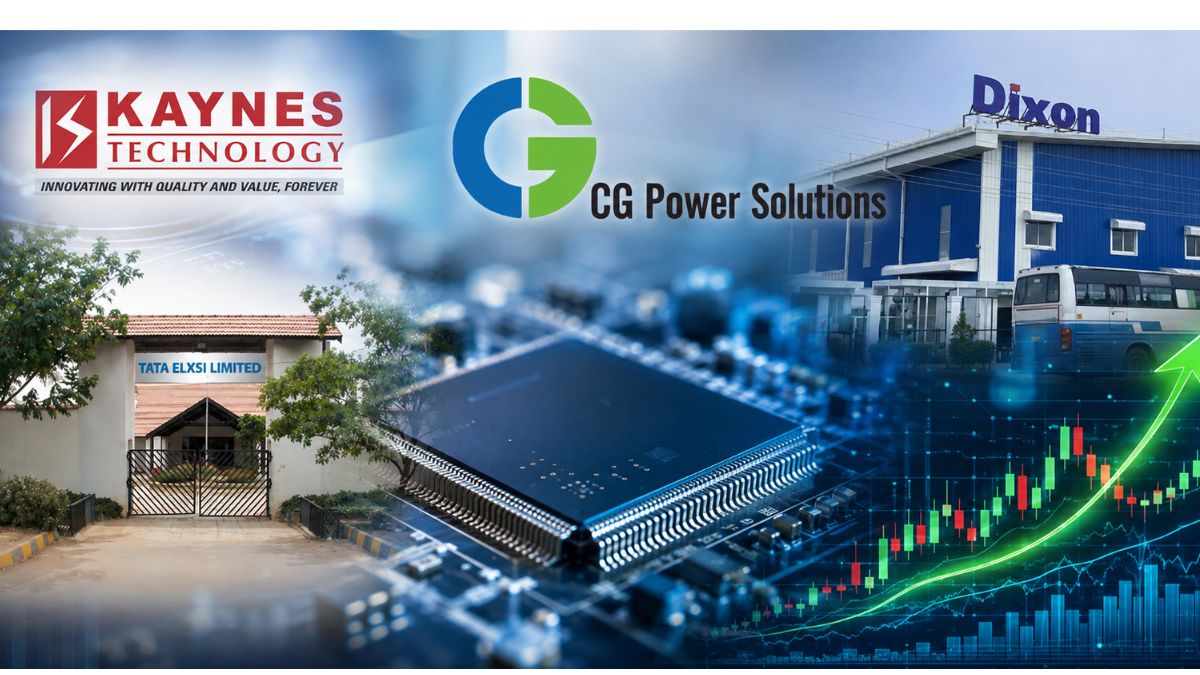
India is trying to build a larger semiconductor industry through a programme called Semicon 2.0.
Four companies are involved, but they are doing different jobs.
CG Power has already started making and shipping packaged chips.
Kaynes Technology is building factories for chip testing, packaging and printed circuit boards.
Dixon Technologies is making more electronic parts such as display and camera modules.
Tata Elxsi is helping design and develop electronic and semiconductor-related technology.
The government programme provides financial support for several parts of the semiconductor supply chain.
The companies’ future progress will depend on production, customers, skilled workers and revenue from their new activities.
Tata Elxsi’s work should not be confused with Tata Electronics’ separate semiconductor manufacturing projects.

CG Power has begun commercial production and shipped packaged semiconductors from its G1 OSAT facility in Sanand, Gujarat.
Kaynes Technology is developing OSAT and PCB facilities, targeting commercial revenue from the third and fourth quarters of FY27.
Dixon Technologies is expanding semiconductor-related exposure through display modules, camera modules, precision engineering and localisation.
Tata Elxsi is pursuing semiconductor opportunities through engineering, embedded technology and product-development services rather than manufacturing.
Semicon 2.0 offers support across chip design, equipment, fabs, ATMP and OSAT, research and development, and talent development.
- Who
- CG Power and Industrial Solutions, Kaynes Technology India, Dixon Technologies India and Tata Elxsi, within India’s Semicon 2.0 programme.
- What
- The companies are expanding into semiconductor manufacturing, packaging, testing, electronic components, engineering and related services.
- Where
- The activities are in India, including CG Power’s G1 OSAT facility in Sanand, Gujarat, and Kaynes’ planned Chennai PCB facility.
- When
- CG Power has already begun commercial production; Kaynes is targeting operations and commercial revenue in Q3 and Q4 of FY27, while the government notification is dated August 31.
- Why
- The companies are seeking opportunities created by India’s semiconductor policy, electronics localisation and growing demand for domestic manufacturing and engineering capabilities.
Key facts
- Semicon 2.0 size
- The government programme covers Rs 1,27,500 crore.
- Government support
- Support includes up to 40% of eligible project cost for silicon wafer fabs, 35% for advanced ATMP and OSAT, 25% for legacy packaging, and 30% capex support for semiconductor equipment and materials.
- CG Power G1 capacity
- The Sanand OSAT facility has peak capacity of 300 million units per year.
- CG Power investment
- CG Semi’s partners plan to invest more than Rs 7,600 crore over five years across the G1 and G2 facilities.
- Kaynes FY26 spending
- Kaynes spent Rs 473 crore on OSAT and Rs 324 crore on PCB in FY26.
- Tata Electronics project
- The Tata Electronics-PSMC wafer-fab project involves Rs 91,000 crore of investment and planned capacity of 50,000 wafers per month.
- Q1 FY27 revenue
- Reported revenue was Rs 3,281 crore for CG Power, Rs 946 crore for Kaynes, Rs 15,557 crore for Dixon and Rs 1,021.1 crore for Tata Elxsi.
Quotes
Vellayan Subbiah
Chairman of CG Power
“So there are two parts of PLI 2. One part is going to be linked to your production value, which we feel largely will come from the global markets. The second is linked to the localisation, in which we understand the details are still awaited; they are mentioning five components, out of which we have a play in two, camera modules and display.”
 financialexpress.com
“Our commitments, as indicated by the Executive Vice Chairman last year, are that we are going to have commercial revenue booking from this year, from the third quarter and fourth quarter, and we are committed to that. And the project is on track.”
financialexpress.com
Sources
Related news
India’s Semicon 2.0 Broadens Chip Ecosystem; Three Stocks Watched
India Notifies Rs 1.27 Lakh Crore Semicon 2.0 Programme

India Notifies ₹1.27 Lakh-Crore Semicon 2.0 Semiconductor Expansion Scheme
India’s Semiconductor Push Opens New Avenues for Chemical Companies

Anand Rathi's Ganesh Dongre Recommends Four Stocks to Buy

Motilal Oswal sees 30% upside as Kaynes Tech Q1 results

Indian Stocks Mixed Ahead of Q1 Results and Earnings Previews