

9 hrs ago
Supreme Court Upholds 2018 SC/ST Act Amendment Again

The Supreme Court was asked to review a change to a law protecting Scheduled Castes and Scheduled Tribes.
The change made it unnecessary to hold a preliminary inquiry before registering certain FIRs.
It also removed the need for prior approval before making arrests in specified situations.
The amendment restored restrictions on anticipatory bail in cases under the law.
Brijbhushan Saini’s lawyer said these rules could be misused and called the bail restriction reverse discrimination.
He also raised questions about conviction rates and compensation payments.
The Court said it had already upheld the amendment in 2020.
It refused to reopen that decision because safeguards against misuse were already available.

The Supreme Court rejected Brijbhushan Saini’s PIL challenging the constitutional validity of the 2018 SC/ST Act amendment.
The bench declined a request to reconsider its 2020 judgment upholding the amendment.
Section 18A removed preliminary-inquiry requirements before FIR registration and prior-approval requirements before arrests.
The amendment restored statutory restrictions on anticipatory bail under the SC/ST Act.
Saini’s lawyer cited possible misuse, low conviction rates and compensation concerns, but the Court said safeguards already existed.
- Who
- A Supreme Court bench comprising Chief Justice Surya Kant and Justices Joymalya Bagchi and V Mohana heard a PIL filed by Brijbhushan Saini; Vishnu Shankar Jain represented him.
- What
- The Supreme Court rejected a challenge to the constitutional validity of the 2018 amendment to the Scheduled Castes and Scheduled Tribes (Prevention of Atrocities) Act and declined to revisit its 2020 judgment.
- Where
- The Supreme Court in New Delhi.
- When
- Tuesday, September 22; the reports do not specify the year.
- Why
- The Court said the amendment had already been upheld in 2020 and that adequate safeguards against possible misuse had been laid down.
Petitioner’s concerns
Supreme Court’s position
Anticipatory bail
Petitioner’s concerns
Vishnu Shankar Jain argued that the statutory bar on anticipatory bail amounted to “reverse discrimination” and could be misused.
Supreme Court’s position
The Court declined to reconsider the restriction, noting that the amended provisions had already been upheld in 2020.
FIRs and arrests
Petitioner’s concerns
The petitioner argued that removing preliminary inquiries and prior approval could enable misuse of the law.
Supreme Court’s position
The Court said adequate safeguards against possible misuse had already been established.
Compensation and case outcomes
Petitioner’s concerns
The petitioner’s lawyer cited a low conviction rate and questioned compensation distribution, referring to an alleged Rs 493 crore payment that he said could encourage FIR filings.
Supreme Court’s position
The Court rejected the plea and did not agree to revisit the amendment’s validity.
Key facts
- Petitioner
- Brijbhushan Saini
- Law
- Scheduled Castes and Scheduled Tribes (Prevention of Atrocities) Act, 1989
- Amendment
- Scheduled Castes and Scheduled Tribes (Prevention of Atrocities) Amendment Act, 2018
- Key provision
- Section 18A removed preliminary-inquiry and prior-approval requirements in specified circumstances.
- Anticipatory bail
- The amendment restored the statutory restriction on anticipatory bail under the Act.
- Earlier ruling
- The Supreme Court upheld the amendment in Prithvi Raj Chauhan v. Union of India in 2020.
- Compensation allegation
- The petitioner’s lawyer referred to an allegation that Rs 493 crore had been distributed as compensation.
Sources
Related news
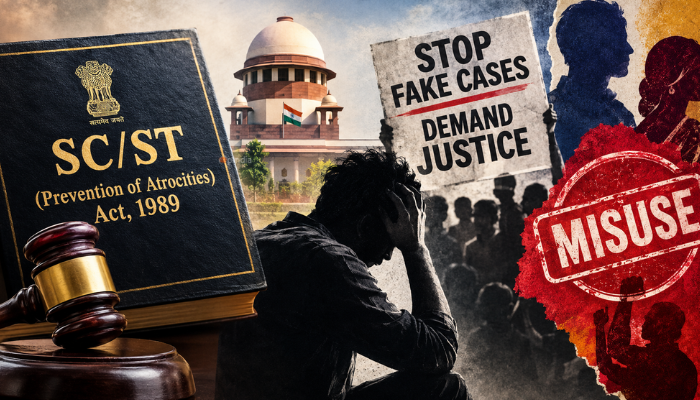
Courts Examine Alleged Misuse of SC/ST Act Compensation

Delhi Police, Azad Oppose YouTuber’s Anticipatory Bail Plea
Delhi High Court to Hear YouTuber’s Anticipatory Bail Plea

Delhi Court Denies Ajeet Bharti Anticipatory Bail in SC/ST Case

NCSC Seeks Warring Arrest in Buta Singh Remarks Case
NCSC Seeks Arrest Action Over Remarks Against Buta Singh
