5 days ago
D.H. Lawrence Framed Sexuality as Sacred Human Experience
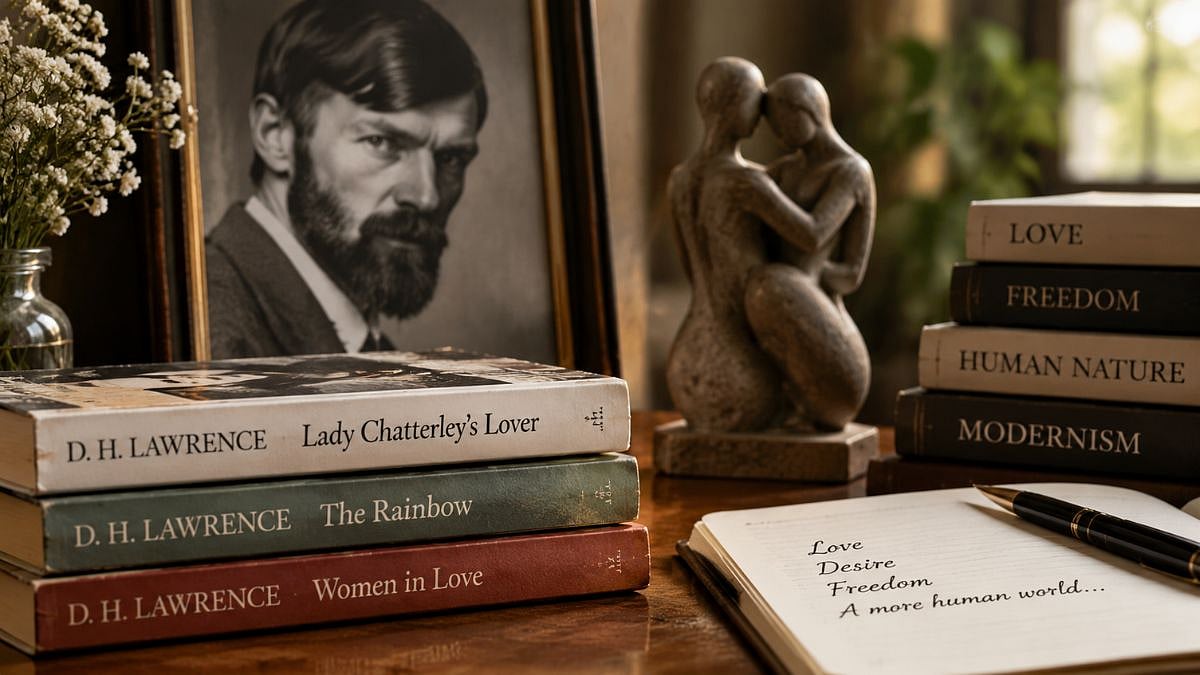
The article explains how D.H. Lawrence wrote openly about sex more than a hundred years ago.
It says he saw physical intimacy as more than just a bodily act.
In his view, it could help people feel connected to nature and to one another.
The article presents sex as a powerful experience involving emotions, the body, and the spirit.
It also discusses Eastern ideas that connect sexuality with balance and spiritual growth.
These ideas are associated with Taoism, Tantra, Hinduism, and Buddhism.
The writer believes shame and strict social rules can make people misunderstand intimacy.
Overall, the article argues that sex should be treated as a natural and potentially meaningful part of human life.

The article presents D.H. Lawrence as a modernist writer who challenged conventional attitudes toward sexuality.
It highlights Lady Chatterley’s Lover (1928), The Rainbow (1915), and Women in Love (1920).
Lawrence is described as viewing physical intimacy as a force opposing industrial society and rigid morality.
The article connects sexuality with spiritual ideas found in Taoism, Tantra, Hinduism, and Buddhism.
It argues that intimacy should be understood as sacred and natural rather than treated mainly with shame or secrecy.
- Who
- The article focuses on English novelist D.H. Lawrence and is written by Sumit Paul.
- What
- It examines Lawrence’s portrayal of sexuality as a profound, natural, and potentially spiritual human experience.
- Where
- The article discusses Lawrence’s English literary context and compares it with ideas from Eastern philosophical traditions.
- When
- The discussion centers on Lawrence’s novels published in 1915, 1920, and 1928, as well as changing attitudes toward sexuality.
- Why
- It argues that sexuality has often been constrained by shame, religious morality, social rules, and intellectual repression.
Key facts
- Featured writer
- D.H. Lawrence
- Highlighted novel
- Lady Chatterley’s Lover, published in 1928
- Other highlighted novels
- The Rainbow (1915) and Women in Love (1920)
- Central argument
- The article portrays physical intimacy as deeper than a purely physical act.
- Lawrence’s stated view
- Sexual passion is presented as a force that can reconnect people with natural instincts.
- Eastern traditions discussed
- Taoism, Tantra, Hinduism, and Buddhism
- Article author
- Sumit Paul
Quotes

Shams-e-Tabriz
The article identifies him as Rumi’s soulmate and cites him while discussing sacred sexuality.
“Ishq shaguftan shavat astan”
 freepressjournal.in

Honoré de Balzac
French novelist cited by the article in support of its description of sex as a profound human experience.
“Sex is the lyre which vibrates the grandest chords of our being.”
freepressjournal.in
Sources
Related news

Why D.H. Lawrence Remains Literature’s Dangerous Writer

Hindi Novel Reimagines Sita’s Life Through Her Own Voice

Moral Knots Persist in Debates Over Bodies and Clothing

Lust Stories 3 Team Explores Intimacy And Desire

Author Says Spirituality Is Missing While Discussing Debut Novel