2 hrs ago
Former HCL CEO Says Cheaper AI Threatens Big AI

Former HCL CEO Nayar says cheaper AI models could seriously challenge the biggest AI companies.
He said some newer models can do most tasks while costing much less and working much faster.
One estimate described them as solving 70–80% of problems at one-tenth the cost.
Elsewhere, he referred to young developers building language models at about half the cost.
Nayar said these models do not need to solve every problem to affect the market.
He also questioned how companies will earn enough money to repay the trillions invested in AI.
Some AI leaders and researchers are warning that the technology may be developed too quickly.
Nayar thinks some of the most extreme warnings are exaggerated.
He is less concerned that only a few companies currently have major control over AI, because he believes competitors can eventually emerge.

Nayar said newer AI models may solve 70–80% of problems at far lower cost and much greater speed.
He argued that such models could disrupt the business models of leading AI companies.
Nayar questioned how the industry will generate revenue from trillions of dollars in AI investment.
He dismissed extreme AI-doomsday warnings as part of an industry hype cycle.
Nayar said concentration among a few AI companies is typical of capitalism and can eventually be challenged.
- Who
- Former HCL CEO Nayar, alongside concerns raised by AI leaders including Sam Altman and Dario Amodei.
- What
- Nayar warned that cheaper, faster AI models could disrupt major AI companies and questioned the industry's business case.
- Where
- When
- Why
- He said lower-cost models could perform much of the same work while challenging the returns expected from enormous AI investments.
Nayar's View
Frontier AI Concerns
Speed of AI development
Nayar's View
Nayar said extreme warnings about AI are part of an industry hype cycle and argued that innovation should not be discouraged by claims that a dominant AI system has arrived.
Frontier AI Concerns
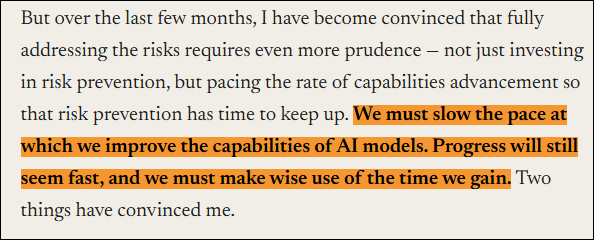
Researchers and executives including Anthropic CEO Dario Amodei and OpenAI CEO Sam Altman have warned about the risks of developing AI too quickly; Altman has supported a slower pace for frontier AI.
Impact of cheaper models
Nayar's View
Nayar said models that solve most problems at a fraction of the cost and in less time could disrupt the business models of major AI companies.
Frontier AI Concerns
The article does not provide a detailed response from major AI companies to Nayar's cost and performance claims.
Concentration of AI power
Nayar's View
Nayar said concentration among a few companies is an expected feature of capitalism and can eventually be challenged by new competitors.
Frontier AI Concerns
The article presents concerns that concentrating AI power among two or three companies could be unsettling and unhealthy for society.
Key facts
- Potential model performance
- Nayar said cheaper models could solve 70–80% of problems.
- Cost comparison
- One comparison cited models operating at one-tenth the cost; Nayar also referred to young developers building models at about half the cost.
- Speed comparison
- The models were described as operating up to 10 times faster.
- Investment concern
- Nayar said trillions of dollars invested in AI were not yet finding a return on investment.
- Business-case concern
- He said AI had not yet produced a business case comparable to internet search or Amazon.
- Industry concentration
- Nayar said AI power being concentrated among three or four companies was less concerning to him.
- Historical example
- He cited Microsoft's operating-system dominance and Linux's subsequent emergence as an example of competition challenging concentration.
Quotes

Nayar
Former HCL CEO commenting on the disruptive potential of cheaper, faster AI models
“There are lots of young people who are developing LLMs at half the cost and 10 times faster. And therefore, when you bring in this kind of 'sher aaya' concept, that kind of innovation really dies down. So I would take that with a pinch of salt.”
 businesstoday.in
“It will not be able to solve 100% of the problems, but the very fact that it can solve 80 or 70% of the problem at one-tenth the cost and 10 times faster is a market disruptor. The business model is getting disrupted.”
businesstoday.in
Sources
Related news
India’s AI Race Gains Momentum, But Jobs Remain Uncertain

AI Boom Faces Debt, Funding and Cheaper Model Risks

Study Finds Limited Anti-Competitive Conduct in India’s AI Market

Former HCL CEO Rejects AI Doomsday Warnings as Hype
Anthropic CEO Urges AI Slowdown Amid Safety and Monopoly Concerns

Anthropic CEO Dario Amodei Urges AI Industry to Slow Down

Why India Must Innovate and Manufacture for Inclusive Growth

Delhi Court Convicts Man in Attempted Acid Attack on Wife

IIT Kharagpur at 75, born in a former colonial prison