

10 months ago
German Study Documents Rats Hunting Bats Midair, Raises Virus Spread Concerns
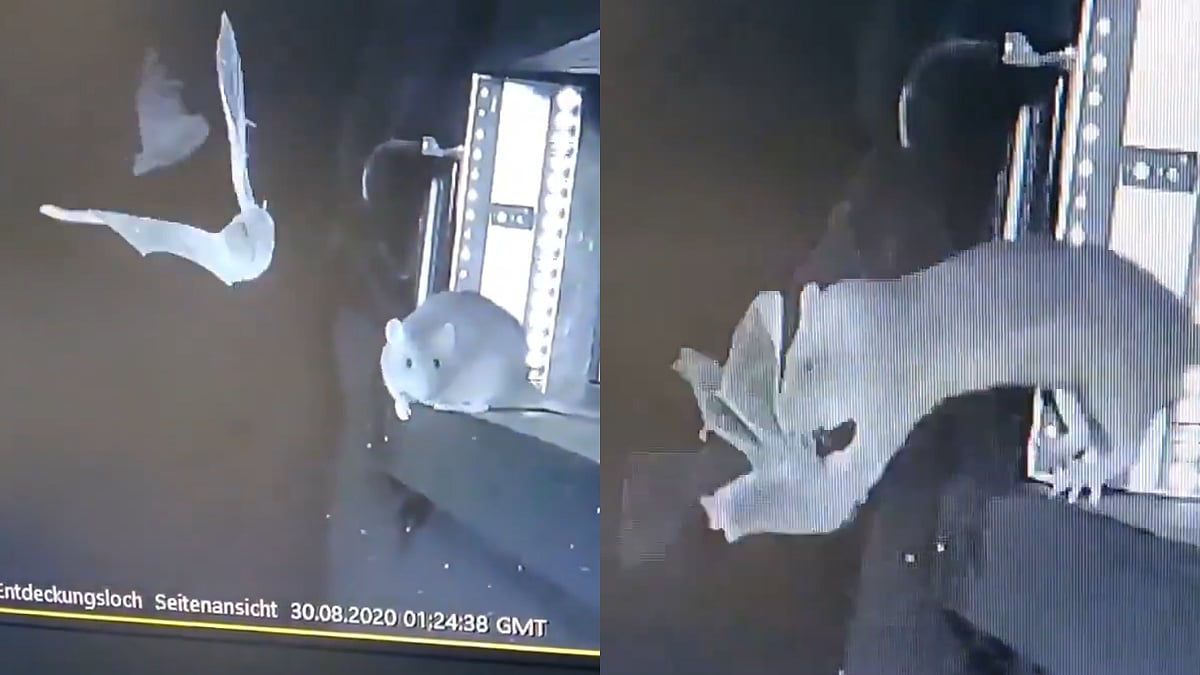
Imagine tiny nighttime hunters, rats, learned to catch flying bats right out of the air!
Scientists in Germany saw this for the very first time using special night cameras near where bats sleep.
They watched rats chase and catch bats in the dark, even finding bat leftovers.
This is a bit like two animals that can carry sicknesses meeting in a new way.
Because both rats and bats can sometimes carry viruses, like coronaviruses, this new hunting behavior might be a way for those sicknesses to spread between them.
Scientists are studying this to understand how nature works and if it could be risky for other animals or even people.
It shows us how much more there is to learn about the animal world and how different creatures interact.

Scientists have documented rats hunting and catching bats in midair for the first time.
The study was conducted by researchers in northern Germany using night vision cameras near bat colonies.
Researchers observed 30 instances of rats pursuing bats, with 13 successful hunts.
Both rats and bats are known to carry various viruses, raising concerns about pathogen spillover.
The behavior may offer an explanation for how bat-borne viruses, like coronaviruses, could spread.
- Who
- Northern German scientists, led by Florian Gloza-Rausch
- What
- Observed and documented rats hunting and catching bats in midair, a previously undocumented behavior.
- Where
- Urban bat colonies in northern Germany (Lüneburg and Bad Segeberg).
- When
- Visuals dated back to 2020; study published recently.
- Why
- The behavior raises concerns about the potential for virus spread, as both rats and bats are known disease transmitters.
Scientific Observation
Potential Implications
Rats Hunting Bats
Scientific Observation
Scientists have observed and documented rats successfully hunting bats in midair in total darkness, a behavior previously undocumented scientifically.
Potential Implications
This behavior raises concerns about potential risks of virus spread, as both rats and bats are known to harbor various fatal illnesses.
Virus Transmission
Scientific Observation
The study focused on documenting the hunting behavior and did not directly investigate disease transmission between the species.
Potential Implications
The researchers emphasize that because both species are known carriers of various illnesses, this interaction could facilitate the spillover of bat pathogens like coronaviruses.
Key facts
- Study Location
- Northern Germany (Lüneburg and Bad Segeberg)
- Journal Publication
- Global Ecology and Conservation
- Lead Author
- Florian Gloza-Rausch, Museum of Natural History in Berlin
- Documented Hunts
- 30 instances of brown rats pursuing bats
- Successful Hunts
- 13 successful hunts observed
- Bat Colony Size (Bad Segeberg)
- Up to 30,000 bats
- Bat Carcasses Found
- More than fifty
Quotes
Florian Gloza-Rausch
a biologist at the Museum of Natural History in Berlin and the lead author of the report
“To our knowledge, this type of rat behaviour has not previously been documented scientifically.”
 freepressjournal.in


