2 weeks ago
Strong Growth and Forex Inflows May Worsen Household Inflation
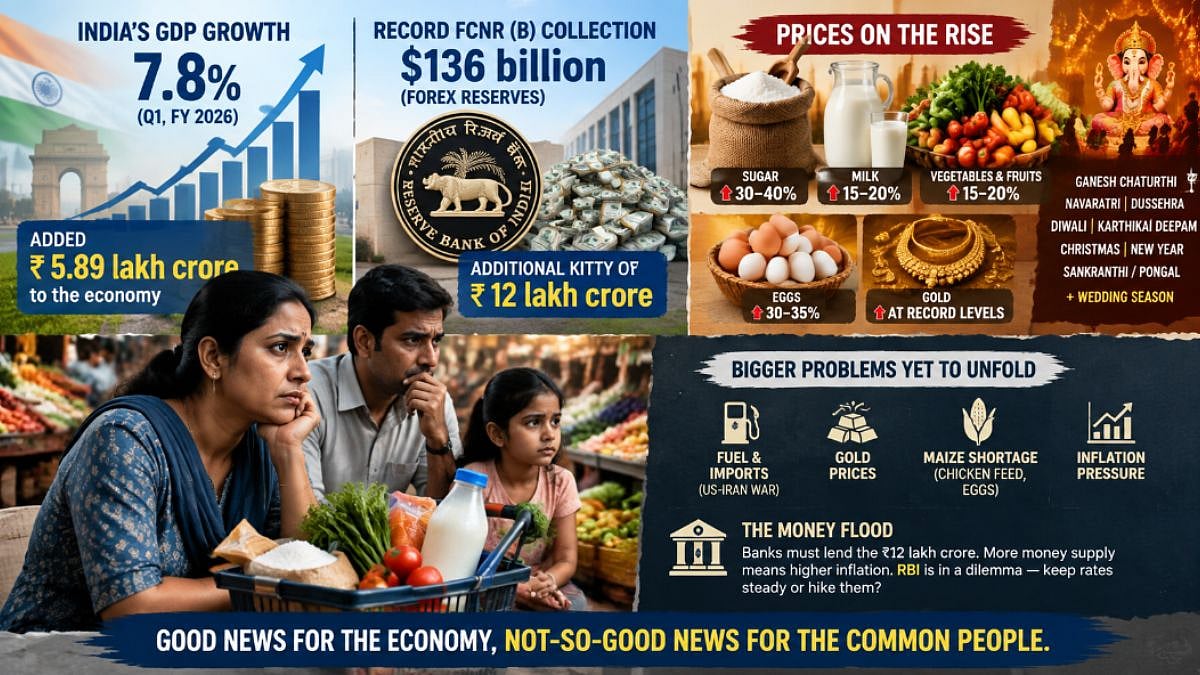
India’s economy grew quickly during the first three months of the current financial year.
Banks also received a very large amount of money from deposits made under the FCNR (B) scheme.
These developments are good signs for financial markets and the economy.
However, the article says families are still paying more for food and other everyday needs.
Sugar prices have risen sharply, and milk, fruits, and vegetables have also become more expensive.
The government says the sugar shortage is linked to lower production, weather damage, rising demand, and other supply problems.
Some critics instead blame the use of sugar and crops to make ethanol.
The article warns that more money moving through banks could increase inflation.
It says people may have to wait six months to a year before they feel the benefits of economic growth.

India recorded 7.8% GDP growth in April–June 2026, adding about Rs 5.89 lakh crore to the economy.
The FCNR (B) scheme reportedly attracted $136 billion, although the article also refers to the figure as $137 billion.
Retail sugar prices have risen 30–40%, with prices ranging from Rs 61 to Rs 68 per kilogram in five cities.
Milk, vegetables, and fruits have reportedly become 15–20% more expensive, while egg prices have risen 30–35%.
The article argues that stronger growth and increased bank lending could raise inflation before ordinary households see meaningful benefits.
- Who
- India’s economy, households, banks, the Reserve Bank of India, government officials, and analysts are central to the discussion; the article was written by Muralidhar Swaminathan.
- What
- The article examines why strong GDP growth and large FCNR (B) inflows may not immediately help households and could add to inflationary pressure.
- Where
- India, with retail sugar prices cited for Delhi, Mumbai, Chennai, Bangalore, and Ranchi.
- When
- GDP growth covered April–June 2026; the article discusses the coming festive season and the following six months to one year.
- Why
- The article attributes household price pressures to supply shortages, seasonal demand, weather damage, global conditions, speculation, and the possibility that increased money supply will fuel inflation.
Government and Supporters
Article’s Critique and Critics
Cause of higher sugar prices
Government and Supporters
The government attributes the shortage mainly to lower domestic production, festive-season demand, weather damage, tighter global supplies, speculation, and hoarding. It also says sugar diversion to ethanol has declined and that nearly three-fourths of ethanol now comes from grains, particularly maize.
Article’s Critique and Critics
Anti-ethanol policy lobbyists and other critics blame the diversion of sugar and crops to ethanol for contributing to higher sugar prices, although the article says this explains the surge only partly.
Meaning of economic growth
Government and Supporters
Government circles, analysts, policymakers, and financial experts have celebrated the 7.8% GDP growth and large FCNR (B) inflows as positive economic developments.
Article’s Critique and Critics
The article argues that these gains have not yet improved everyday affordability and may take six months to a year to reach ordinary people, if they do.
Effect of large financial inflows
Government and Supporters
The deposits provide banks with additional funds to lend and increase available resources in the economy.
Article’s Critique and Critics
The article warns that increased lending and money supply could intensify inflation, leaving the Reserve Bank of India to balance the risks of keeping rates low against the cost pressures of raising them.
Key facts
- GDP growth
- 7.8% in the first quarter of the current fiscal year, covering April–June 2026.
- GDP addition
- About Rs 5.89 lakh crore was added to the economy during April–June 2026.
- FCNR (B) inflows
- The article reports $136 billion collected through the FCNR (B) scheme, while elsewhere citing $137 billion.
- Sugar prices
- Retail prices were reported at Rs 62 per kilogram in Delhi, Rs 66 in Mumbai, Rs 63 in Chennai, Rs 61 in Bangalore, and Rs 68 in Ranchi.
- Sugar imports
- India imported 1 million metric tonnes of sugar, reportedly for the first time in at least more than a decade.
- Ethanol diversion
- The government says the share of sugar diverted to ethanol fell from about 12% in 2022–23 to about 9% in 2025–26.
- Other price increases
- Milk, vegetables, and fruits reportedly rose 15–20%, while egg prices increased 30–35%.
Sources
Related news

Warring Questions 7.8% GDP Growth, Seeks Relief for Indians

Shiv Sena (UBT) Says GDP Growth Masks Rupee, Jobs Crisis

Onion and Sugar Prices Raise Political Heat Before Festivals
Haryana Congress Flags Sharp Rise in Sugar Prices
India’s Sugar Price Surge Exposes Deeper Supply-Management Challenges

India’s Sugar Prices Surge as Demand, Weather and Speculation Weigh

ITC Raises Classic Connect and Gold Flake Prices Again

HDFC AMC CEO Warns Retail Investors Against Chasing IPO Profits

More PSU Stake Sales Signaled After Hindustan Copper OFS

SEBI Reviews CAS Trading, Proposes Flexible Debt Maturity Norms