

12 months ago
Mars Sunsets: Blue Hues Explained by Dusty Atmosphere
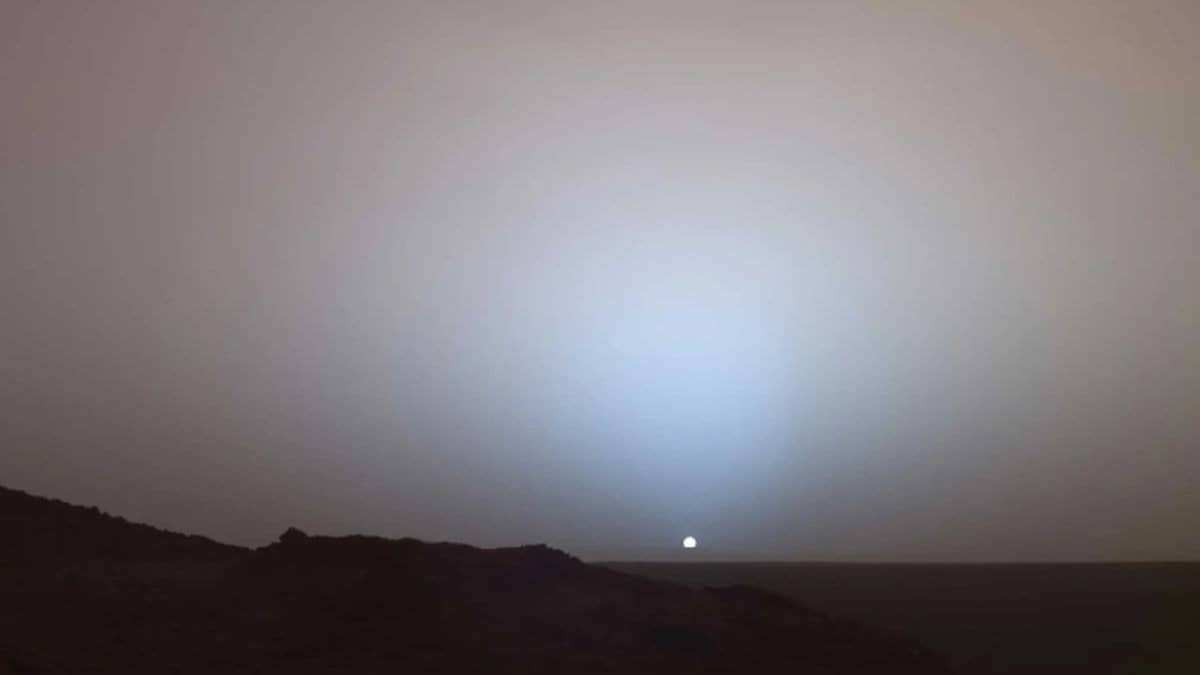
Sunsets on Mars appear blue because of dust in its atmosphere.
Unlike Earth, where sunsets show reds and oranges, Mars's thin atmosphere causes a different effect.
The fine dust allows blue light to travel through, making the area around the sun blue.
The rest of the sky appears yellow and orange.
This phenomenon has been observed by NASA's rovers, like Curiosity, and Spirit.
A similar effect can happen on Earth after volcanic eruptions.
These fine dust particles change the sunset colours we usually see.

Mars sunsets appear blue due to the planet's dusty atmosphere.
Fine dust scatters blue light, making the area around the Sun appear blue.
The rest of the sky appears yellow to orange during Martian sunsets.
NASA's rovers like Curiosity and Spirit have captured images of these sunsets.
A similar effect happens on Earth after some volcanic eruptions.
- Who
- NASA and its rovers
- What
- Observed and explained the blue sunsets on Mars.
- Where
- Mars
- When
- Since at least May 19, 2005
- Why
- Due to dust particles that scatter blue light more efficiently.
Key facts
- Planet
- Mars
- Atmospheric Factor
- Fine dust particles
- Sunset Color
- Blue near the Sun, yellow/orange elsewhere
- Rover responsible
- Curiosity, Perseverance, Spirit
- Sunset image date
- May 19, 2005
Quotes
Mark Lemmon
a science team member of NASA’s Curiosity rover mission
“The very fine dust is the right size so that blue light penetrates the atmosphere slightly more efficiently. When the blue light scatters off the dust, it stays closer to the direction of the Sun, while red and yellow light scatter more widely across the sky.”
 republicworld.com
Sources
Related news
NASA Finds Broad, Shallow Pits During Curiosity’s Mars Traverse
Curiosity Rover Discovers Vast Honeycomb Landscape on Mars

Curiosity Entertainment Expands Leadership with New Execs
NASA Loses Contact With MAVEN Mars Orbiter
