3 days ago
Forensic Study Finds Evidence of Servant Sacrifice in Ancient Egypt
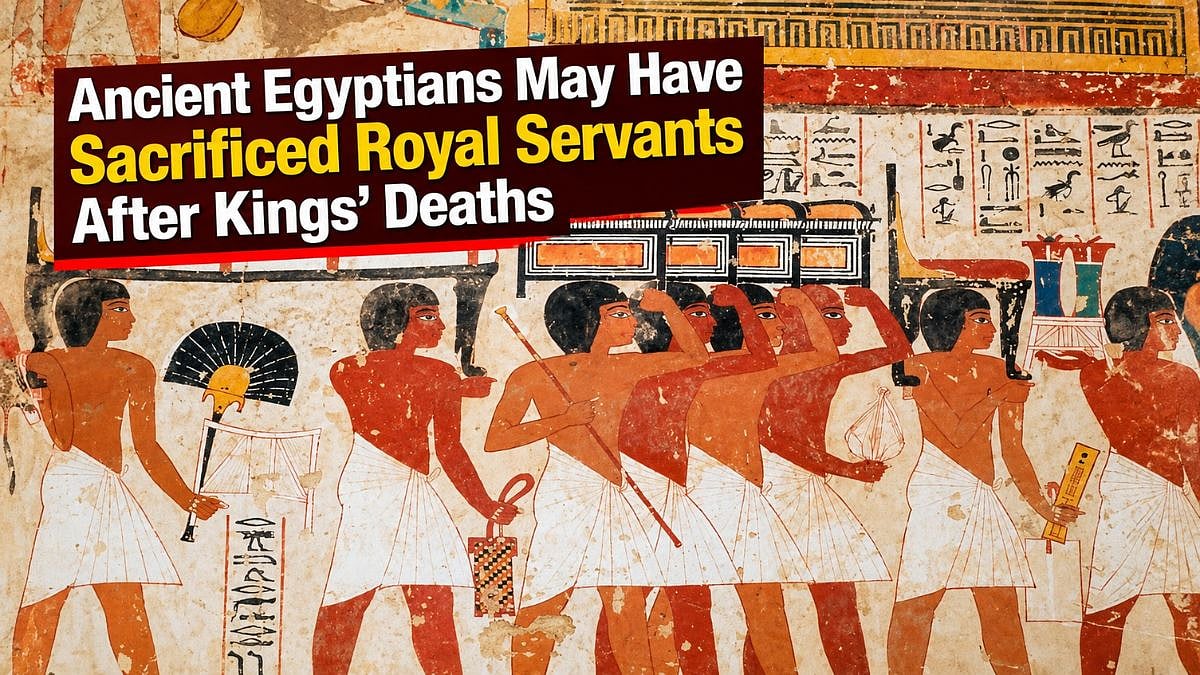
Researchers looked closely at skulls from people buried near ancient Egyptian kings.
The remains are about 5,000 years old.
They used modern forensic methods to study the skulls.
Eighteen of the 46 skulls had fractures that likely happened near the time the people died.
The researchers say this supports the idea that some royal servants were killed and buried near their rulers.
The servants may have been expected to serve the rulers in the afterlife, or their deaths may have shown the rulers’ power.
Some may have volunteered, while others may have been chosen or forced.
The evidence cannot show that everyone buried there was killed.
Some people may have died naturally, and some methods of killing would not leave marks on skulls.

Researchers examined 46 preserved skulls from Egypt’s First Dynasty, dating to about 3100–2900 BC.
Eighteen skulls had fractures judged consistent with injuries around the time of death.
The skulls came from graves near royal tombs at Abydos, an ancient burial ground in southern Egypt.
Researchers say the injuries and burial context support the theory that at least some royal retainers were killed and buried near rulers.
The evidence does not establish that all those buried near the tombs were sacrificed; retainers may have volunteered, been chosen, or been forced.
- Who
- Bioarchaeologist Roselyn Campbell examined preserved skulls from people buried near royal tombs.
- What
- Forensic analysis found fractures consistent with near-death head injuries in 18 of 46 skulls, supporting the possibility that some royal retainers were killed.
- Where
- The graves were at Abydos in southern Egypt; the preserved skulls were held at the University of Cambridge.
- When
- The remains date to about 3100–2900 BC; the study was published in Frontiers in Environmental Archaeology.
- Why
- Researchers suggest retainers may have been killed to serve rulers in the afterlife or to display royal power.
Evidence Supporting Sacrifice
Limits and Uncertainty
What the injuries show
Evidence Supporting Sacrifice
Fractures in 18 skulls, combined with their burial near royal tombs, support the interpretation that at least some retainers were killed.
Limits and Uncertainty
The sample is small and incomplete, and the evidence cannot establish that everyone buried near the tombs was sacrificed.
How and why people died
Evidence Supporting Sacrifice
The injuries are consistent with potentially fatal blows, and retainers may have been killed to serve rulers in the afterlife or display royal power.
Limits and Uncertainty
Some people may have died naturally, and other possible methods, such as asphyxiation, would not necessarily leave visible skull evidence; the motives and circumstances remain uncertain.
Whether retainers consented
Evidence Supporting Sacrifice
Some retainers may have been selected or forced to die.
Limits and Uncertainty
Campbell said some may instead have volunteered to seek eternal life or honor.
Key facts
- Period
- Egypt’s First Dynasty, approximately 3100–2900 BC
- Skulls examined
- 46 preserved skulls
- Skulls with fractures
- 18, nearly 39% of those examined
- Grave location
- Abydos, southern Egypt
- Lead researcher
- Roselyn Campbell, a postdoctoral researcher at Purdue University
- Publication
- Frontiers in Environmental Archaeology
- Excavation
- Flinders Petrie excavated the remains in the 1920s and preserved some skulls
Quotes
Roselyn A. Campbell
Postdoctoral researcher at Purdue University and author of the study
“By consulting modern forensic studies and advances in our understanding of how human bodies react to injuries and to decay processes over time, I was able to identify clear evidence of head injuries in some of these individuals that occurred around the time of death.”
 NDTV
NDTV
 freepressjournal.in
“These injuries, combined with the archaeological context, strongly suggest that at least some of the retainers were killed and then buried around the tombs of these rulers.”
NDTV
Sources
Related news

Lost Pages Linked to Henry VIII Aide Found in Brighton

Forensic Professor Plans to Publish Review of Epstein Autopsy
How Indian Sculptures’ Global Dispersal Complicates Their Interpretation
Study Finds Devil’s Arrows Were Deliberately Transported

Greece to Hand Over Remains of Medieval Bulgarian Tsar Samuel

Readers Debate Robot Farewells, Aviation Safety and Food Waste