

1 hr ago
UK, Norway and US Foil Russian Arctic Cable Sabotage Exercise
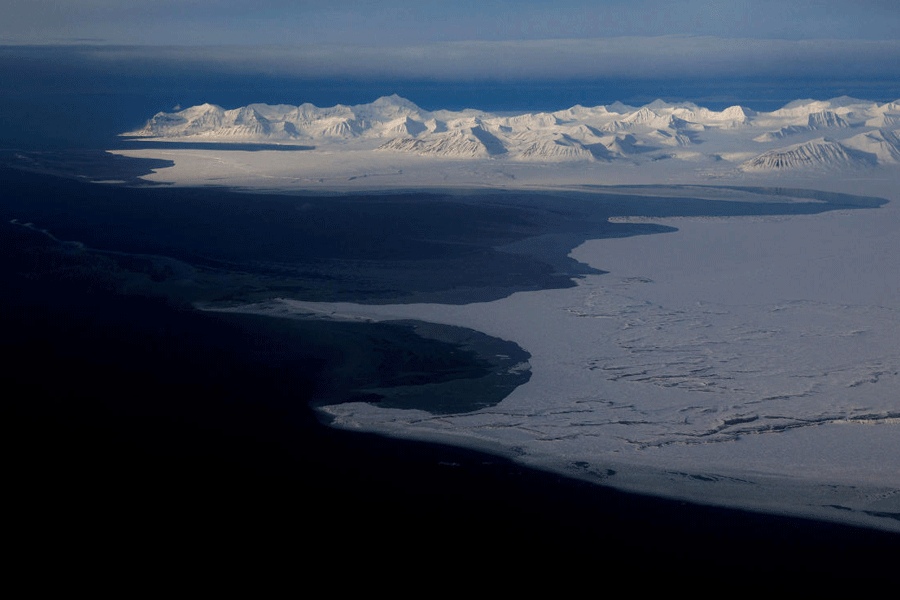
Britain, Norway and the United States watched Russian submarines near Svalbard in the Arctic.
Western officials said the submarines were practicing how to damage important underwater cables.
These cables help carry internet traffic and satellite information.
The Russian vessels did not cut or damage any cables during the exercise.
The allied countries tracked the vessels and confronted them.
The vessels then left the area without finishing the exercise.
Russia’s Defence Ministry did not comment on the specific incident.
The Kremlin generally denies carrying out sabotage against NATO countries.
The countries involved said they wanted to show that suspicious activity near critical infrastructure would be detected.

British, Norwegian and U.S. forces tracked Russian deep-sea vessels near Svalbard during a spring exercise.
The vessels were linked by Western officials to Russia’s Main Directorate of Deep-Sea Research, or GUGI.
Officials said the exercise simulated deploying technology intended to disable undersea cables without leaving fingerprints.
The Russian vessels were confronted, prevented from completing the exercise and eventually left the area; no cables were damaged.
The operation focused on two fiber-optic cables connecting Svalbard with mainland Norway, which carry satellite data and support global communications.
- Who
- British, Norwegian and U.S. forces tracked Russian vessels associated by Western officials with GUGI, Russia’s Main Directorate of Deep-Sea Research.
- What
- The vessels reportedly simulated deploying a covert weapon designed to disable subsea cables, but were prevented from completing the exercise.
- Where
- In Arctic waters near the Svalbard archipelago, including the area between Svalbard and mainland Norway.
- When
- The operation took place in the spring; Britain and Norway disclosed related covert activity on April 9.
- Why
- Western officials said the exercise was connected to possible preparations for a conflict with NATO and attacks on critical infrastructure.
Western officials and NATO allies
Russia and the Kremlin
Nature of the exercise
Western officials and NATO allies
Western officials said Russian deep-sea vessels were practicing how to deploy technology capable of disabling subsea cables during a potential conflict with NATO.
Russia and the Kremlin
Russia’s Defence Ministry did not respond to questions about the incident, while the Kremlin generally denies conducting sabotage operations in NATO countries or planning confrontation.
Threat to infrastructure
Western officials and NATO allies
Western officials and security analysts described subsea cables as strategically important and said suspicious surveying and interference could indicate preparations for sabotage.
Russia and the Kremlin
No specific Russian acknowledgment of targeting the cables was reported, and the article says the vessels did not damage any cables.
Allied response
Western officials and NATO allies
Britain, Norway and the United States tracked and confronted the vessels to deter covert operations and protect critical infrastructure.
Russia and the Kremlin
The Kremlin has rejected broader allegations of Russian sabotage activity, and Russia did not publicly confirm the reported operation.
Key facts
- Cables involved
- Two 1,400-kilometre fiber-optic cables connect Svalbard with mainland Norway.
- Cable depth
- The cables lie as deep as 2,700 metres below the sea’s surface.
- Main data source
- The cables carry satellite data from SvalSat, described as the world’s largest satellite ground station.
- Russian unit
- The operation was attributed by Western officials to GUGI, Russia’s Main Directorate of Deep-Sea Research.
- Participating allies
- The joint operation involved the United Kingdom, Norway and the United States.
- Result
- The Russian vessels left the area, and no cables were damaged.
- Norwegian response
- Defence Minister Tore Sandvik said Russia had been shown that it could not operate covertly.
Quotes
Tore Sandvik
Norway’s Defence Minister
“We have made it unequivocally clear to Russian authorities that any attempt to target our critical infrastructure will be detected and met with consequences. It is in no one's interest to escalate tensions in the High North.”
 telegraphindia.com
“Through our joint operation, we sent a clear message to Russia that they cannot operate covertly.”
telegraphindia.com
Ami Daniel
Chief executive of maritime risk analytics firm Windward
“The current thinking is that Russia and China are probably the most active and critical underwater threats.”
telegraphindia.com
Sources
Related news

Western Intelligence Warns of Russian Sabotage Across Europe

Denmark Says Russia Recruits Danes for Sabotage Planning
India warns China's underwater data collection not for peaceful purposes
Lavrov Says NATO Arctic Activity Poses Direct Threat to Russia