

2 hrs ago
India’s Electronics Boom Faces A Growing Semiconductor Import Challenge
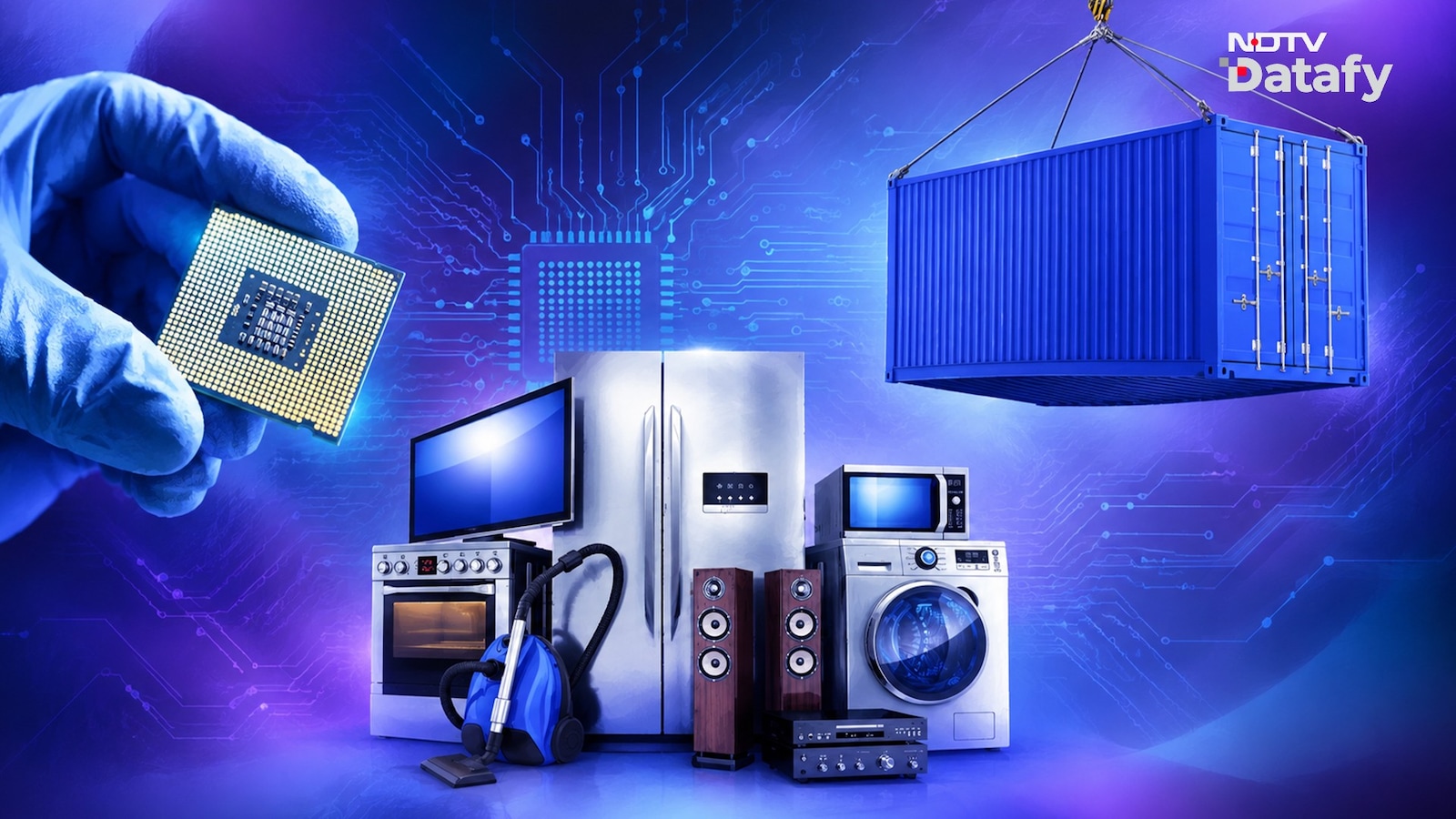
India now makes almost all of the mobile phones sold inside the country.
This is a major change from relying heavily on imported phones.
Mobile phone production and exports have grown very quickly.
Electronics exports have also nearly doubled in five years.
However, India still buys most of its semiconductors, which are tiny parts used in electronic devices.
About 90% to 95% of the semiconductors needed in India come from other countries.
This created a semiconductor trade deficit of nearly $35 billion in 2025-26.
The government wants to build more chip factories and develop Indian chip designs.
Prime Minister Narendra Modi also said India could attract companies seeking reliable places to expand their semiconductor operations.

Domestic production now accounts for 99.2% of mobile phones sold in India.
Mobile phone production rose 33-fold and exports increased 165-fold over 11 years.
Tamil Nadu led electronics exports in 2025-26 with nearly 31% of the national total.
India imported $36.5 billion in semiconductors but exported about $1.5 billion in 2025-26.
The government is supporting 12 approved semiconductor projects and promoting domestic chip design and manufacturing.
- Who
- India’s electronics industry, the Indian government, NITI Aayog, and Prime Minister Narendra Modi.
- What
- India has achieved major growth in mobile phone and electronics manufacturing but remains highly dependent on imported semiconductors.
- Where
- India, with electronics exports concentrated in Tamil Nadu, Maharashtra, Karnataka, Gujarat, and Uttar Pradesh.
- When
- The reported trade figures cover 2025-26; Narendra Modi addressed Semicon India 2026 on September 17.
- Why
- To reduce foreign-exchange outflows and supply-chain vulnerability while building a domestic semiconductor ecosystem.
Strategic Risks And Gaps
Growth Opportunities And Government Response
Semiconductor dependence
Strategic Risks And Gaps
NITI Aayog warns that meeting 90%-95% of semiconductor demand through imports creates foreign-exchange outflows and leaves critical sectors vulnerable to supply-chain disruptions.
Growth Opportunities And Government Response
The government views the widening gap between demand and domestic capacity as an opportunity to establish a stronger semiconductor ecosystem.
India’s manufacturing position
Strategic Risks And Gaps
Despite its mobile phone success, India’s semiconductor trade deficit nearly reached $35 billion in 2025-26, showing that electronics assembly has not yet translated into chip self-sufficiency.
Growth Opportunities And Government Response
India has become the world’s second-largest mobile phone manufacturer by volume, and officials believe its growing demand and manufacturing base can attract semiconductor investment.
Future industry priorities
Strategic Risks And Gaps
Limited domestic chip manufacturing and intellectual-property creation remain significant weaknesses in the electronics supply chain.
Growth Opportunities And Government Response
Narendra Modi called for more fabless companies, domestic intellectual property, silicon photonics, and system-level innovations involving memory architecture and heat management.
Key facts
- Domestic mobile production
- 99.2% of mobile phones sold in India are manufactured domestically.
- Mobile phone growth
- Production increased 33-fold and exports rose 165-fold over 11 years.
- Electronics trade
- India imported electronic goods worth $179 billion and exported $90.6 billion in 2025-26.
- Top exporting state
- Tamil Nadu accounted for nearly 31% of India’s electronics exports in 2025-26.
- Semiconductor import dependence
- An estimated 90%-95% of domestic semiconductor demand is met through imports.
- Semiconductor trade
- India imported $36.5 billion in semiconductors and exported about $1.5 billion in 2025-26.
- Approved projects
- The government has approved 12 semiconductor projects.
Quotes
NITI Aayog
Indian government policy institution cited as the source of the May 2026 semiconductor report
“The country's semiconductor market is projected to reach around $200 billion by 2035. However, despite growing domestic demand, nearly 90-95 per cent of this demand is currently met through imports, leading to large foreign exchange outflows and increasing the vulnerability of critical sectors to supply-chain disruptions”
 NDTV
NDTV
Sources
Related news

India Targets 35–40% Domestic Value Addition in Mobile Phones

India’s $214 Billion Non-Petroleum Trade Deficit Challenges Make in India
India Pushes Beyond Assembly Into Domestic Electronics Components
Modi Pitches India as Trusted Hub for Semiconductor Manufacturing

Study Finds China Supplies 80% of India’s Electronics Imports
India Expands Semiconductor Mission to Build Chips and Talent
Eknath Shinde Praises Modi at PM’s Vadnagar Birthday Event
PM Modi Thanks People, Highlights Service And Developed India
Cheetah Lamp Art Marks Modi’s Birthday in Madhya Pradesh

Vasai-Virar Civic Body Launches Month-Long Seva Sankalp Abhiyan

Rajasthan BJP leaders mark PM Modi’s birthday with service activities