Science & Tech · Space · 21 hrs ago
How to find the Double Cluster in Perseus on autumn evenings
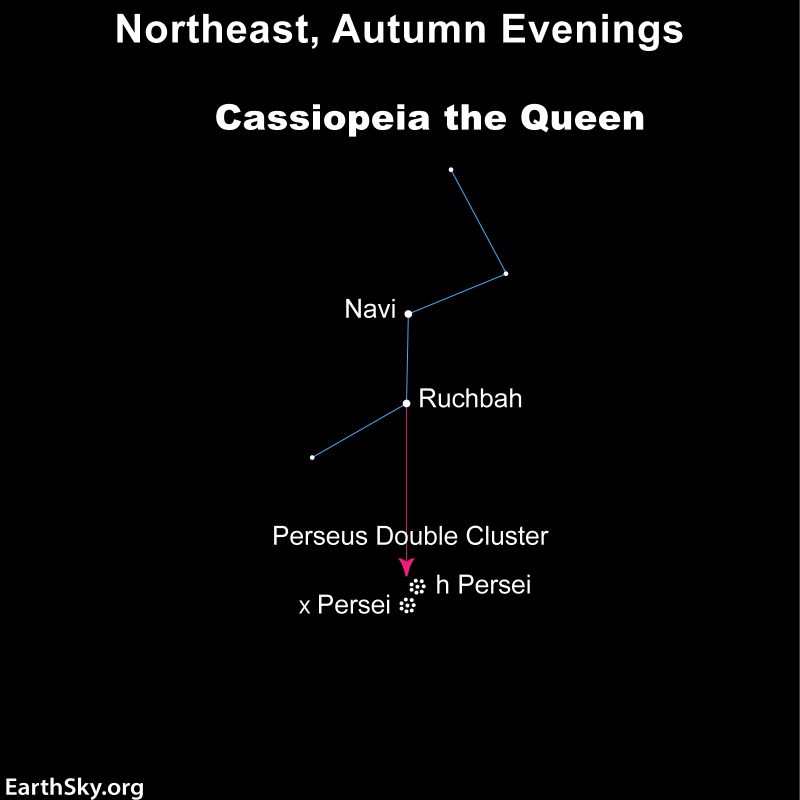
The Double Cluster is a pair of open star clusters in the constellation Perseus, near Cassiopeia in the Northern Hemisphere sky.
Each cluster contains a few hundred young, hot stars that are many thousands of times more luminous than the Sun.
The pair is about 7,500 light-years away, in the Perseus arm of the Milky Way, while our solar system is in the Orion arm.
To find it, look for Cassiopeia’s distinctive M or W shape, then scan the space between Cassiopeia and Perseus with binoculars.
Under dark skies, the clusters can also be seen without binoculars.
From mid-northern latitudes, they remain above the horizon all year; farther south in the Northern Hemisphere, autumn and winter evenings are good times to look.
The clusters are harder to see when they are near the horizon, so waiting until later in the night can help.
They are highest in the northern sky on late autumn and early winter evenings.

The Double Cluster in Perseus can be found by scanning between Cassiopeia and Perseus with binoculars.
Cassiopeia is easy to identify by its distinctive M or W shape.
The Double Cluster consists of two nearby open star clusters known as h Persei and chi Persei.
The clusters are about 7,500 light-years away and each contains a few hundred stars.
At mid-northern latitudes, the Double Cluster is above the horizon every night of the year.
- Who
- Stargazers looking for the Double Cluster in Perseus.
- What
- The article explains how to locate two nearby open star clusters using Cassiopeia and Perseus as guides.
- When
- It is visible in the evening most of the year, except in late spring and summer.
- Where
- Between the constellations Cassiopeia and Perseus in the northern sky.
- Why
- Not stated
This story does not have two clearly opposing sides.
If you have a dark sky and find Cassiopeia – which is easy, because the constellation has a distinctive M or W shape – be sure to look for Perseus, too.
Then just scan between the two constellations with your binoculars for two glittering groups of stars.
Although considered a deep-sky jewel, the Double Cluster is visible to the unaided eye in a dark country sky.
This story does not have a timeline yet.
- Cluster names
- h Persei and chi Persei
- Distance
- About 7,500 light-years
- Location
- Between Cassiopeia and Perseus
- Number of stars
- A few hundred stars in each cluster
- Best viewing guidance
- Scan between Cassiopeia and Perseus with binoculars
Sources
Related news
Anduril unveils Steelfin interceptor missile family

EU awards Belgian startup €2.4 billion contract for 264 satellites

French astronaut Sophie Adenot says space brought a full range of emotions

Margaret Hamilton, whose software helped Apollo astronauts reach the Moon, dies at 90
SpaceX plans to expand Starlink into a major US mobile carrier

China’s FAST telescope has discovered more than 1,300 pulsars

NASA releases nearly 800 GB of Artemis II lunar data

Astronomers trace record-distant radio burst to a young galaxy
Simulations Suggest an Earth-Mass Planet Could Orbit One Star in 70 Ophiuchi
Camera captures aurora over parts of the Netherlands

New Images Reveal Gas Knots and a Possible Survivor in Supernova Remnant